🔴 Correction, 30 August 2026. This post originally stated the G440 HL hybrid uses a 46-inch ALTA Quick shaft. That is wrong — PING’s official G440 HL Hybrid page (https://ping.com/en-us/golf-clubs/hybrids/g440-hl-hybrid) publishes a full 3H-7H loft/length/lie/swingweight table, and the lengths are identical to the standard G440 hybrid: 40 1/4” at 3H down to 38 1/4” at 7H. HL is still a distinct build — aluminum back weight, PING ALTA Quick shaft, Lamkin UTx Lite grip, and C7 swingweight versus the standard line’s constant D1 — but the shaft is not 46 inches long, and it is not “considerably longer than the standard line.” That 46-inch figure has been removed below. The rest of the loft-specific fade/draw design claims held up against the official page and are unchanged.
The PING G440 hybrid is one of the better-selling utility clubs on the market. Popularity like that makes it easy to assume it’s a “safe, unremarkable” club.
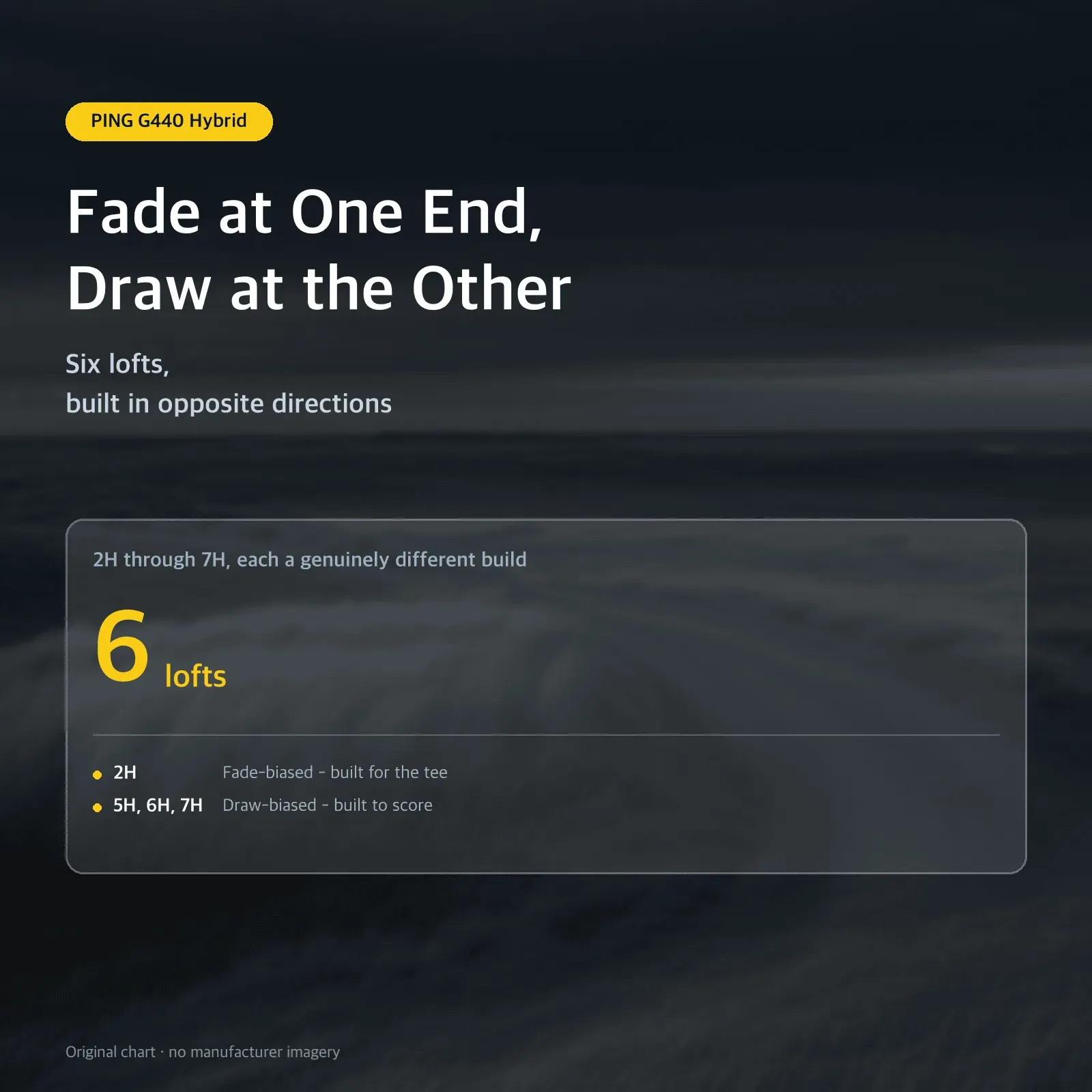
Reading the official spec sheet and product descriptions tells a different story. Each loft in the lineup is a genuinely different tool. The lower-numbered heads are built toward a fade, the higher-numbered heads toward a draw — opposite directions by design.
And PING is one of the few manufacturers that prints “matching iron” and “matching fairway wood” directly on its spec sheet.
1. The full official spec table
| Hybrid | Loft | Length | Lie |
|---|---|---|---|
| 2H | 17.0° | 40 3/4” | 57.0° |
| 3H | 20.0° | 40 1/4” | 57.5° |
| 4H | 23.0° | 39 3/4” | 58.0° |
| 5H | 26.0° | 39 1/4” | 58.5° |
| 6H | 30.0° | 38 3/4” | 59.0° |
| 7H | 34.0° | 38 1/4” | 59.5° |
Full Official Spec Table — Loft, length, and lie for all six models. Swingweight is D1 across all six. Loft adjusts +/-1.5°; lie up to 3° flat.
All six loft numbers, as published by PING:
- 2H — 17.0°, 40 3/4”, 57.0° lie, matches a 2-iron and a 5-wood
- 3H — 20.0°, 40 1/4”, 57.5° lie, matches a 3-iron and a 7-wood
- 4H — 23.0°, 39 3/4”, 58.0° lie, matches a 4-iron and a 9-wood
- 5H — 26.0°, 39 1/4”, 58.5° lie, matches a 5-iron, no matching wood
- 6H — 30.0°, 38 3/4”, 59.0° lie, matches a 6-iron, no matching wood
- 7H — 34.0°, 38 1/4”, 59.5° lie, matches a 7-iron, no matching wood
Swingweight is D1 across all six lofts. Loft adjustment is ±1.5° on every model, and lie can go up to 3° flat.
2. What’s regular and what isn’t
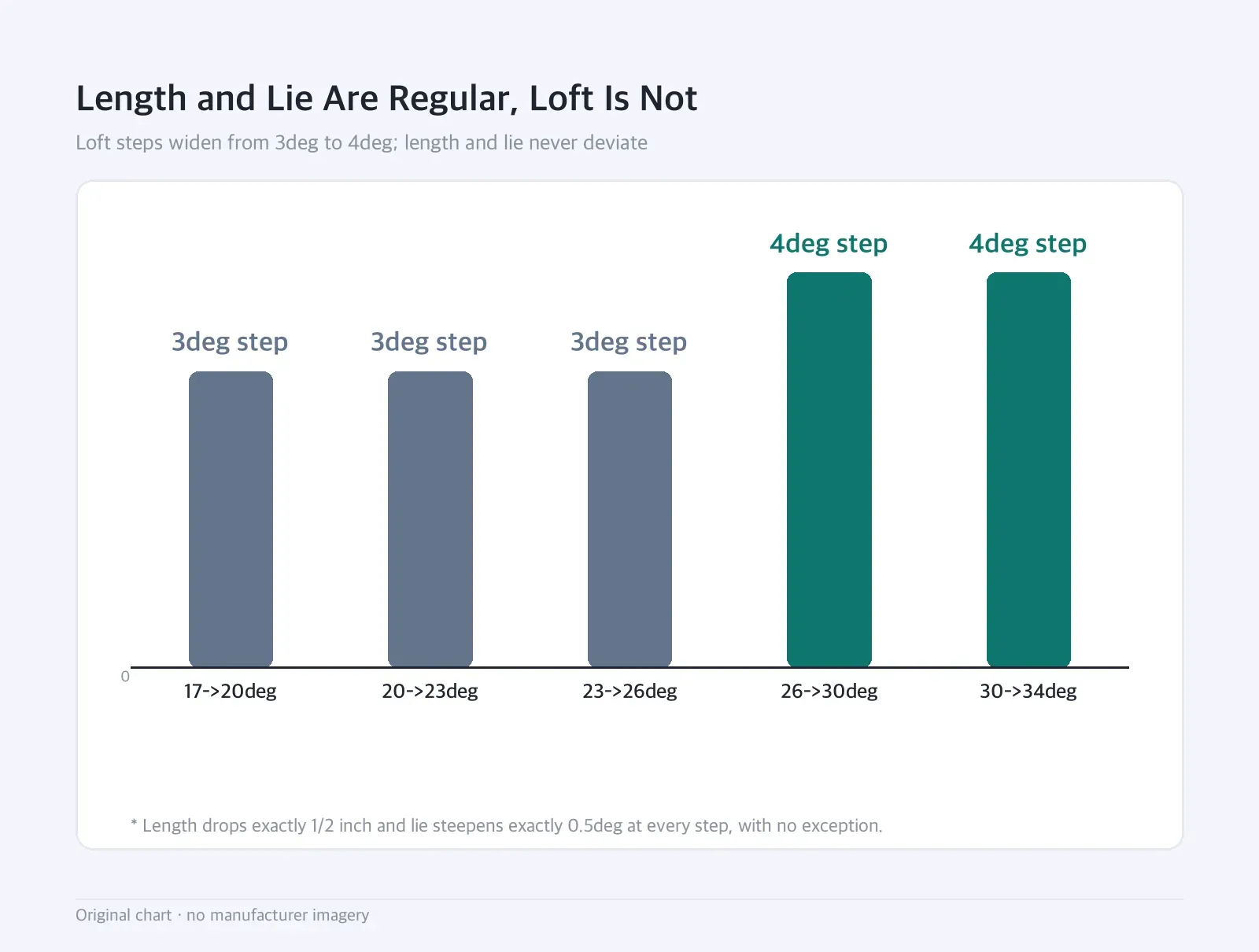
Read down the table and two things stand out.
Length and lie are perfectly regular. Length drops by 1/2 inch and lie steepens by 0.5° at every step, with no deviation across all six lofts.
Loft is the exception. The gaps from 17° to 20° to 23° to 26° are 3° each, but from 26° to 30° to 34°, the gaps widen to 4°.
The lower the loft, the more distance a single degree changes. So the lower end of the range is divided more tightly, and the upper end is spaced wider — the same logic used to gap lofts across an iron set.
3. Each loft is built with a different intended shot shape
| Hybrid | Bias | Stated purpose |
|---|---|---|
| 2H | Fade-biased | Lower, penetrating flight - a tee-shot club |
| 3H, 4H | Neutral | Raised loft - flies higher, holds greens better |
| 5H, 6H, 7H | Draw-biased | Higher, straighter - flows into the iron set |
Each Loft, a Different Intended Shot Shape — Ping’s own ‘loft-specific design’. Low numbers protect against trouble off the tee; high numbers are built to score.
This is where the club’s character shows up most clearly. PING calls this “loft-specific design.”
- 2H — fade bias. A lower, more penetrating trajectory. Stated as a tee-shot club.
- 3H, 4H — neutral. Loft is raised to fly higher with more stopping power.
- 5H, 6H, 7H — draw bias. Built to fly higher and straighter, and to flow into the iron set.
The lower-numbered heads are built to keep the ball in play off the tee; the higher-numbered heads are built to attack greens. Because the purposes differ, the design runs in opposite directions.
If you’re planning to carry more than one of these, that matters for how you combine them. Carrying a 3H and a 6H together gives you one neutral club and one draw-biased club, not two of the same character.
4. Head technology — weight saved and moved lower
PING’s stated construction:
Free hosel and carbon fly wrap crown save weight, which is then repositioned lower in the head to lower the center of gravity. The carbon crown is also described as producing a more solid-sounding impact.
A shallow face makes it easier to strike higher on the face and raises launch angle. Face thinning and shape refinement raise ball speed on center strikes while limiting ball-speed loss on mis-hits.
Sole shape thins the rear weighting so that adjusting loft or lie through the hosel doesn’t throw off how the club sits at address or the face angle at impact.
5. HL is a separate line
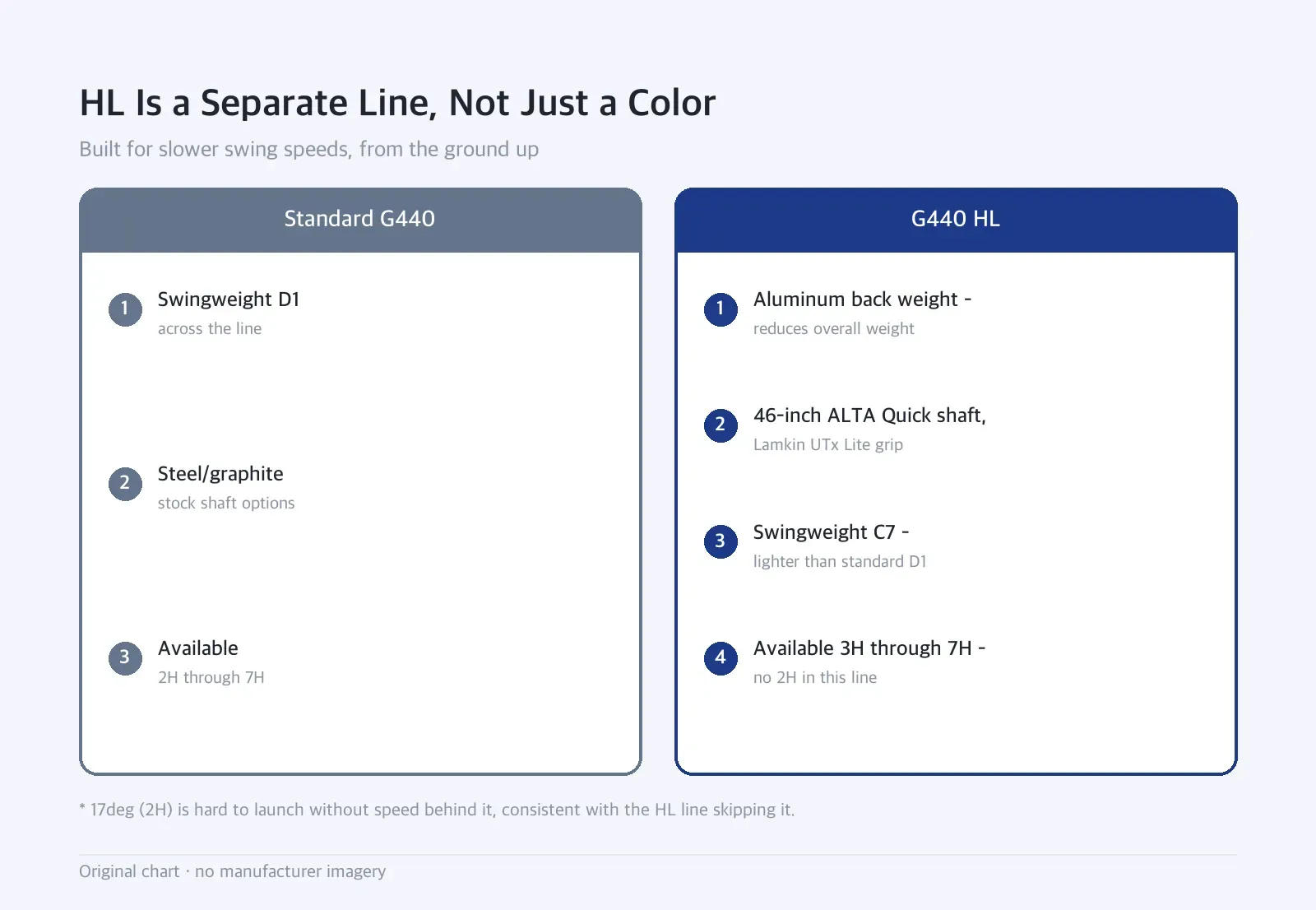
There’s a separate G440 HL built for slower swing speeds. It’s not just a different color — the configuration itself is different.
- Aluminum back weight — reduces overall weight.
- PING ALTA Quick shaft — same per-loft lengths as the standard line (40 1/4” at 3H down to 38 1/4” at 7H); the HL distinction is in weight and swingweight, not shaft length.
- Lamkin UTx Lite grip.
- Swingweight C7 — lighter than the standard line’s constant D1.
- Available in 3H through 7H.
The HL build’s speed comes from a lighter total package — aluminum back weight, C7 swingweight, and a lighter grip — not from extra shaft length. Length is unchanged from the standard line at every loft.
The 2H being left out of this line is consistent with that logic: 17° is a loft that’s hard to launch without enough speed behind it.
6. So how do you choose
Start by fixing the loft you need to fill, not the model number. Look at what loft your current setup ends at above this club and where your irons begin — the gap tells you the loft to look for.
Then match it to purpose.
- For a tee-shot club, that’s 2H — designed with a fade bias and a lower trajectory.
- To bridge the gap between fairway wood and irons, that’s 3H or 4H — neutral character.
- To replace long irons outright, that’s 5H and up — draw bias, higher trajectory.
Cross-check against your typical miss. If you tend to miss left, a draw-biased 5H or higher can amplify that miss.
If your swing speed is on the slower side, look at HL as well. Its lighter overall build (aluminum back weight, C7 swingweight) targets that range at the same lengths as the standard line.
7. Who this club fits
These are inferences drawn from the confirmed specifications, not a ranking.
- A golfer replacing 6- and 7-irons with hybrids — the lineup runs up to 34°, a range Titleist’s hybrid line, for comparison, stops short of at 24°.
- A golfer who wants a consistent feel across the set — fixed 1/2-inch length steps, 0.5° lie steps, and a constant D1 swingweight keep the feel steady even as loft increases.
- A golfer who wants to use a hybrid off the tee — 2H is explicitly stated by the manufacturer to be built for that purpose.
- A golfer who wants clarity on exactly what a hybrid is replacing — this is a brand that prints the matching iron and matching wood directly on the spec sheet.
Cases where the fit runs the other way:
- A golfer who misses left frequently and is considering 5H or higher — the draw bias overlaps with that miss.
- A golfer who wants a lighter, easier-to-load build without changing shaft length — HL’s C7 swingweight is the relevant spec, not shaft length, which matches the standard line.
- A golfer hoping one club can fill two loft gaps at once — the ±1.5° adjustment range doesn’t fully substitute for the neighboring loft.
8. What could not be confirmed
- Head volume and the specific weight distribution figures — not disclosed.
- The magnitude of the fade or draw bias — only the direction (“fade bias,” “draw bias”) is disclosed, not a numeric measure.
- Real-world carry distance figures — these vary too much by tester and conditions to cite reliably here.
- None outstanding on HL’s loft/length/lie/swingweight table — PING’s official G440 HL Hybrid page publishes the full 3H-through-7H table (20.0°-34.0° loft, 40 1/4”-38 1/4” length, 57.5°-59.5° lie, C7 swingweight throughout), identical lengths to the standard line.
Summary
The six G440 hybrid heads are not six versions of the same club. The lower numbers are built to keep the ball out of trouble off the tee; the higher numbers are built to score from the fairway — opposite directions by design.
That means “how’s the G440 hybrid?” doesn’t have a single answer — the character flips depending on which loft you’re asking about. Decide the loft gap you need to fill and the role it needs to play first, then pick the number.
The loft, length, lie, and design-bias figures in this piece are drawn only from PING’s official spec sheet and product descriptions. Where a figure could not be confirmed, it has been left blank rather than estimated.
Sources
- PING official G440 hybrid spec sheet and product descriptions — including the “matching iron” and “matching fairway wood” columns PING prints and most brands do not.
Confirmed live on PING’s official G440 Hybrid page: the 2H-7H loft/length/lie table, the EQUIVALENT IRON/EQUIVALENT FAIRWAY columns, D1 swingweight, and the fade-to-draw “loft-specific design” language. Also confirmed live on PING’s official G440 HL Hybrid page: the full 3H-7H loft/length/lie/swingweight table (identical lengths to the standard line, 40 1/4” down to 38 1/4”), the aluminum back weight, PING ALTA Quick shaft, Lamkin UTx Lite grip, and C7 swingweight. This piece originally stated the HL shaft was 46 inches; that figure does not appear on PING’s official page and has been corrected above.