PING’s s259 succeeds the prior s159. Checking the official spec table on ping.com, it’s the only current wedge line we’ve reviewed where loft, bounce, grind, lie angle, length, and swingweight are all published together, in full.
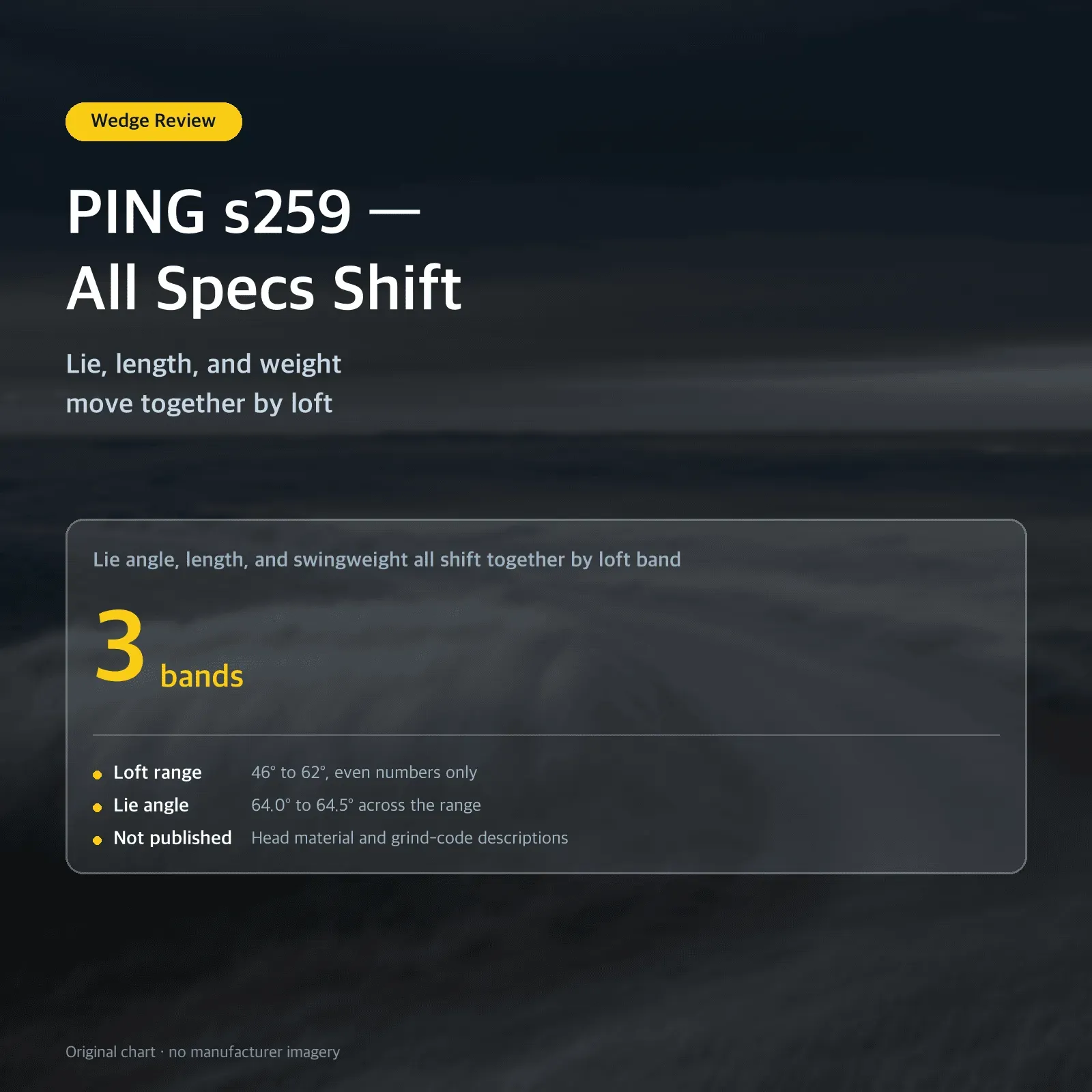
s259 also has a structural feature we haven’t seen elsewhere in this category: as the loft band changes, lie angle, length, and swingweight all shift together — not just length and swingweight.
1. Nine lofts, 46° through 62°
s259 spans nine lofts — 46°, 48°, 50°, 52°, 54°, 56°, 58°, 60°, 62° — with bounce values from 6° to 14° assigned by grind. Grind codes are S-12, W-14, H-10, S-10, E-8, T-6, H-8, and B-8, eight in total.
Confirmed changes from the previous generation are three: refined grinds (E and T codes changed), redesigned grooves (MicroMax), and a shortened hosel.
PING is the only line in this set built entirely on even-numbered lofts — a consistent 2° step from 46° through 62°.
2. Lie angle, length, and swingweight move together by loft band
| Loft band | Lie angle | Length | Swingweight |
|---|---|---|---|
| 46-52° | 64.0° | 35.5in | D2 |
| 54-56° | 64.3° | 35.25in | D3 |
| 58-62° | 64.5° | 35in | D4 |
Lie, Length, and Swingweight Move Together — The only current line checked where lie angle itself changes by loft band. The lie-angle range is narrow — 64.0° to 64.5° across the full spread — but the structural fact that it moves at all is the meaningful difference.
This is the core of what makes s259 distinct. The 46–52° band carries a 64.0° lie angle, 35½-inch length, and D2 swingweight. The 54–56° band carries 64.3° lie angle, 35¼-inch length, D3 swingweight. The 58–62° band carries 64.5° lie angle, 35-inch length, D4 swingweight.
Many wedge lines hold lie angle flat across all lofts and vary only length and swingweight. s259 moves lie angle too, making it the most finely loft-tuned structure among the current lines we’ve checked. As loft increases, lie angle is set progressively more upright.
The lie-angle range itself is narrow — 64.0° to 64.5° across the full 46–62° spread, a swing of only half a degree. Small as that number is, the structural fact that lie angle moves at all — rather than being fixed or simply unpublished — is the meaningful difference against lines that don’t do this. Swingweight moves in three steps, D2 to D4, tracking the same direction as the lie-angle progression.
3. Eight grind codes, but no descriptive text
| Grind code | Bounce |
|---|---|
| S-12 | 12° |
| W-14 | 14° |
| H-10 | 10° |
| S-10 | 10° |
| E-8 | 8° |
| T-6 | 6° |
| H-8 | 8° |
| B-8 | 8° |
Eight Grind Codes, Bounce Only — No official text explains what swing style or lie condition each code targets. The number after the letter code is bounce — what T, S, H, E, and B individually stand for isn’t explained in any official material found.
s259’s grinds are S-12, W-14, H-10, S-10, E-8, T-6, H-8, and B-8. The number after the letter code is bounce.
We could not find official language describing what swing style or lie condition each code targets — no sentence-level explanation of the kind some competitors publish for their grinds. We’re reporting the codes and bounce numbers as confirmed and not going beyond that.
Some pattern is inferable from the naming itself — T-6 reads as T code with 6° bounce, W-14 as W code with 14° bounce — but what T, S, H, E, and B individually stand for isn’t explained in any official material we found, so we note the naming pattern without guessing at its meaning.
4. Three changes: grind, groove, hosel
Compared with the prior generation, three confirmed changes stand out. First, grind refinement — the E and T codes changed. Second, groove redesign — a new groove geometry called MicroMax. Third, a shortened hosel.
For all three, what changed is confirmed on the official page; why it changed, or what measurable effect it has, is not. The hosel shortening itself is confirmed, but neither the magnitude of the shortening nor any resulting change in center of gravity is published.
The same applies to the MicroMax groove redesign — the name change and the geometry change are confirmed, but any specific spin-increase figure falls into manufacturer-claim territory and isn’t cited here.
5. Who this fits
Based on the confirmed specs. This does not substitute for an actual fitting.
- Golfers who want lie angle tuned by loft band, not just length and swingweight — s259 is the only line here where lie angle itself changes by loft.
- Golfers who want to confirm every spec before a store visit — the full table is published.
May not fit:
- Golfers who want written guidance on what each grind code is for — only codes and bounce numbers are published, so trying grinds in person matters more here.
- Golfers who need a loft higher than 62° — s259 tops out there.
6. What we could not confirm
| Item | Status |
|---|---|
| Head material and finish | Not specified on the official page |
| Descriptive text for the eight grind codes | Only codes and bounce numbers were confirmed |
| Manufacturer distance/spin claims | Unverifiable, not cited |
What Could Not Be Confirmed — Left blank rather than filled in. Three confirmed changes from s159: refined E/T grinds, a redesigned MicroMax groove, and a shortened hosel.
- Head material and finish — not specified on the official page.
- s259 is the one current line here where a material name isn’t published at all, unlike several competitors that name their alloy.
- Official descriptive text for each of the eight grind codes — only codes and bounce numbers were confirmed.
- Manufacturer distance/spin claims — not independently verifiable, so not cited here.
Summary
s259 is the most fully specified wedge line we’ve reviewed, and the only one where lie angle, length, and swingweight all shift together by loft band. What’s missing is descriptive text explaining what each grind code is for.
For anyone who wants to check specs before visiting a store, this is the most transparent line of the ones we’ve examined by the numbers. But transparent numbers and helpful explanatory text turned out to be two different things — s259 is strong on the first and thinner on the second. In-store, it’s worth asking for the numbers and the grind explanations as two separate requests, since neither online source reliably has both.
Every figure in this piece came from a confirmed source. Where we couldn’t confirm a value, we left it blank rather than guess.
Sources
- PING official spec table on ping.com — loft, bounce, grind, lie angle, length and swingweight, the only current wedge line reviewed here that publishes all six.
🔴 Unconfirmed: what swing style or lie condition each grind code targets. No sentence-level official explanation was found, unlike some competitors publish.
Confirmed live on PING’s official s259 page: all nine lofts (46°-62°), all eight grind codes (S-12, W-14, H-10, S-10, E-8, T-6, H-8, B-8), and the three lie/length/swingweight bands (64.0°/35.5”/D2, 64.3°/35.25”/D3, 64.5°/35”/D4) exactly as described in this piece. Items the manufacturer does not publish remain named as unconfirmed rather than estimated.