Zero torque is the story of the 2026 putter market. Major brands have joined the category one after another.
PING isn’t among them. More precisely, it’s deliberately absent. The company states outright that its new putters are “not zero torque” — and adds, “this is better.”
Here’s what PING is doing instead, and how the Scottsdale line is built.
1. Ten models
| Family | Models |
|---|---|
| Craz-E | Craz-E · Craz-E CB |
| Prime Tyne | Prime Tyne 4 · Prime Tyne C |
| Oslo | Oslo 3 |
| Anser | Anser · Anser 2D · Anser 4 |
| Other | B63 · DS72 |
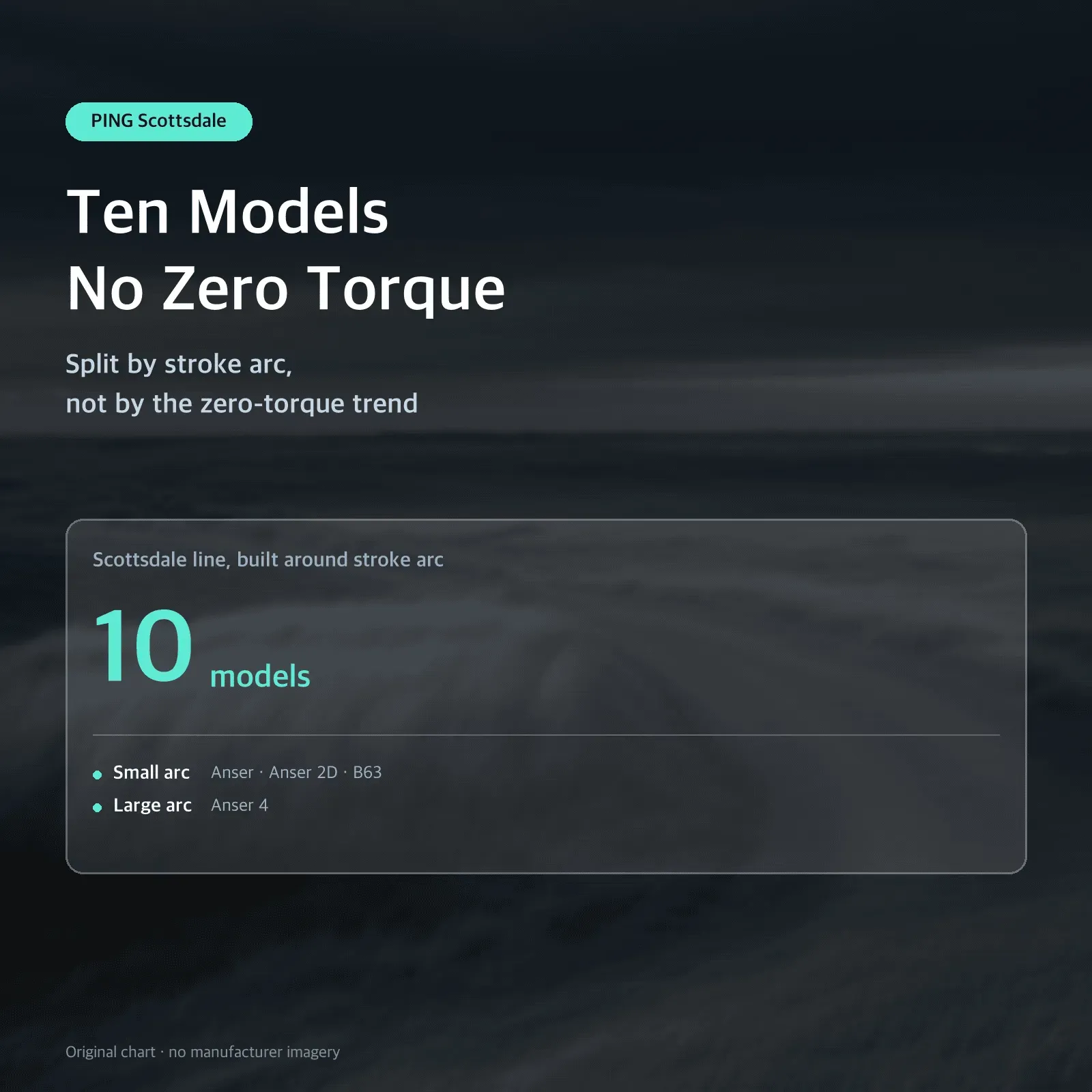
Ten Models in the Scottsdale Line — The Anser name still sits at the center of the lineup. On Aug 20, 2026, two Scottsdale TEC models and a PLD Milled SE DZB went on retail sale.
The Scottsdale line runs ten models.
- Craz-E · Craz-E CB
- Prime Tyne 4 · Prime Tyne C
- Oslo 3
- Anser · Anser 2D · Anser 4
- B63 · DS72
The Anser is the brand’s signature name — one of the most-copied shapes in putter history, and still at the center of the lineup.
On August 20, 2026, two Scottsdale TEC models and a PLD Milled SE DZB went on retail sale.
2. The line is split by stroke arc
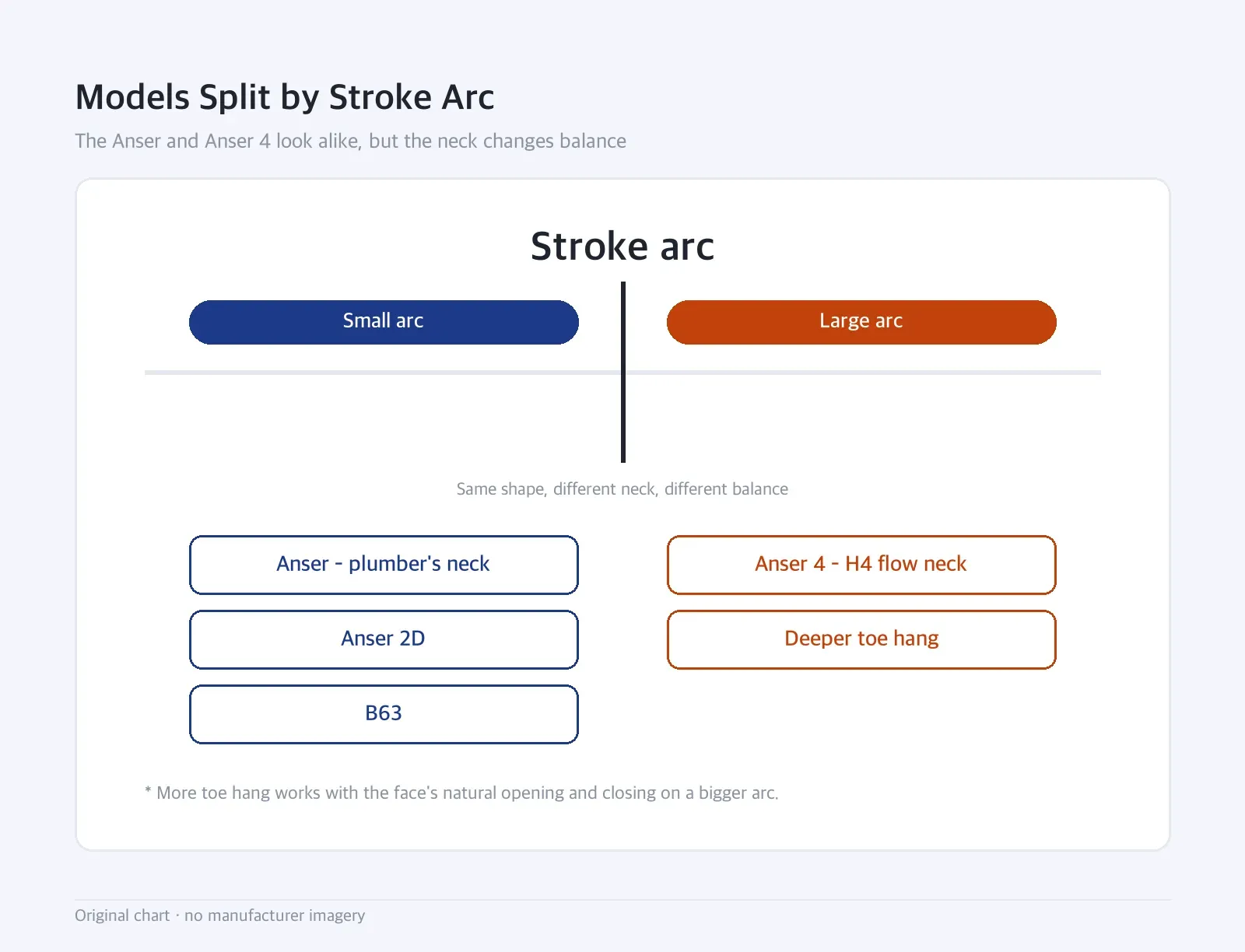
The organizing principle here is clear. Models are split by the size of the stroke arc.
- Small arc — Anser · Anser 2D · B63
- Large arc — Anser 4
Within the same Anser family, the Anser 4 is set apart by its neck. The Anser 4 uses an H4 flow neck, while the standard Anser uses a plumber’s neck. The flow neck produces more toe hang.
More toe hang means the face’s natural opening and closing through the stroke isn’t fought against — useful for a stroke with more arc.
It’s easy to shop by shape alone, but this brand has kept the shape similar while changing the neck to shift balance. The Anser and Anser 4 look alike but behave differently.
3. A running-shoe material on the face
| Feature | What it does |
|---|---|
| PEBAX insert | Lightweight elastic polymer, used in running-shoe midsoles |
| Feel | Softens impact while keeping the response lively |
| Alignment | Two-tone shading between top rail and rear draws the eye to the face |
The Face Material - PEBAX — A running-shoe elastic polymer, not a metal insert. Scotty Cameron uses carbon steel for damping; PING uses elastic polymer for softness.
The standout choice in this line is the insert material: PEBAX.
PEBAX is a lightweight material used in athletic shoes, known for its elasticity — it’s common in running-shoe midsoles.
Used on a putter face, it can do two things at once: soften the feel at impact while keeping the response lively. PING describes it as a “soft yet responsive face” that improves feedback and distance control.
Putter brands take different approaches to insert material. Scotty Cameron uses carbon steel for the material’s own damping; PING uses elastic polymer for softness. Different directions toward similar aims.
The line also uses two-tone shading between the top rail and the rear — intended, PING says, to draw the eye toward the face and the ball.
Splitting color this way is a form of alignment aid. Instead of a printed line, a contrast boundary gives the eye something to follow. PING describes it as producing “a cleaner setup and more consistent aim.”
4. “Ours isn’t zero torque”
| Model | Approach |
|---|---|
| Scottsdale TEC | Onset shaft; stated “not zero torque,” and “better” |
| PLD Custom Ally Blue Onset | 3° loft, 70° lie, shaft bored behind the face |
“Ours Isn’t Zero Torque” — PING’s own words about the Scottsdale TEC putters. Neither PING’s “better” figures nor zero-torque proponents’ numbers are public.
This is the most notable part of the brand’s positioning.
On the 2026 Scottsdale TEC putters, PING states plainly: this is not zero torque, and it’s better than zero torque.
Instead, it uses an onset shaft — pulling the face back from the shaft axis to reduce rotational torque. The goal is similar, but zero is not the target.
A limited PLD Custom model, the Ally Blue Onset, follows the same approach: 3 degrees of loft, 70 degrees of lie, with the shaft bore drilled directly into the mallet head, behind the face and slightly heel of center. This, too, is low torque rather than zero torque.
There was talk of PING releasing a true zero-torque model in 2026, but nothing has been officially announced.
This piece doesn’t referee which approach is right. Neither the figures behind PING’s “better” claim nor the numbers cited by zero-torque proponents have been made public.
5. How to choose
Start by identifying your stroke arc. This line splits right along that line.
- Straight-back-straight-through or small arc → Anser · Anser 2D · B63
- Larger arc → Anser 4, with its H4 flow neck and deeper toe hang
Remember that similar shapes can behave differently. The Anser and Anser 4 look alike but have different necks and different balance. Choosing by eye alone can get it wrong.
Check your feel preference. The PEBAX insert sits on the softer end. If you prefer a hard, crisp sound, look toward the milled-face options instead.
If you’re curious about low torque, look at the TEC — with the right expectation. It’s low torque, not zero torque. If you want something with rotation fully eliminated, look elsewhere.
6. Who this putter is for
Judgment calls based on confirmed specs.
- Golfers who know their stroke arc — this line splits models by arc, narrowing the field quickly
- Golfers with a larger arc — the Anser 4’s H4 flow neck targets that range
- Golfers who prefer a soft feel — the PEBAX insert points that direction
- Golfers unsure about zero torque — this brand offers low torque as an explicit middle option
It may be less suited for:
- Golfers who want true zero torque — this brand doesn’t sell that
- Golfers who prefer a firm feel — PEBAX leans soft
- Golfers who shop by shape alone — balance shifts by neck even within the same Anser family
7. What we could not confirm
- Head weight, length, and loft for each of the ten models — the official spec sheet was not available
- The exact toe-hang angle — only the word “deeper” was confirmed
- Model names and specs for the two Scottsdale TEC putters — only the August 20 retail date was confirmed
- The data behind PING’s claim that lower torque is “better” — the claim itself was confirmed, but not the figures
- PEBAX insert hardness — not publicly disclosed
In one line
Scottsdale is a line split by stroke arc, with balance shifted through neck design even within the same Anser family.
And this brand isn’t joining the zero-torque trend. It states plainly: “ours is low torque, not zero torque, and it’s better.” Few brands explain why they didn’t follow a trend. Agree or not, that’s one more piece of reasoning to weigh.
Lineup and material details here are drawn only from official PING materials. What we couldn’t confirm is left blank.
Sources
- PING official materials — lineup and material details here are drawn from these alone.
Confirmed live on PING’s official Scottsdale putters page: all ten models (Craz-E, Craz-E CB, Prime Tyne 4, Prime Tyne C, Oslo 3, Anser, Anser 2D, Anser 4, B63, DS72). The PEBAX face insert, the Anser 4’s H4 hosel, and its “strong arc” positioning were confirmed on PING’s official Anser 4 product page. PING’s specific “not zero torque, and it’s better” wording for the Scottsdale TEC line (section 4) could not be verified in fetchable text on PING’s own pages within this research — it is widely reported by golf media citing PING, but that falls outside this piece’s official-source-only scope, so it stays flagged rather than linked as directly confirmed. Items the manufacturer does not publish remain named as unconfirmed rather than estimated.