Look through Titleist’s retail lineup and the Pro V1 family splits into more variants than expected: the standard model, alignment options, Left Dash, and RCT.
Most of these are priced the same as the standard model. RCT is the exception — it carries a price premium.
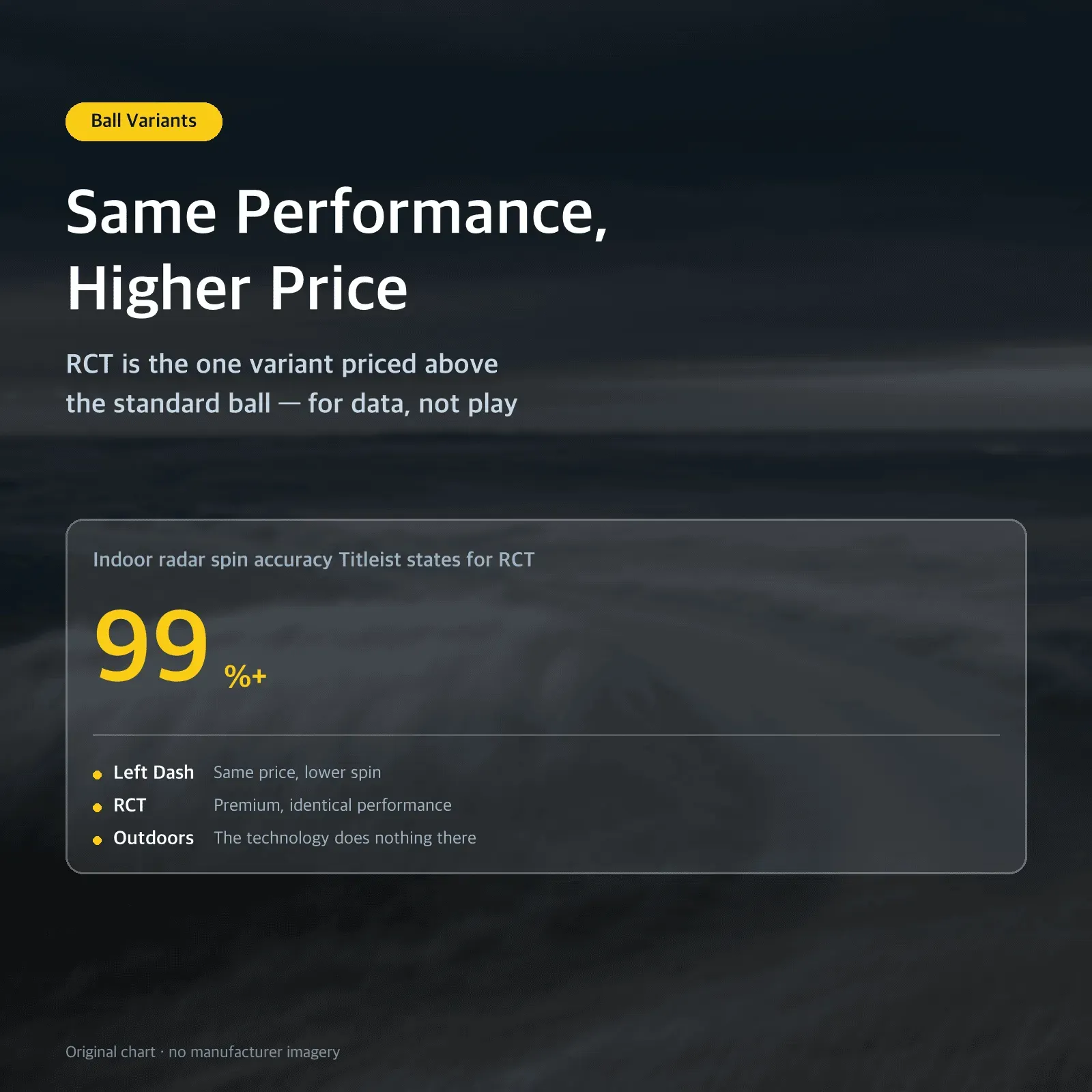
Yet Titleist states explicitly that RCT performs identically to the standard Pro V1. Same performance, higher price. This piece looks at what that premium is actually paying for.
1. Left Dash — the variant that used to be hard to get
| Model | Construction | Character |
|---|---|---|
| Pro V1 | 3-piece | Fewer layers |
| Pro V1x | 4-piece | Flies higher |
| Pro V1x Left Dash | 4-piece, thicker casing | Lower spin |
Left Dash — Same Layers, Different Distribution — Three parallel options at one price, not a hierarchy. Left Dash also carries a different dimple depth profile. The name comes from the dash printed left of the text.
Start with Left Dash. The name comes from the dash mark printed to the left of the “Pro V1x” text on the box.
This model used to be difficult to source outside of tour-issue supply or imports. It is now sold through standard retail alongside the rest of the lineup, at the same price as the standard models.
The construction details Titleist confirms are:
- Four-piece — the same layer count as the standard Pro V1x.
- A thicker casing layer.
- A different dimple depth profile from the standard Pro V1x.
Same four-piece structure, different distribution of layer thickness and different surface treatment. The stated direction is reduced spin on longer shots.
2. Where Left Dash fits
Titleist’s three models in this family are priced the same. That means they are three parallel options, not a hierarchy.
Laid out by character:
- Pro V1 — three-piece. Fewer layers.
- Pro V1x — four-piece. Flies higher.
- Pro V1x Left Dash — four-piece with a thicker casing. Lower spin.
This is a spot for golfers who play the Pro V1x but feel they’re carrying too much driver spin. It is not the spot for a golfer whose ball doesn’t get up in the air enough.
3. RCT has a radar reflector built inside the ball
| Item | What Titleist states |
|---|---|
| Design, materials, manufacturing | Identical to the standard Pro V1 |
| Performance | Identical |
| Indoor spin measurement accuracy | 99% or higher |
| Outdoor use | Playable, but the technology serves no purpose |
| Development time | Three years |
What the RCT Premium Buys: Radar Capture Technology — a reflector embedded inside the ball. The premium is not for a ball that performs better. It is for confidence that the spin number is correct.
RCT stands for Radar Capture Technology. It’s a ball with a radar-reflective marker embedded inside it. Titleist’s golf ball R&D group states the design took three years to develop.
The purpose is singular: accurate spin measurement indoors.
Radar-based launch monitors track a ball all the way through flight outdoors, but indoors the ball only travels a short distance before hitting a screen. Capturing accurate spin data in that short window is difficult. The workaround has been to apply reflective stickers to the ball and orient it a specific way before each shot.
RCT removes that step. The reflector is already inside the ball, so there’s no sticker to apply and no specific orientation required.
4. Same performance, more accurate data
This is the core point. Titleist states the following about RCT:
- Design, materials, and manufacturing quality are identical to the standard Pro V1.
- Performance is identical.
- Indoor spin measurement accuracy rises to 99% or higher.
- It can be played outdoors, but the technology serves no purpose there.
In other words, the premium is not for “a ball that performs better.” It’s for confidence that your spin number is correct.
Once that’s clear, the decision simplifies. It’s worth something to someone who actually uses that number. It’s worth nothing to someone who doesn’t.
5. It matters which kind of indoor setup you’re using
| Setup | Does RCT earn its premium? |
|---|---|
| Radar launch monitor, indoors | Yes — this is what it is built for |
| Camera or infrared simulator | No — a different detection method |
| Venue house balls | No — you are not playing your own ball |
| On the course | No — nothing for the technology to do |
It Matters Which Indoor Setup You Use — RCT is built for one detection method, not for indoor golf in general. Playing indoor golf often is not by itself a reason to buy RCT.
One distinction worth making explicit: RCT is built for radar-based launch monitors.
Many indoor golf simulators read the ball with camera or infrared sensors rather than radar. The underlying method is different, and most of these venues use house balls rather than a player’s own ball.
So playing indoor golf frequently is not, by itself, a reason to buy RCT. RCT earns its premium in indoor fitting and practice environments that run a radar-based launch monitor — TrackMan and similar systems.
Miss that distinction and you can spend the premium and never see what it does.
6. Who should actually buy which
| If this is you | Buy |
|---|---|
| You read spin numbers off indoor radar | RCT |
| You adjust clubs or swing from those numbers | RCT |
| You are getting an indoor fitting | RCT, even a single sleeve |
| Your Pro V1x driver spin runs high | Left Dash, at no premium |
| Most of your golf is on the course | The standard ball |
Who Should Actually Buy Which — Since performance is stated as identical, the standard ball costs nothing in play. Left Dash is a low-risk swap to try — it is priced the same as the standard models.
To summarize:
RCT is worth buying if:
- You use a radar-based launch monitor indoors — a personal simulator or a practice facility running that kind of equipment.
- You adjust your clubs or swing based on spin numbers — a wrong number leads to a wrong adjustment.
- You’re getting an indoor fitting — even a single sleeve can be worth it if that’s the only setting where it matters.
The standard ball is enough if:
- Most of your golf is played on a course — the technology has nothing to do outdoors.
- You play indoor golf on house balls rather than your own.
- You don’t track spin numbers at all.
Since Titleist’s own position is that performance is identical, choosing the standard ball costs you nothing in performance.
7. Who each variant fits
These are inferences drawn from the confirmed specifications, not a ranking.
- Left Dash — for a Pro V1x player who feels driver spin is running too high. The thicker casing is designed to bring spin down. Since it’s priced the same as the standard model, it’s a low-risk swap to try.
- Left Dash — for anyone who previously had to import this model; it is now available through standard retail channels.
- RCT — for a golfer who manages their own numbers indoors on radar equipment.
Cases where the fit runs the other way:
- A golfer whose ball doesn’t get up in the air enough — Left Dash is designed in the opposite direction, toward less spin.
- A golfer buying RCT under the impression it’s a “premium” tier — the manufacturer states performance is identical.
- A golfer who only plays camera- or sensor-based indoor systems — that’s not the environment RCT is built for.
8. What could not be confirmed
- Compression for Left Dash — not disclosed by the manufacturer.
- The exact thickness of the Left Dash casing layer — only described as “thicker,” with no figure given.
- Dimple count for Left Dash — the depth profile is described as different, but the count itself was not confirmed.
- Which indoor simulator systems, by brand or model, use radar detection versus camera or infrared — this varies by venue and was not generalized here.
- A direct measured comparison between RCT and the standard ball — since the manufacturer states they are identical, no separate measurement was sought.
Summary
Left Dash is a third option sold at no premium; RCT is a variant priced for data accuracy, not performance.
That means Left Dash is a low-risk swap to try if you feel your spin is running high, and RCT is worth its premium only if you’re actually in an environment where that premium does something — a radar-based indoor setup. If you only play the course, that money has nowhere to work.
The construction details and pricing comparisons in this piece are drawn only from Titleist’s official product descriptions and retail listings. Where a figure could not be confirmed, it has been left blank rather than estimated.
Sources
- Titleist Presents: “Searching for Spin” — The Story Behind Titleist RCT Golf Balls — official Titleist newsroom release stating RCT models (Pro V1, Pro V1x, and Pro V1x Left Dash) offer “the same design, quality and performance” as the standard balls.
- Titleist Introduces Innovative Pro V1 Radar Capture Technology — official Titleist newsroom release confirming indoor spin-capture accuracy of “99 percent.”
Two archived URLs are recorded above; both confirm the “identical performance” claim and the 99%-accuracy figure cited in the body. The Left Dash construction details (thicker casing, different dimple depth profile) and the “three years of development” figure could not be verified against a live titleist.com product page in this pass — www.titleist.com blocks automated fetches (HTTP 403) — so they remain unconfirmed rather than linked. Items the manufacturer does not publish are named as unconfirmed rather than estimated.