These are the two names golfers run into most often when choosing a ball. Because the names differ by a single character, it is easy to read them as a top-tier and a step-down model.
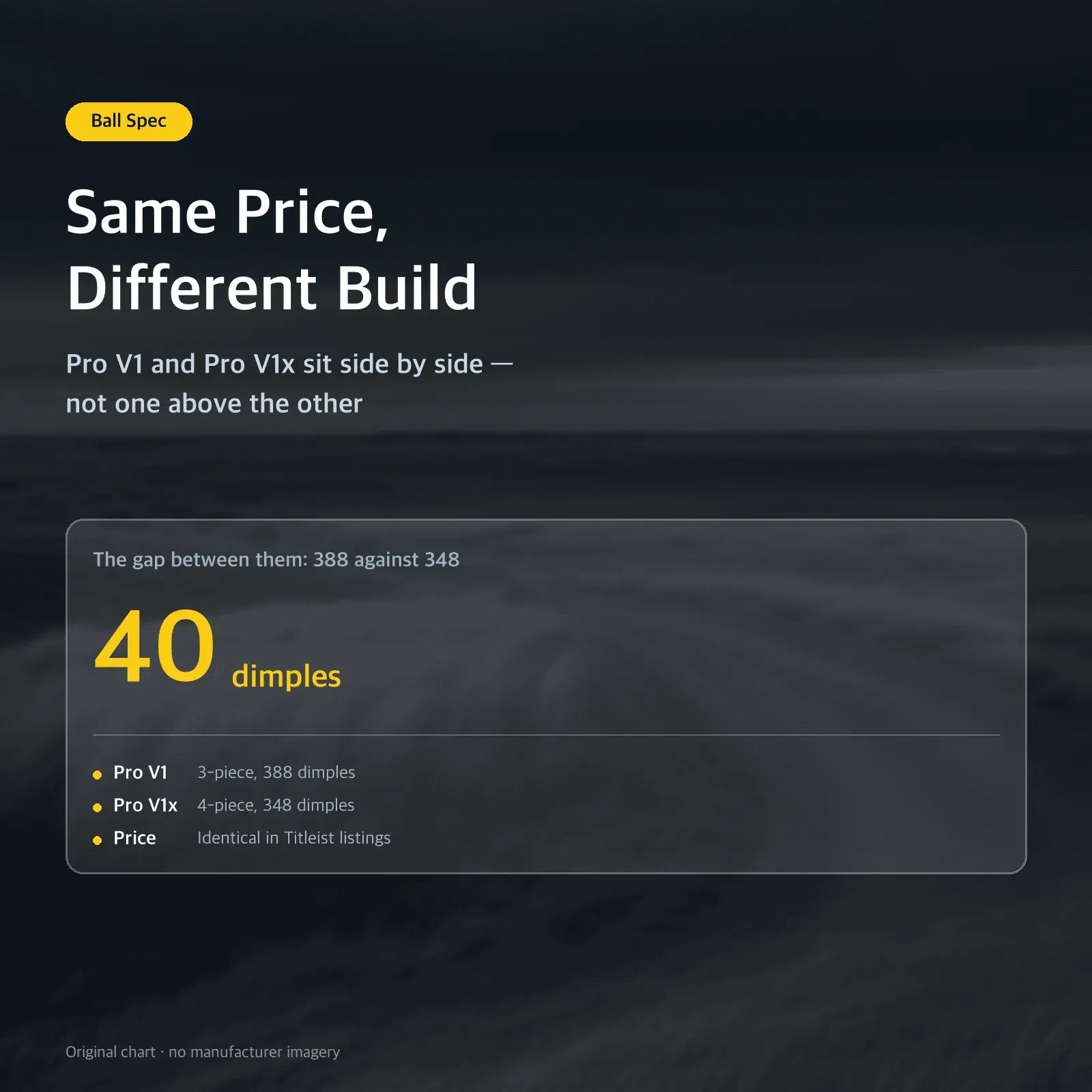
But the official specifications tell a different story. The two balls are priced identically in Titleist’s own retail listings. What differs is the internal construction and the dimple pattern.
This is a case of two balls built for different ball flights, priced the same, and left for the golfer to sort out.
1. Different construction — three-piece vs. four-piece
| Model | Construction | What the extra layer is |
|---|---|---|
| Pro V1 | 3-piece | Core, mantle, cover |
| Pro V1x | 4-piece | An extra casing layer between core and cover |
One Layer Apart, Priced the Same — An extra layer is not an upgrade. If it were, the price would differ — it does not.
This is the clearest difference between the two.
- Pro V1 — three-piece
- Pro V1x — four-piece
The Pro V1x has one additional layer. An extra casing layer sits between the core and the cover.
Splitting the ball into more layers means different layers are engineered to respond at different compression depths — one behavior for a driver strike that compresses the ball deeply, another for a wedge shot that barely touches the surface.
There is an easy misread here. Having an extra layer does not make it the higher-tier ball. If it were a genuine upgrade, the price would differ. It doesn’t.
2. Dimple count and pattern also differ
| Model | Dimples | Pattern name |
|---|---|---|
| Pro V1 | 388 | Spherically-tiled Tetrahedral |
| Pro V1x | 348 | Spherically-tiled Tetrahedral |
The Pattern Name Is Shared, Only the Count Differs — Treating “Spherically-tiled Tetrahedral” as a Pro V1x-only feature is a misread — it is applied to both.
Titleist publishes different dimple specifications for the two models — but the pattern name itself is shared.
- Pro V1 — 388 dimples, Spherically-tiled Tetrahedral Dimple Design
- Pro V1x — 348 dimples, also Spherically-tiled Tetrahedral Dimple Design
Both balls use the same named dimple pattern. What differs is only the count — 388 versus 348 — not the pattern’s design name. It would be a misread to treat “Spherically-tiled Tetrahedral” as a Pro V1x-exclusive feature; Titleist applies the same pattern name to both models and varies the dimple count between them.
A 40-dimple difference. Dimples govern airflow around the ball, so count and depth feed directly into trajectory.
Dimples manage the boundary layer of air at the ball’s surface. More dimples means each one is smaller; fewer means each is larger. Whether a ball’s surface is divided into 388 or 348 dimples is a question of how that surface is partitioned.
The Pro V1x is generally described as flying with a higher trajectory. The extra layer and the 40-dimple difference are the design elements behind that tendency.
One qualification needs to be precise here: dimple count and layer count are publicly disclosed specifications, but a figure like “flies X degrees higher” is not. What can be confirmed is that the designs differ — not the exact magnitude of the resulting trajectory difference.
3. What matching pricing tells you
At Titleist’s own retail pricing, both models are priced the same. The Pro V1x Left Dash is also priced the same as the standard models.
This tells you Titleist has positioned the three models as a difference in character, not a hierarchy. Not high, middle, low — more like left, center, right.
That changes how you choose. The question is not “which one is better,” but “which one matches my ball flight.” Since the price is identical, budget does not make the decision for you.
4. Titleist does not fit by swing speed
| Order | What to fit | Why |
|---|---|---|
| First | Shots around the green | Where the differences show most clearly |
| Second | Wedges and irons | Fitted to the ball already chosen |
| Last | The driver | Treated as the least important club in ball fitting |
Titleist Does Not Fit by Swing Speed — Titleist does not publish compression figures and states it does not recommend a ball by swing speed.
This is where the manufacturer’s position gets specific.
Titleist does not publicly disclose the compression figures for its balls. And the company states that it does not recommend a ball based on swing speed in its ball-fitting process. The stated reasoning is that there is no meaningful difference in how deeply a tour pro versus an amateur compresses the ball on impact.
Instead, the recommended fitting order is:
- Start at the green and work backward. This is where the differences show up most clearly.
- Settle on the ball first, then fit wedges and irons to it.
- The driver comes last. Titleist treats it as the least important club in ball fitting.
The logic is that amateurs miss far more greens than tour players do, so what happens around the green should be evaluated first.
5. So how do you choose between the two
| Step | What to hit | What decides it |
|---|---|---|
| 1 | 30-50 yard approaches, alternating | Feel and stopping distance differ most here |
| 2 | Long irons, 4 through 6 | Whether the flight holds the green |
| 3 | Driver, last | Where the difference between them is smallest |
Choosing Between Them in One Session — Comparing a shot today against a memory of one last week compares swings, not balls.
With pricing identical and the manufacturer declining to recommend by swing speed, what’s left is hitting both and comparing. A workable order:
First, start around the green. Hit 30-50 yard approach shots with each ball, alternating. This is where feel and stopping distance differ the most.
Second, look at long-iron trajectory. Whether the ball with a 4- through 6-iron gets up in the air enough to hold the green is the deciding factor. If it doesn’t, the Pro V1x — designed with the layer and dimple pattern that produce a higher flight — is the better fit.
Third, check the driver last. This is where the difference is smallest. The manufacturer itself puts the driver last in its own fitting sequence.
One more point: the comparison only means something if both balls are hit on the same day. Comparing a shot hit on one day against a memory of a shot hit on another day compares swings, not balls.
6. Who each ball fits
These are inferences drawn from the confirmed specifications, not a ranking.
The Pro V1 (three-piece) may fit you if:
- Your trajectory is already high enough that you don’t need more height — this is the lower-flighting of the two.
- You prefer a more uniform feel across the layers, rather than a design segmented into more zones.
- The 388-dimple tetrahedral pattern has produced a flight that has worked for you.
The Pro V1x (four-piece) may fit you if:
- You want a higher trajectory — the extra layer and the 40-dimple difference are engineered toward that.
- You feel your long irons don’t hold enough height to stop on the green.
There are also cases where neither answer is “yes”:
- If you’re using price to infer a hierarchy — both are priced the same, so price is not a useful signal here.
- If you’re reading layer count as a tier ranking — the same manufacturer selling both at the same price rules that out.
- If you’re trying to decide from a swing-speed number — the manufacturer doesn’t recommend that method and doesn’t publish compression figures.
7. What could not be confirmed
What this piece could not fill in:
- Compression figures for either model — not disclosed by the manufacturer. Third-party measurements circulating range roughly from 87 to 98.
- Layer thickness and material composition for each layer — not disclosed.
- The magnitude of the trajectory difference — the direction (“flies higher”) is confirmed, but a specific figure in degrees or distance is not published.
- Regional limited-edition production quantities — not confirmed.
Summary
Pro V1 and Pro V1x are not stacked one above the other — they sit side by side. The matching price is what tells you that.
One extra layer and a 40-dimple difference are what set the trajectory direction apart. So instead of asking which one is better, start by checking whether your current ball flight is getting up high enough. And that check is better made around the green than off the tee — that’s the order the manufacturer itself recommends.
The layer counts, dimple figures, and pricing in this piece are drawn only from Titleist’s official specifications and retail listings. Where a figure could not be confirmed, it has been left blank rather than estimated.
Sources
- Titleist Introduces New Pro V1 and Pro V1x Golf Balls — official Titleist newsroom release confirming Pro V1’s 388-dimple and Pro V1x’s 348-dimple counts, the shared “Spherically-tiled Tetrahedral Dimple Design” name, and the dual-core Pro V1x with casing layer.
- Titleist’s stated fitting position — the manufacturer does not fit by swing speed, which is the specific claim the body turns on.
One archived URL is recorded above; it confirms the dimple counts and dimple-pattern name cited in the body. The fitting-order/swing-speed claim in item two, and the numbered 3-piece/4-piece construction, could not be verified against a live titleist.com page in this pass — www.titleist.com blocks automated fetches (HTTP 403) — so it remains unconfirmed rather than linked. Items the manufacturer does not publish are named as unconfirmed rather than estimated.