Narrowing iron shafts to four steel options, we opened each brand’s official page in turn: True Temper Dynamic Gold, KBS Tour, Nippon Shaft N.S. Pro 950GH, and Nippon Shaft’s own MODUS3 TOUR 120. All four carry an “S” flex, so we lined up weight against that shared label.
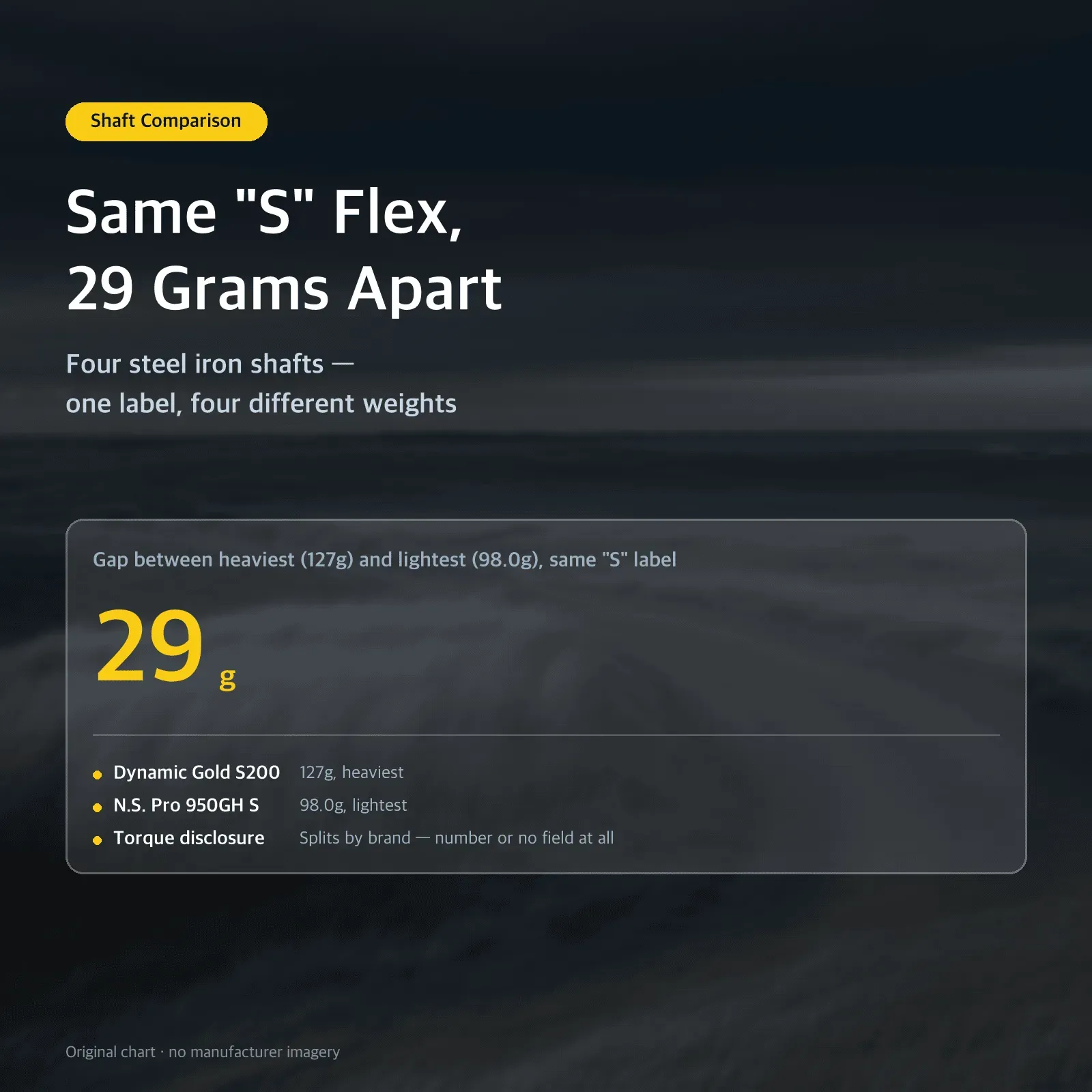
The result was bigger than expected. Within the same “S” label, the heaviest and lightest were 29 grams apart. This piece covers that overall gap; each brand’s individual specs are covered separately.
1. Four steel shafts, same S, different weight
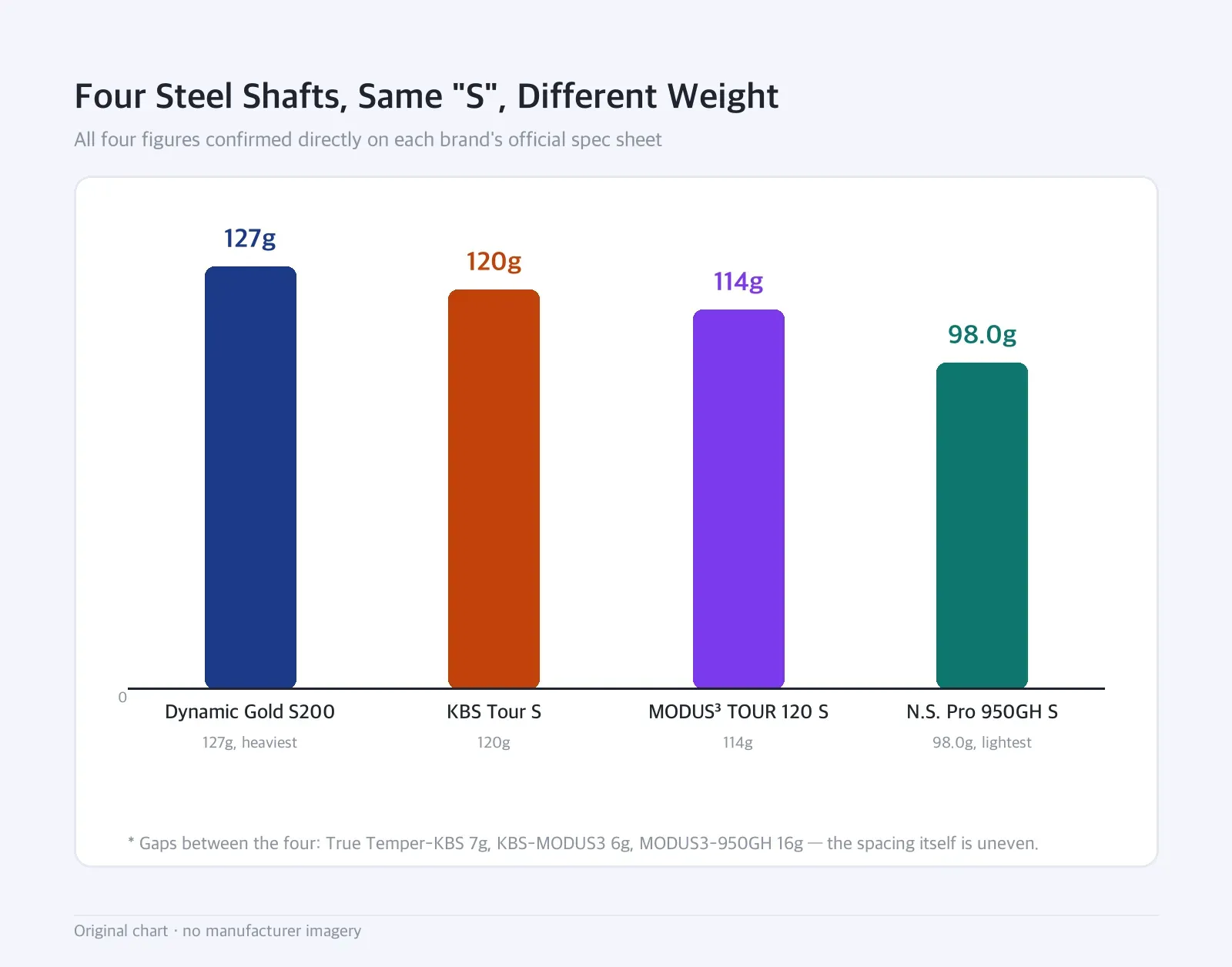
True Temper Dynamic Gold S200 is heaviest at 127 grams. KBS Tour S is 120 grams, Nippon MODUS3 TOUR 120 S is 114 grams, and N.S. Pro 950GH S is lightest at 98.0 grams. All four figures come directly from each brand’s official spec sheet.
That’s a 29-gram gap between 127 and 98.0 grams. Across a full iron set, that difference compounds club to club. The same “S” label doesn’t mean the same required swing effort or the same feel in hand — something that only became clear once all four spec sheets were lined up together.
Even within Nippon Shaft itself, 950GH and MODUS3 TOUR 120 are separate lines, and there’s a 16-gram gap between the two — covered separately in more detail.
Reordering by weight: Dynamic Gold 127g, KBS Tour 120g, MODUS3 TOUR 120 114g, N.S. Pro 950GH 98.0g. The gap between True Temper and KBS is 7g, between KBS and MODUS3 is 6g, and between MODUS3 and 950GH is 16g. The spacing between those gaps isn’t even, either — something only visible once the numbers are lined up in order. The last gap in particular, 16 grams within the same brand’s own lineup, was the biggest single jump — and unexpected.
2. Why the gap exists wasn’t confirmed
No official statement from any brand directly explained why weight is designed so differently within the same flex label. What can be confirmed from the spec sheets themselves is more limited.
True Temper and KBS spread weight closely across multiple flexes within one line, while Nippon Shaft splits its weight range across two separate lines, 950GH and MODUS3. That the approach to dividing weight ranges differs brand to brand is confirmed by the spec sheets; the design reasoning behind it is not something any brand explained directly.
One more thing stood out: weight order and brand reputation don’t necessarily track together. There’s a common impression that “a heavier steel shaft means tour-oriented,” but looking at just these four shafts, nothing in the spec sheets themselves backs that impression up. The spec sheets carry numbers only — whether those numbers target a particular swing style is explained by some brands and not others. This piece doesn’t go into that explanatory language, only the confirmed numbers.
3. Torque disclosure also splits by brand
| Brand | Torque field |
|---|---|
| True Temper Dynamic Gold | Qualitative label only: “Low” |
| KBS Tour | No torque or kick-point field at all |
| Nippon N.S. Pro 950GH | Numeric, to one decimal place; kick point “mid” |
| Nippon MODUS³ TOUR 120 | Numeric, to one decimal place; kick point “mid/butt” |
Torque Disclosure Also Splits by Brand — same category of spec sheet, one side gives numbers, the other doesn’t. Even within Nippon Shaft, the 950GH and MODUS³ TOUR 120 are separate lines with a 16g weight gap between them.
Almost as notable as weight is how torque gets published. True Temper uses only a qualitative label — “Low” — across every flex. No numeric torque value or kick-point figure appears anywhere on its official page. KBS doesn’t have a torque or kick-point field on its spec sheet at all.
Nippon Shaft goes the other way. Both 950GH and MODUS3 TOUR 120 publish torque to one decimal place for every flex. 950GH labels kick point as “mid,” MODUS3 as “mid/butt.” Same category of spec sheet — one side is numbers, the other has no field at all.
4. Not concluding “there’s no industry standard”
One thing worth being careful about: this gap tempts you to say “the industry has no standard.” But no association or manufacturer document that would support that claim turned up in this research, so this piece doesn’t make that claim.
What can be stated with confidence is two things. First, the numerical gap: actual weight within the same “S” label spans up to 29 grams. Second, the disclosure gap: brands that publish torque as a number and brands that don’t. Both are things confirmed directly on screen; nothing beyond that is included here.
CPM (frequency) is the same story. None of the six brand official pages reviewed for this research carried a CPM field. Since it’s a measured value that may simply not belong on a web spec sheet, this is recorded as “not confirmed,” not “doesn’t exist.”
This isn’t an entirely new story. A separate piece on the irons themselves asked “how far do tour irons actually disclose?” The same axis — some brands publishing offset as a number, some only describing it in words — shows up again here in shaft torque disclosure. Whichever component of the club changes, the choice of “write it as a number or explain it in words” appears to hold consistently by brand. That connection is developed further in a separate piece.
5. Who this comparison is useful for
A judgment framework drawn from confirmed specs.
- Golfers comparing two shafts labeled the same “S” by weight alone — the gap can run up to 29 grams, so checking actual gram weight rather than the flex label is the safer approach.
- Golfers who want torque numbers to gauge workability — the Nippon Shaft lines disclose to a decimal place, but True Temper and KBS can’t be compared that way.
This may not fit:
- Golfers expecting an “S flex” label to mean a similar swing feel — this comparison shows exactly where that expectation breaks down.
- Golfers who want to know why the gap exists (design philosophy, material, etc.) — this research confirmed the resulting numbers only; no official explanation of the cause was found.
6. What we could not confirm
| Item | Status |
|---|---|
| Design reasoning behind the weight gap | No direct manufacturer statement found |
| A document supporting “no industry standard” | None confirmed |
| CPM (frequency) | No field on any of the six brand pages reviewed |
| Manufacturer distance/spin claims | Unverifiable, not cited |
What Could Not Be Confirmed — left blank rather than filled in. Recorded as “not confirmed,” not “doesn’t exist” — CPM may simply not belong on a web spec sheet.
- The design reasoning behind the weight gap — no direct manufacturer statement found.
- An association or manufacturer document supporting “there’s no industry standard” — none confirmed.
- CPM (frequency) — no field on any of the six brand pages reviewed.
- Manufacturer distance/spin claims — unverifiable, so not cited.
In one line
Within the same “S” label, these four steel shafts span 98.0 to 127 grams — a 29-gram gap. Brands that disclose torque as a number and brands that don’t split the same way.
Each brand’s specific specs are covered separately, including the two Nippon Shaft lines and the graphite comparison. Rather than choosing by the flex label alone, checking the actual gram weight is the safer approach.
Every chart here was built directly, and every number comes from confirmed sources. Anything we could not confirm was left blank.
Sources
- Dynamic Gold — True Temper — official spec table confirmed live: S200 is 127g.
- KBS TOUR — KBS Golf Shafts — official spec table confirmed live: S is 120g.
- N.S.PRO MODUS³ TOUR 120 — Nippon Shaft — official spec table confirmed live: S is 114g.
- N.S.PRO 950GH — Nippon Shaft — official spec table confirmed live: S is 98.0g, the lightest of the four.
Four archived URLs are recorded above; each confirms the S-flex weight figure that produces the 29-gram spread this piece turns on (127g / 120g / 114g / 98.0g). Items the source does not publish are named as unconfirmed rather than estimated.