A separate piece once tabulated offset and bounce disclosure across five tour-iron models. Offset was published by four brands and withheld by one; bounce was published by only one. Building that table left one impression: how much detail a brand puts on a spec sheet varies, even for the same category of item.
Checking shafts for this piece turned up the same shape of question again — this time not about a clubhead but a shaft, and not about offset or bounce but torque. The same question, asked with a different part.
That earlier piece compared brands within the “tour iron” category. This one widens the lens to “shaft” itself, a part used across irons, drivers, and woods alike. Whichever part of the club you look at, the same question — numbers, or words? — keeps coming back.
Line the two up and the shape of the conclusion is similar even though the subject differs. The offset piece ended with “nobody publishes blade length as a number.” This one ends with “no brand puts CPM on a spec sheet.” Both remain something a consumer has to check in person.
1. Six brands, split by torque disclosure
| Brand | Material | Practice | What the sheet shows |
|---|---|---|---|
| Nippon Shaft | Steel | Numeric, one decimal | 1.8° (MODUS³ 120 S), 1.7° (950GH X) |
| Fujikura | Graphite | Numeric, one decimal | 3.1° (VENTUS TR Blue S) |
| Mitsubishi | Graphite | Numeric, one decimal | 3.9° (Tensei 1K Pro Blue 60S) |
| Graphite Design | Graphite | Numeric, one decimal | 3.1° (Tour AD GC-6 S) |
| True Temper | Steel | Qualitative label only | The single word “Low” |
| KBS | Steel | No field at all | Torque is not on the sheet |
Every row was read off the brand’s own spec page, each linked in Sources. Within steel the practice splits three ways; within graphite all three brands publish a number.
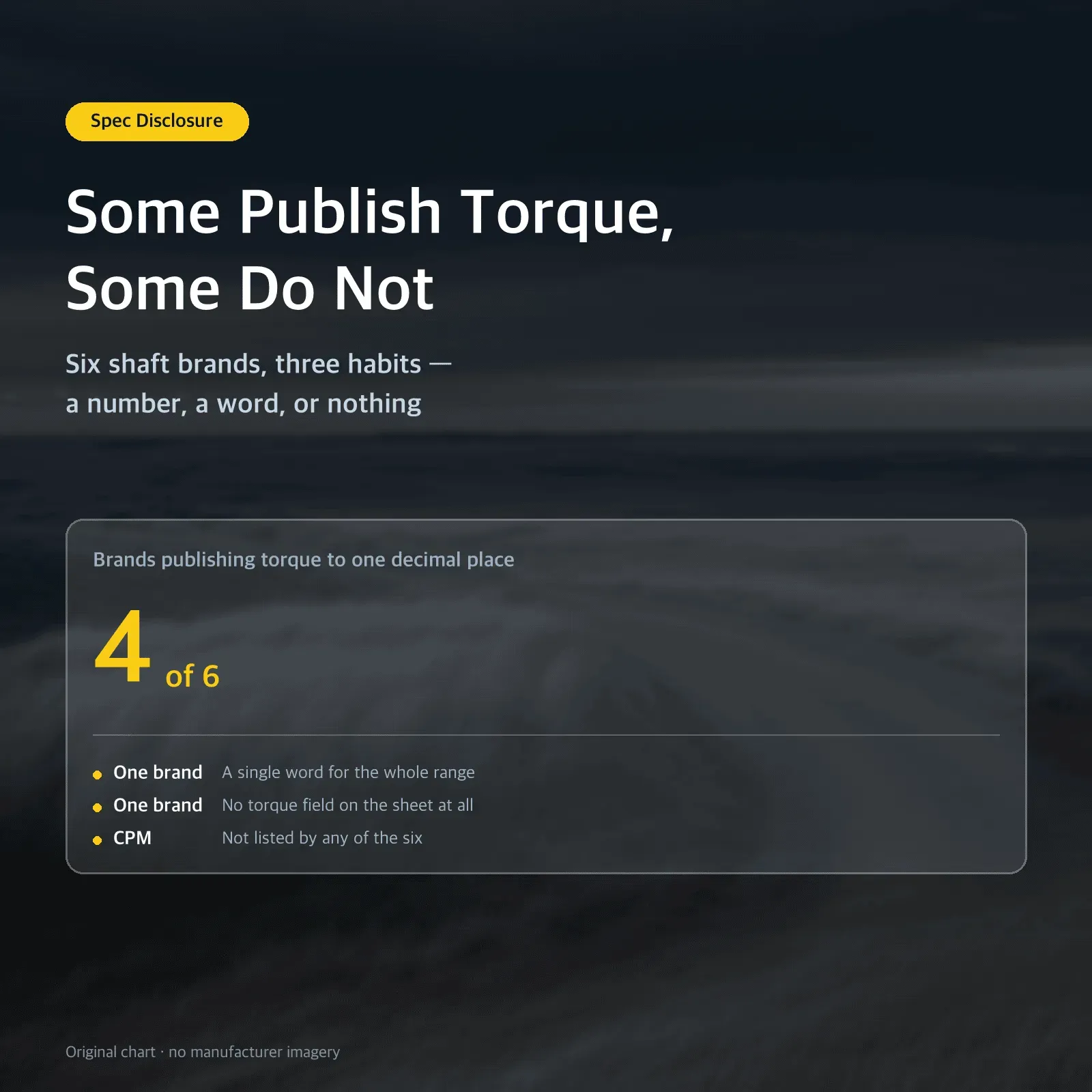
The six shaft brands checked here split into three groups by how they disclose torque. True Temper gives a single qualitative label — “Low” — across the entire Dynamic Gold flex range. KBS does not list torque on its spec sheet at all; the Tour page publishes flex, weight, tip, length, butt diameter and finish, and stops there. The remaining four publish a figure to one decimal place.
Among the four that publish a number, one is steel (Nippon Shaft, 1.8 and 1.7 degrees across two models) and three are graphite (Mitsubishi 3.9, Fujikura 3.1, Graphite Design 3.1). The line between material and disclosure practice doesn’t map perfectly, but every graphite brand checked here does publish a number — that pattern held across this research.
Narrow it to the three steel brands alone, and only one publishes a number. Narrow it to the three graphite brands, and all three do. Within steel, disclosure practice splits; within graphite, all three brands checked here take the same approach — a difference that only shows up once you compare by material.
2. Same structure, different subject than offset
| Question | Iron heads | Shafts |
|---|---|---|
| Is it published? | Offset: 4 yes, 1 no | Torque: 4 yes, 1 word, 1 absent |
| How is it hidden? | Replaced with words | Words, or item removed |
| Published by nobody | Blade length | CPM (frequency) |
The Same Split, Asked of a Different Part — an earlier comparison asked this of iron heads; this one asks it of shafts. Iron-head makers and shaft makers are often separate companies, so the two tables do not lay on top of each other.
The earlier piece split brands by whether offset was given in millimeters — four did, one didn’t. Here the item is torque, and the brand lineup is different: ironhead makers and shaft makers are often different companies, so the two tables can’t be laid directly on top of each other.
There is a shared structure, though. Where one iron brand described a reduced offset only in words, without a number, one shaft brand here drops torque from the sheet entirely. Hiding a number happens two ways — replacing it with words, or removing the item altogether — and this batch shows both, split between two different brands.
In the offset piece, blade length was a spec no brand published as a number across six models checked, though some at least acknowledged the item exists in words. Here, no item was met with that same total silence across every brand. CPM (cycles per minute) comes closest, but it isn’t mentioned in words anywhere either — it sits closer to “the item itself isn’t acknowledged” than to “acknowledged but unquantified.” Similar on the surface, different in practice.
3. A precedent for narrowing disclosure over generations
The offset piece also found that one manufacturer had an offset figure on its earlier model’s spec sheet and dropped it from the successor model — disclosure withdrawn, not just withheld. Nothing that direct turned up in this shaft research. One graphite line is due for a generational update in the near term, and whether its published items carry over unchanged is something this research cannot answer yet.
That’s a gap in what could be confirmed, not a prediction. It’s worth checking again once the next-generation spec sheet is published.
Recalling that earlier precedent, disclosed items narrowing across a generation has already happened at least once on the clubhead side. Whether the same thing happens on the shaft side is unknown for now, but it’s a pattern worth keeping in mind when the next spec sheet appears.
4. Who this is useful for
Useful for golfers who buy by the numbers on both the ironhead and the shaft — the offset/bounce comparison and this torque comparison together show each brand’s disclosure tendencies across two axes.
Useful for golfers weighing steel against graphite who want to narrow brands by torque disclosure — the graphite brands here all publish a number, while only one of the three steel brands does.
Useful for golfers choosing a graphite shaft who want a torque number to base the decision on — all three graphite brands checked here publish to a decimal.
Less useful for golfers already using a steel-family shaft from a brand that gives only a qualitative label or no figure at all — neither brand’s official spec sheet has a number to find.
Less useful for anyone expecting this torque-disclosure axis to line up with the earlier offset-disclosure axis by brand — ironhead makers and shaft makers are often separate companies, so the two don’t map directly onto each other.
5. What we could not confirm
- An official association or manufacturer document stating “there is no industry standard” — not found. Only the disclosure gap and the numeric variance itself are stated as fact here.
- Torque disclosure for the next-generation graphite shaft mentioned above — not yet released, so unconfirmed.
- Why the brands using qualitative labels or no torque figure maintain that practice — no official explanation found.
- CPM (cycles per minute) — not listed by any of the six brands checked.
- Manufacturer distance or spin claims — not cited, as they could not be verified.
In one line
Of the six shaft brands checked here, four publish torque to a decimal place, one uses a qualitative label, and one omits the item entirely. The same shape of split seen earlier with iron offset shows up again with a different part.
Weight variance within a nominal flex and disclosure practice are two separate axes. One is an actual gap in the hardware; the other is a brand’s choice about what to publish. Worth checking each on its own terms rather than folding them together.
Sources
Every brand’s own spec page, each opened and read on 30 August 2026:
- Nippon Shaft N.S.PRO 950GH and MODUS³ TOUR 120 — torque given per flex to one decimal (950GH 2.0/1.9/1.8/1.7°; MODUS³ 1.8/1.7/1.6/1.5°), plus kickpoint and balance point.
- True Temper Dynamic Gold — the torque column reads “Low” for every flex; no number anywhere on the page.
- KBS Tour — the spec table’s fields are flex, clubs, weight, tip, length, butt OD and finish. There is no torque column.
- Fujikura VENTUS TR — torque per flex to one decimal.
- Mitsubishi Tensei 1K Pro Blue — 60S listed at 61g / 3.9°.
- Graphite Design Tour AD GC — GC-6 S listed at 65g / 3.1°.
This piece names the brands rather than counting them anonymously, because the claim is about who discloses what — a reader who cannot see which brand is which cannot check it. Where a brand publishes nothing, that absence is stated as an absence on a page we opened, not inferred.