
Nearly every club in a modern golf bag has a steel or graphite shaft. Nobody plays with wood anymore.
But steel shafts weren’t legal from the start. And the date they became legal differed by five years on either side of the Atlantic.
The USGA allowed them in 1924. The R&A didn’t until 1929.
1. Before steel, it was hickory
| Problem | Effect |
|---|---|
| Every piece behaved differently | Grain density varied even within the same tree |
| Reacted to humidity | Properties shifted with the weather |
| High, inconsistent torque | Hard to control how much the head twisted |
What Wooden Shafts Got Wrong — problems that couldn’t be avoided with hickory. Under those conditions, the idea of a matched set of clubs barely made sense.
The material before steel was hickory — a North American hardwood, stiff but flexible enough to work as a shaft.
Wooden shafts came with problems that couldn’t be avoided:
- Every piece behaved differently. Even cut from the same tree, differences in grain density changed how much a shaft flexed.
- They reacted to humidity. Properties shifted with the weather.
- Torque was high. It was hard to control how much the head twisted during the swing.
That meant two clubs of the same model could feel different. Under those conditions, the idea of a matched set barely made sense.
2. The USGA opened the door first — 1924
The USGA legalized steel shafts in 1924.
Steel solved most of wood’s problems. Made to spec, it behaved consistently, was less affected by humidity, and its torque could be controlled.
Above all, it became possible to reproduce the same specification repeatedly. That’s what later made the idea of a “set” possible — matching several irons only works once the material itself is consistent.
The habit of comparing shaft weight and torque as numbers today traces back to this. Wood could carry those numbers too, but they meant little when every piece varied.
3. The R&A waited five more years — 1929
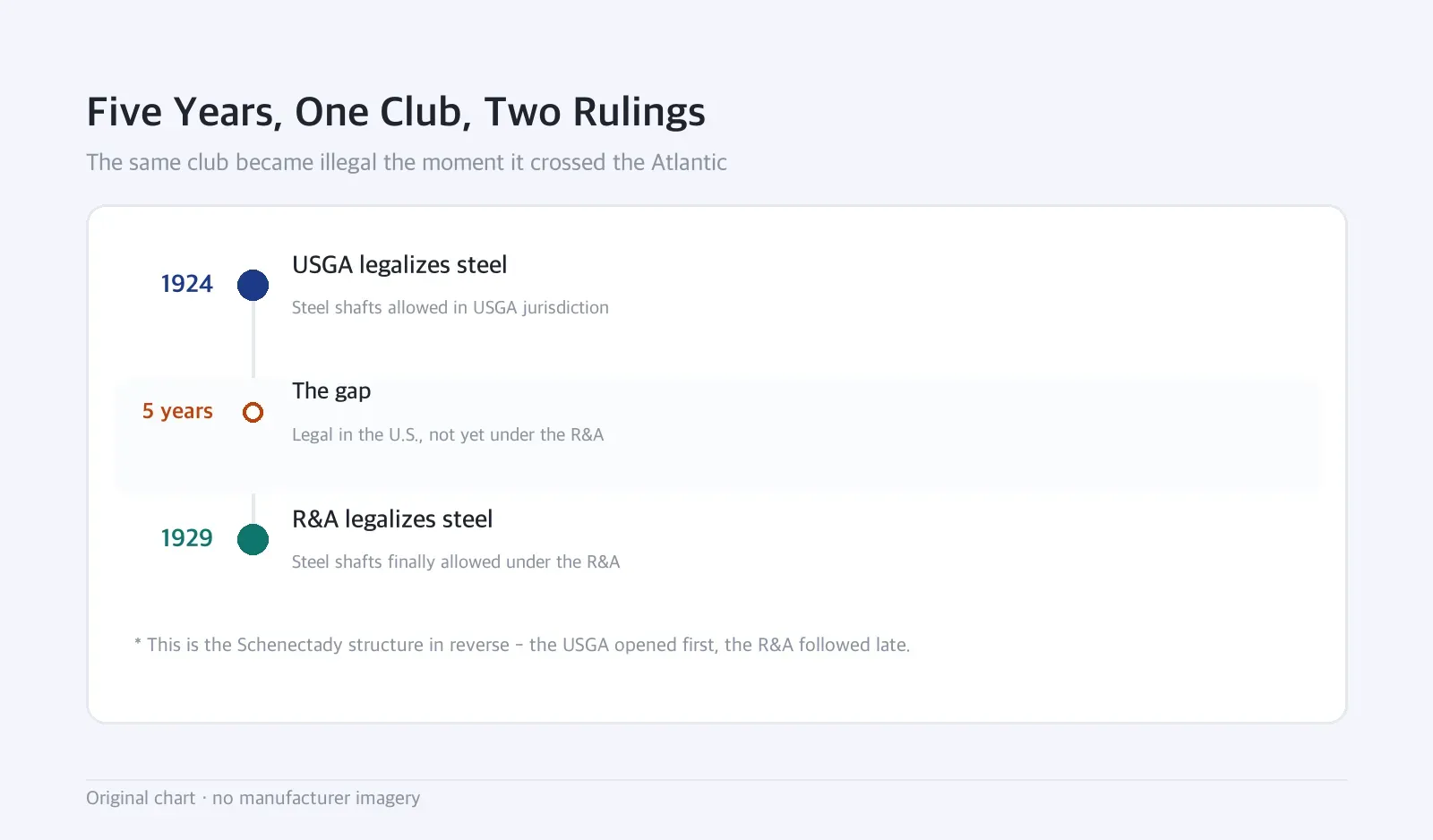
The R&A legalized steel shafts in 1929.
For those five years, the situation looked like this:
- In the United States, players could use steel shafts.
- Under R&A jurisdiction, they couldn’t.
- The same club became illegal the moment it crossed the Atlantic.
This is the same structure as the Schenectady putter case from 1910 — but in reverse direction. There, the R&A restricted and the USGA allowed. Here, the USGA opened first and the R&A followed late.
Why it took five years is something this piece could not confirm. Attitudes toward tradition, conditions in the hickory-shaft manufacturing trade, and judgments about performance change all get mentioned, but we found no confirmed source.
One thing worth noting, though: hickory shafts were handmade. There were craftsmen who selected, cut, and shaped the wood, and people whose livelihood depended on that work. Steel comes from a factory. A change of material also meant an entire industry changing shape.
This is inference, not something we’re presenting as confirmed.
4. What the five years left behind
| Stage | What followed |
|---|---|
| Steel legal both sides | A consistent material made matching several clubs possible |
| Matched sets became common | By the 1930s, some players carried twenty or thirty clubs |
| 1936-1938 | 14-club limit adopted, effective 1938 |
What the Five Years Left Behind — a material change led, eventually, to a limit on quantity. The gap itself matters less than what it led to: standardization, then a limit on club count.
The gap itself matters less than what happened afterward.
Once steel became legal on both sides, club manufacturing changed. Being able to set a specification and reproduce it repeatedly is what made the idea of a matched set possible.
And not long after, a different problem showed up. Because clubs became easier to produce, players started carrying more of them. By the 1930s, some players carried twenty or thirty clubs.
The result was the 14-club limit, adopted in 1936 and effective in 1938. A change in material led to a limit on quantity — a story covered separately.
5. Three splits, one pattern
Looking at three cases where the two governing bodies diverged, a pattern emerges.
- 1910, the Schenectady putter — R&A banned it, USGA allowed it
- 1924 and 1929, steel shafts — USGA allowed it first, R&A five years later
- 1998, the coefficient of restitution — USGA restricted it, R&A didn’t (covered separately)
| Case | Gap |
|---|---|
| 1910 - Schenectady putter | R&A banned it; the USGA did not follow |
| 1924-1929 - steel shaft | Five-year gap, USGA first |
| 1998 - coefficient of restitution | USGA restricted; the R&A did not (covered separately) |
Three Splits, One Pattern — the direction varied each time, divergence was the constant. It’s hard to call either body consistently more conservative — each restricted at least once.
The direction varied each time. It’s hard to say either body was consistently more conservative — the R&A restricted at Schenectady, the USGA restricted on the coefficient of restitution.
The common thread is that when a new technology appeared, the two bodies’ judgments didn’t line up right away.
6. Who this is useful for
Based on what could be confirmed:
- Golfers shopping for shafts — what’s taken for granted now wasn’t always allowed. Standardizing the material is what made the concept of a matched set possible.
- Golfers building a matched set — the idea of matching several clubs’ properties only became possible once the material itself was consistent.
- Golfers curious about equipment history — a material change triggered a rule change; the 14-club limit is the result.
- Golfers interested in hickory clubs — hickory-shaft competitions still exist today.
This is less useful for:
- Golfers who only need current rules — material restrictions aren’t an issue today.
- Golfers comparing shaft performance — this piece is history; weight and torque comparisons are covered separately.
7. What we could not confirm
- Why the R&A waited five years — we found no confirmed source. This is the piece’s biggest gap.
- The original text of both rulings — we did not confirm the exact 1924 and 1929 wording.
- How international competitions handled the five-year gap — we don’t know what standard applied when American players competed in the British Open during this period.
- The actual rate and pace of the shift from hickory to steel.
- The original patent and manufacturer of the steel shaft.
- The date graphite shafts became legal — not covered here.
In one line
Steel shafts became legal with the USGA in 1924 and the R&A in 1929. For five years, the same club was legal on only one side of the Atlantic.
What the change really left behind wasn’t the time gap — it was standardization. Once the material became consistent, the same specification could be reproduced, and that made the idea of a set possible. Once clubs multiplied, a limit on quantity followed.
The dates in this piece come only from confirmed sources, and anything unconfirmed is marked as such.
Sources
- USGA legalization of steel shafts, 1924.
- R&A legalization of steel shafts, 1929 — the five-year gap this piece is about.
No archived URLs are recorded for these sources in the original research. Items the source does not publish are named as unconfirmed rather than estimated.