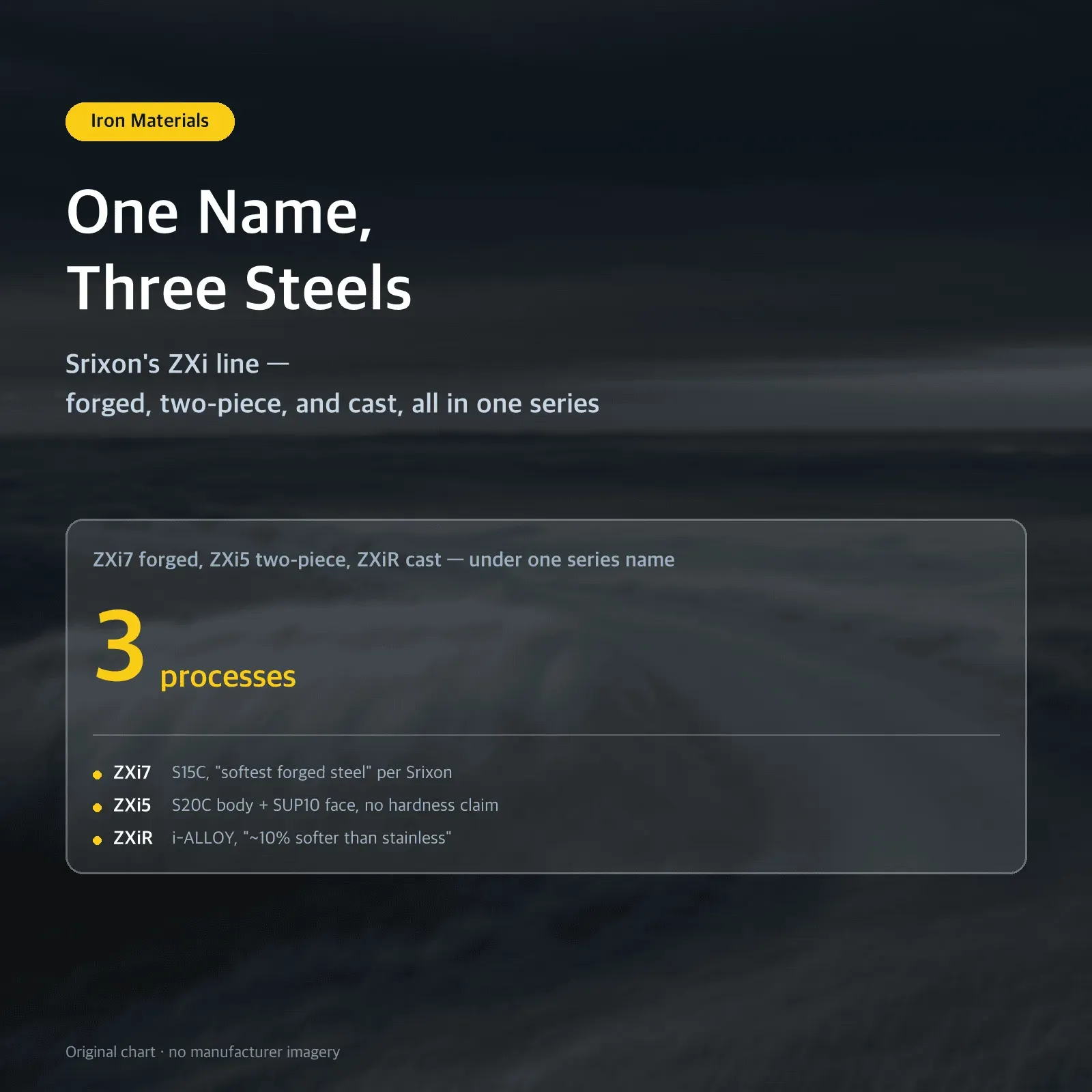
How many types of steel can sit inside one brand’s single series? Working through Srixon’s ZXi line, the answer turned out to be three. ZXi7 uses S15C, ZXi5 uses an S20C-plus-SUP10 combination, and ZXiR uses i-ALLOY. One name, ZXi — three different material grades underneath.
This isn’t a cross-brand comparison. This is what happens under a single name, at a single brand. The question this piece asks isn’t how the models stack against rivals, but why one brand bothered to build three different answers.
1. Three models, three processes
| Process | Material | |
|---|---|---|
| ZXi7 | Forged, single piece | S15C |
| ZXi5 | Two-piece, body + face insert | S20C body / SUP10 face |
| ZXiR | Cast, single piece | i-ALLOY |
Three Models, Three Manufacturing Processes — Forged, two-piece, and cast, different concepts, one series name. Usually a series shares one process and differs only by material grade — ZXi changes the process itself, model to model.
ZXi7 is traditionally forged — a single steel (S15C) hammered as one piece. ZXi5 is two-piece — a body (S20C) joined to a separate face insert (SUP10). ZXiR is cast — poured from a single material. The three processes — “hammer one material,” “join two materials,” “pour one material” — are three completely different manufacturing concepts.
Lined up by process alone, they read as a spectrum from forged to cast. ZXi7 sits at one end, ZXiR at the other, ZXi5 in between. Three approaches coexisting under one series name reads as a lineup designed not around “one technology” but around “a tailored answer for each target.”
Usually within a single series, higher and lower models share a manufacturing process and differ only by material grade. ZXi doesn’t. The manufacturing process itself changes model to model. Looked at purely as cost or production efficiency, that’s an inefficient choice — which suggests each model’s target (players, forgiveness, game-improvement) got its own individually tailored answer.
2. S15C — the manufacturer’s own pick for “softest forged steel”
| Model | Material | Manufacturer claim |
|---|---|---|
| ZXi7 | S15C | “Softest steel” Dunlop uses in a forged iron |
| ZXi5 | S20C + SUP10 | No comparative hardness phrase found |
| ZXiR | i-ALLOY | “~10% softer than conventional stainless” |
Softness Claims — Two Models State a Figure, One Doesn’t. ZXi7’s claim is scoped “among forged irons” — it can’t be compared directly against ZXiR’s stainless-based claim.
ZXi7’s S15C is described by the manufacturer as the softest steel Dunlop has used in a forged iron. A PureFrame milling pattern is applied to the back of the face.
“Softest” is relative. We could not confirm what it’s being compared against, or whether a precise hardness figure exists. What we could confirm is that this phrase appears verbatim on the manufacturer’s own product page.
The qualifier “among forged irons” is worth noting too. It’s a comparison within the forged-iron category, not across the company’s whole lineup. That means this phrase alone can’t be compared directly against i-ALLOY (cast). S15C is described as “softest among forged,” i-ALLOY as “10% softer than stainless” — the comparison baseline is different for each from the start.
3. SUP10 — why it’s only in the face
ZXi5 pairs an S20C stainless body with a SUP10 high-strength steel face. It carries a MainFrame milling pattern.
What’s notable here: we could not find a manufacturer statement directly comparing S20C and SUP10 as “softer/harder.” ZXi7’s S15C and ZXiR’s i-ALLOY each come with a specific comparative claim — “softest steel,” “10% softer” — but no such comparative phrase exists for ZXi5’s material combination. The structure (two-piece) is clearly explained; the hardness comparison is left blank.
Line the three up, and ZXi7 and ZXiR lead with “how soft is the material,” while ZXi5 leads with “how is the structure divided.” The marketing angle itself differs model to model. Whether that translates to a real difference in feel is something only hitting them side by side can answer.
4. i-ALLOY — cast, but claimed 10% softer than stainless
ZXiR’s i-ALLOY is stated by the manufacturer to be roughly 10% softer than conventional stainless steel. Cast material approaching forged-level feel is the manufacturer’s own description (covered separately in more detail).
Lined up, the three models emphasize “softness” differently. ZXi7 claims “softest among forged,” ZXiR claims “10% softer than stainless” — both with specific comparative figures. ZXi5 is the only one without such a phrase.
5. Overlaying the 7-iron loft too
| Model | 7-iron loft |
|---|---|
| ZXi7 | 32° |
| ZXi5 | 31° |
| ZXiR | 28.5° (press) or 29° (secondary source) |
7-Iron Loft Weakens Along the Same Spectrum — loft weakens from ZXi7 toward ZXiR, the same direction as the forged-to-cast process spectrum — not stated as deliberate by the manufacturer.
ZXi7 32°, ZXi5 31°, ZXiR 28.5° (per press coverage) or 29° (per a secondary source — the two sources disagree). ZXi7 to ZXi5 is a 1° gap; ZXi5 to ZXiR is roughly 2 to 2.5°.
Loft alone weakens from ZXi7 toward ZXiR, tracking the same direction as the process spectrum (forged to cast). Whether that’s a coincidence or a deliberate design choice hasn’t been stated explicitly by the manufacturer, so it’s left here as an observation only.
It’s a general principle that weaker loft tends to produce lower trajectory and more distance at the same swing speed. But that’s a principle, not a measured distance ranking for these three models. Actual results depend on head design, weight distribution, and strike location, so loft numbers alone aren’t treated here as proof of which one goes furthest.
6. Who this comparison is useful for
A judgment framework drawn from confirmed specs.
- Golfers who can’t decide between forged, two-piece, and cast just from the model names — once you know the three sit under one series name but represent completely different processes, the question shifts from “which is the better ZXi” to “which process matches my priorities.”
- Golfers judging feel by material — ZXi7 (S15C) and ZXiR (i-ALLOY) each carry a specific comparative claim (“softest forged steel,” “10% softer”) that can serve as a basis for weighing the two against each other.
This may not fit:
- Golfers wanting to compare all three materials by absolute hardness figures — all three use relative language (“softest,” “10% softer”) only; no absolute figures like HRC were confirmed.
- Golfers wanting to compare ZXi5’s material the same way as ZXi7 and ZXiR — ZXi5’s structure (two-piece) is clearly explained, but no comparative hardness phrase exists for it, so it can’t be lined up on this axis with the other two.
7. What we could not confirm
| Item | Status |
|---|---|
| S20C vs. SUP10 hardness comparison | No manufacturer phrase exists |
| Absolute hardness values (HRC, etc.) | None confirmed for any of the three |
| ZXiR 7-iron loft, exact figure | 28.5° vs 29° — sources disagree |
| Lie, length, swingweight (all three) | Not confirmed |
What Could Not Be Confirmed — Left blank rather than filled in.
- The exact hardness comparison between S20C and SUP10 — no manufacturer phrase exists.
- Absolute hardness values (HRC, etc.) for all three materials — all three are described only in relative terms (“softer”); no absolute figures confirmed.
- ZXiR’s 7-iron loft, 28.5° vs 29° — the two sources disagree and neither is confirmed as correct.
- Lie angle, length, and swingweight for all three models — entirely unconfirmed. Material and structure could be compared, but the fitting-relevant measurements weren’t available for this set.
In one line
Under one series name, ZXi, three processes and materials coexist: forged (S15C), two-piece (S20C + SUP10), and cast (i-ALLOY). The split between models that state “softness” with a specific figure (ZXi7, ZXiR) and the one that only explains structure (ZXi5) only became visible once they were lined up side by side. Looking at one model at a time would have missed it.
Every chart here was built directly, and every number comes from confirmed sources. Anything we could not confirm was left blank.
Sources
- Srixon/Dunlop official product pages — including the verbatim phrase describing S15C as the softest steel used in a forged iron, confirmed as appearing on the manufacturer’s own page.
No archived URLs are recorded for these sources in the original research. Everything above is drawn from first-party manufacturer material; items the manufacturer does not publish are named as unconfirmed rather than estimated.