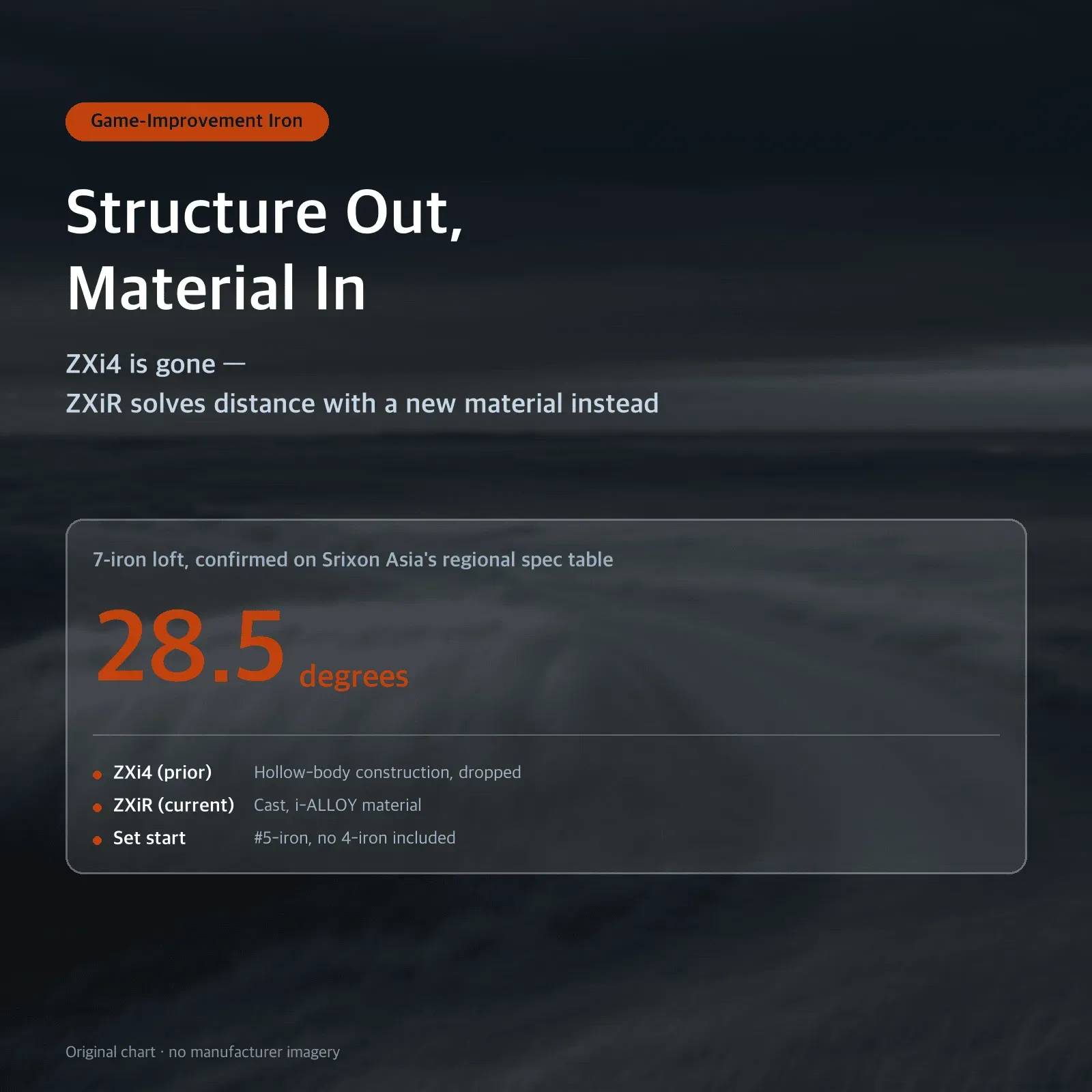
Going through Srixon’s current ZXi iron lineup, one thing stands out. The hollow-body model that used to sit in that lineup, ZXi4, is gone from the current refresh. In its place, in the game-improvement slot, is the ZXiR.
But ZXiR isn’t a hollow-body design. It runs on a new material instead. The method of “adding distance” changed entirely.
1. Where ZXi4 left off — from structure to material
| ZXi4 (prior) | ZXiR (current) | |
|---|---|---|
| Method | Hollow body | Cast, new material |
| Lineup status | Absent from current refresh | Game-improvement slot |
| Goal | Distance + forgiveness | Distance + forgiveness |
ZXi4 Dropped Out, ZXiR Took Its Slot — from hollow structure to new material, a different route to the same goal. Whether ZXi4 is fully discontinued or just dropped from this refresh is outside what this piece confirms.
The current ZXi iron lineup spans five models: ZXi7, ZXi5, ZXiR, ZXiR HL, and ZXiU. The previous ZXi4, a hollow-body model, is absent.
Hollow construction hollows out the head to thin the face and boost rebound. It’s a method several brands have used for years in the game-improvement category. But a hollow structure is difficult to balance against durability at the same time as weight distribution. Dropping that approach for a new-material approach in this generation reads as an attempt to solve the same problem a different way — though that’s an interpretation based on the lineup change, not a line the manufacturer has stated directly confirming “that’s why we dropped hollow construction.”
Hollow construction and new-material construction are different kinds of problems. Hollow is a question of “how it’s built.” New material is a question of “what it’s built from.” Both aim at the same goal — distance and forgiveness — by different routes. Whether ZXi4 is fully discontinued or was simply dropped from this particular refresh is outside the scope of this research — what’s covered here is which models are currently sold.
2. The i-ALLOY material — cast construction aiming for forged feel
According to the manufacturer’s own description, i-ALLOY is roughly 10% softer than standard stainless steel, and noticeably softer than the 431 stainless commonly used in the game-improvement category.
The claim is that this cast construction delivers a feel and feedback close to forged, despite being cast. That’s a notable claim because “soft feel” is usually treated as forged steel’s exclusive territory. It reads as an attempt to close that gap from the cast side, through material choice.
To be clear, this is the manufacturer’s own claim. No third-party measured hardness comparison or independent feel evaluation was found in this research. It should be read with that caveat.
Still, the claim is interesting because the game-improvement category typically competes on distance first and treats feel as secondary. A commonly used material like 431 stainless favors strength and rebound but is generally understood to trade off feel. If i-ALLOY is an attempt to close that trade-off through material alone, that’s an uncommon approach within this category.
3. An AI-designed pattern on the back of the face
| Feature | Manufacturer claim |
|---|---|
| i-ALLOY hardness | ~10% softer than standard stainless |
| Vs. 431 stainless | Noticeably softer (mfr. claim) |
| Back-of-face milling | AI machine-learning-designed pattern |
| Sweet spot | Repositioned lower, based on amateur impact data |
i-ALLOY and the AI-Designed Face Pattern — manufacturer claims, no independent verification found. Both the hardness claim and the milling-pattern design intent are the manufacturer’s own description.
The ZXiR face uses an AI machine-learning-designed mainframe milling pattern on the back, aimed at maximizing MOI.
One detail worth noting: the milling pattern is described as built from analysis of actual amateur impact-location data, and the sweet spot was repositioned toward the lower face based on that analysis.
Amateur golfers commonly strike below the face center more often than at it. Designing around actual impact location rather than an “ideal swing” is a different design philosophy. This, too, is the manufacturer’s own description — independent verification wasn’t found.
4. The 7-iron loft — resolved at 28.5 degrees
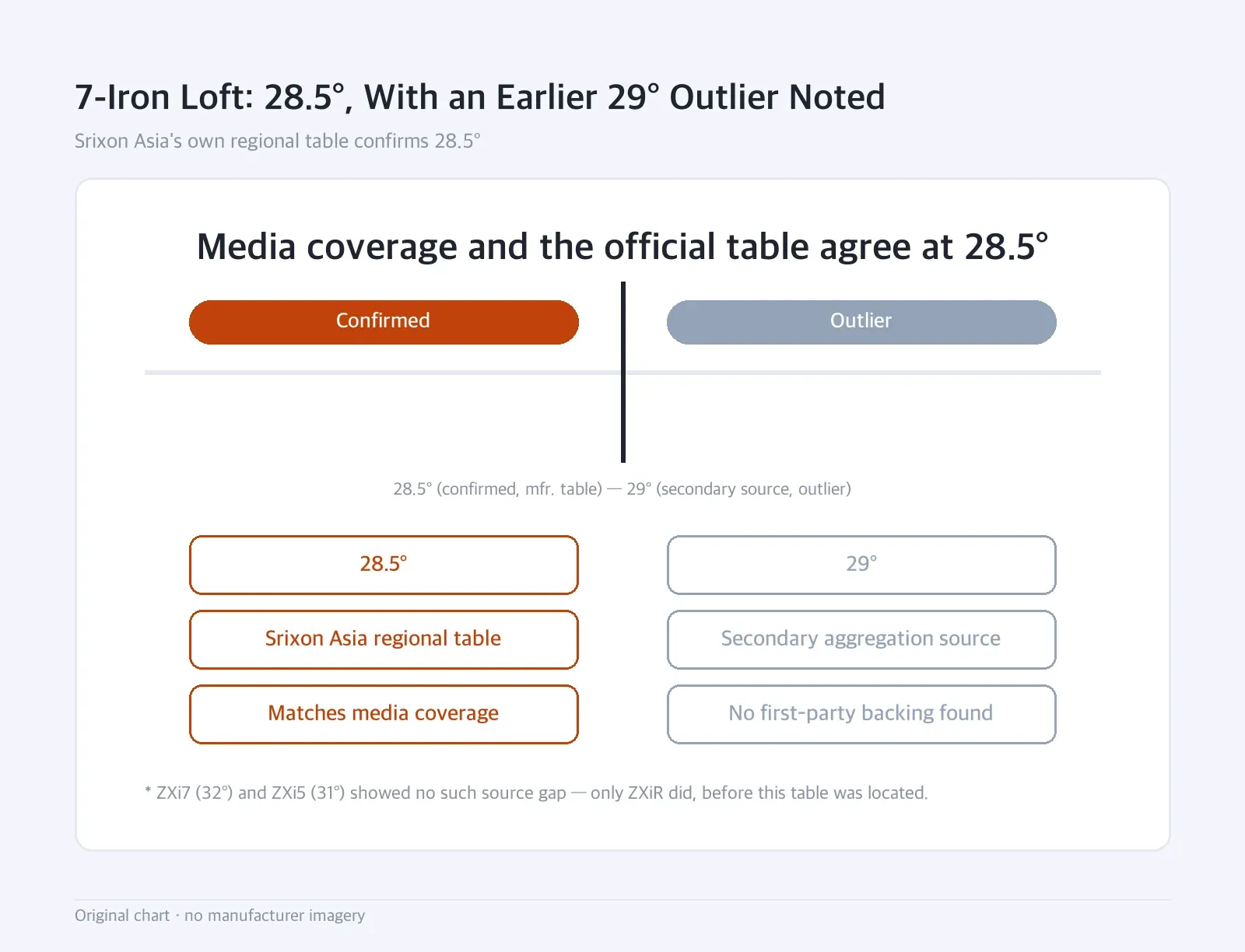
An earlier version of this research flagged a discrepancy: media coverage stated 28.5 degrees, while a secondary spec-aggregation source stated 29 degrees. The other models covered alongside ZXiR (ZXi7 at 32°, ZXi5 at 31°) didn’t show this kind of gap between sources — only ZXiR did, and no official first-party spec sheet could be located at the time.
That’s now resolved. The manufacturer’s own regional spec table (Srixon Asia) lists the ZXiR 7-iron loft at 28.5 degrees, matching the media figure. The 29° figure from the secondary aggregation source was the outlier. The full table is below.
4a. Confirmed spec — loft, lie, offset, length, swing weight (Asia region)
The full iron-by-iron spec table is published on the Srixon Asia regional site.
| HEAD | LOFT | HAND | LIE | OFFSET | LENGTH† |
|---|---|---|---|---|---|
| 4 | 19.5° | RH/LH | 60.5° | 5.0mm | 39.5″ |
| 5 | 22° | RH/LH | 61° | 4.6mm | 38.75″ |
| 6 | 25° | RH/LH | 61.5° | 4.1mm | 38″ |
| 7 | 28.5° | RH/LH | 62° | 3.5mm | 37.25″ |
| 8 | 33° | RH/LH | 62.5° | 3.4mm | 36.75″ |
| 9 | 38° | RH/LH | 63° | 3.2mm | 36.25″ |
| PW | 43° | RH/LH | 63.5° | 2.9mm | 36″ |
| AW | 48° | RH/LH | 63.5° | 2.3mm | 35.75″ |
| SW | 54° | RH only | 63.5° | 2.1mm | 35.5″ |
One detail worth flagging on its own: every loft from 4-iron through AW is offered RH and LH, but the SW is RH only. That’s a real constraint for left-handed golfers building a full set — the sand wedge has to be sourced separately or substituted. It’s also worth noting the offset runs down steadily from 5.0mm at the 4-iron to 2.1mm at the SW, a smooth progression rather than a jump — consistent with the rest of the set being engineered as one continuous line rather than assembled from separately-tuned pieces.
Swing weight is broken out by shaft:
- Steel: swing weight D2 for both S-flex and R-flex (D3 for AW/SW)
- Graphite: swing weight D0 (S-flex) / C9 (R-flex), stepping up to D1/D0 for AW/SW
†A note on the same page flags a measurement change: published iron lengths run about ¼ inch longer than before, but this reflects a change in how length is measured, not a change to the physical clubs. If these numbers look off against another source’s figures for the same iron, that’s the likely reason — check which measurement convention that source uses before assuming a build difference.
Region caveat: this table comes from Srixon Asia’s regional product page, not a confirmed global release. This lineup has already shown region-specific differences elsewhere (see the companion piece on Z-STAR9, sold as Z-STAR in some markets) — treat these exact numbers as the Asia-market build and check your own region’s listing before ordering.
5. ZXiR HL — a higher-launch variant
| Item | ZXiR | ZXiR HL |
|---|---|---|
| 7-iron loft | 28.5° | 32.5° (2.5-4° weaker by club, per coverage) |
| Target golfer | Game-improvement, broad | Senior / women, low-trajectory difficulty |
| Set range | #5-P.A.S | #5-P.A.S |
| SW handedness | RH only | not disclosed |
ZXiR vs. ZXiR HL — two variants of the same game-improvement model. Both sets start at the 5-iron — differing from ZXi7/ZXi5, which start at the 4-iron.
ZXiR HL (High Launch) targets a higher trajectory than ZXiR. Its 7-iron loft is reported at 32.5 degrees, described in coverage as 2.5 to 4 degrees weaker than ZXiR depending on the iron number.
The target golfer also differs. Where ZXiR targets the game-improvement category broadly, ZXiR HL extends that target to senior and women golfers who have difficulty generating trajectory and controlling spin.
Set composition was also confirmed. Both ZXiR and ZXiR HL are listed with a “#5–P.A.S” configuration, meaning the set starts at the 5-iron. That differs from ZXi7 and ZXi5, which start at the 4-iron.
6. Who this club fits
Judgment criteria inferred from confirmed specs. This does not replace an actual fitting.
- Game-improvement golfers who want a soft new-material feel — if i-ALLOY’s claimed softness relative to standard stainless holds up, this is aimed at golfers who found the harsher feel of a typical hollow-body iron uncomfortable.
- Golfers who struggle to generate their own long-iron trajectory — the ZXiR and ZXiR HL sets starting at the 5-iron means the design already drops the 4-iron and below from the set, aimed at golfers who fill that gap with a utility club or hybrid instead.
- Golfers who miss low on the face frequently — if the stated design intent of repositioning the sweet spot lower holds up, that favors golfers with a low impact tendency (though this reflects stated design intent, not measured verification).
This is less useful for:
- Golfers who want a 4-iron included in the set — the ZXiR and ZXiR HL sets confirmed here start at the 5-iron. If a 4-iron is required, check separately whether individual-club purchase is available.
- Better players who want precise feel control — this model is built for the game-improvement, high-launch category. Golfers looking for the feedback of a forged players iron should look at ZXi7 instead.
7. What we could not confirm
| Item | Status |
|---|---|
| ZXiR HL: lie, length, swingweight | Product page had no spec content |
| i-ALLOY hardness claims | Manufacturer claim; no 3rd-party check |
| “PureFrame” vs. “PureFrame iQ” naming | Korean page limited to banners/video |
| Manufacturer distance figures | Not cited — unverifiable |
What We Could Not Confirm — Left blank rather than filled in. Confirmed instead: Dunlop US and Srixon Asia both name the current face tech “PureFrame” (no “iQ”) — “iQ” belongs to an unreleased Japan-reported generation.
- Lie angle, length, swing weight for ZXiR HL — the ZXiR HL product page checked had no spec content at all beyond banner images and a video; only ZXiR’s own table (Section 4a) is confirmed here.
- i-ALLOY’s claimed “roughly 10% softer than standard stainless” and “softer than 431 steel” — both are manufacturer claims; no third-party verification was found.
- Whether the Korean official product page uses “PureFrame” or “PureFrame iQ” — the page’s content is limited to banner images and a video, so this couldn’t be confirmed directly. What is confirmed: Dunlop’s US site and Srixon’s Asia-region site both name the current, already-released ZXi7/ZXi5 face technology “PureFrame” (no “iQ”); “iQ” belongs to a separate, not-yet-released generation reported in Japan.
- Manufacturer-claimed distance figures — not cited, as they could not be verified.
In one line
ZXi4 dropping out and ZXiR taking its place marks a shift from structure to material. Both the i-ALLOY claims and the AI milling pattern come with the caveat that they’re manufacturer claims — but the shift itself, from hollow construction to new material, is the clearest fact to come out of this lineup refresh.
The 7-iron loft discrepancy flagged earlier is resolved: the manufacturer’s own Asia-region spec table confirms 28.5°, and the full loft/lie/offset/length/swing-weight line-up is now confirmed for that region. What remains open — i-ALLOY’s hardness claim, the PureFrame naming question, distance claims — stays open because no first-party source was found for those, not for lack of trying.
Charts in this piece were built from scratch, and figures come only from confirmed sources. Where a value could not be confirmed, it was left blank.
Sources
- Srixon Asia regional spec table — the ZXiR 7-iron loft of 28.5 degrees and the full iron-by-iron table, including the note on the quarter-inch measurement change.
- Media coverage of the launch — the 28.5-degree figure that the manufacturer table later confirmed.
- Secondary spec-aggregation listing — the 29-degree figure, identified here as the outlier.
No archived URLs are recorded for these sources in the original research. The region caveat in the body applies: the table is Srixon Asia’s regional build, not a confirmed global release.