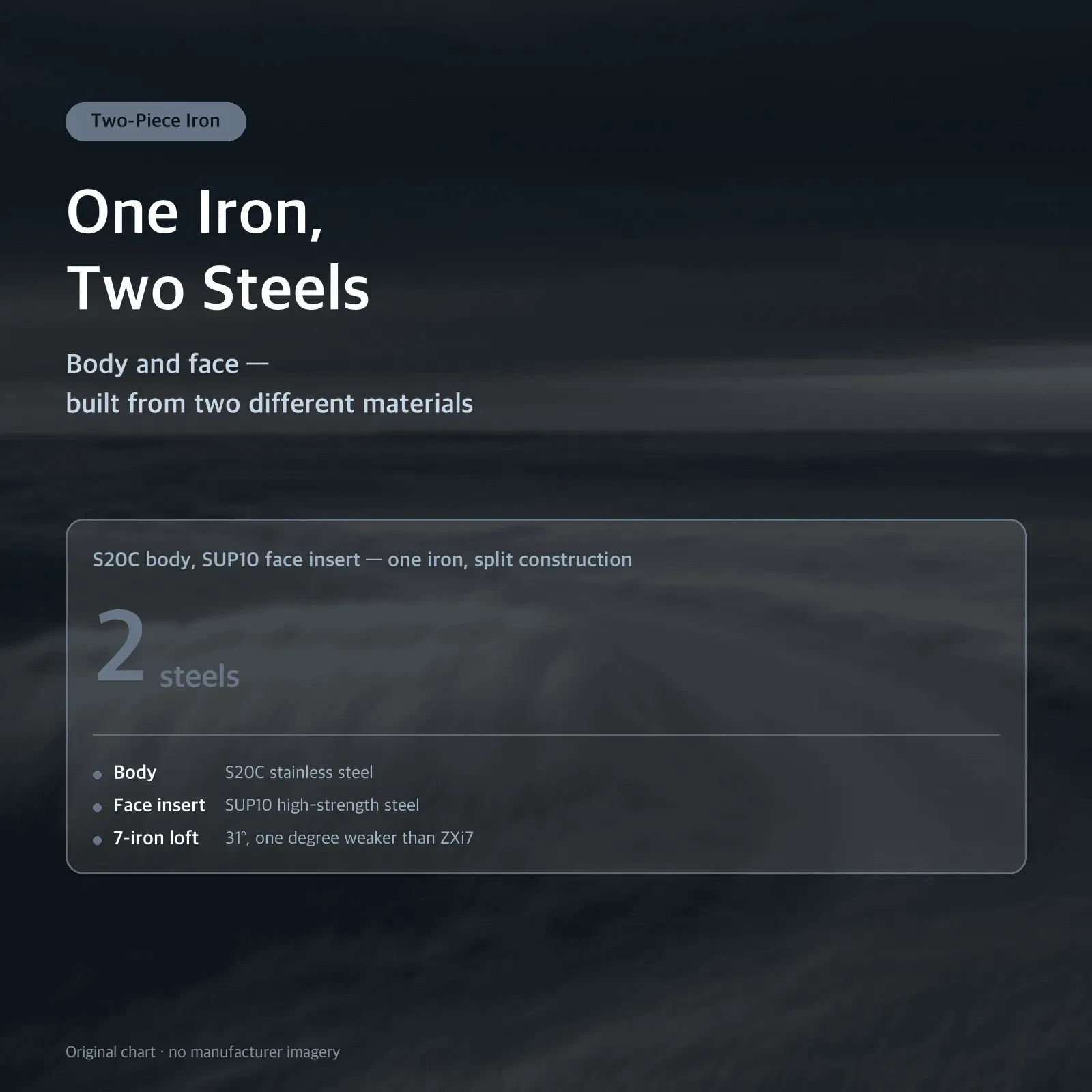
Iron heads are typically built from a single material — forged or cast, body and face share the same steel. ZXi5 doesn’t. The steel used in the body is different from the steel used in the face.
Within the current ZXi lineup, if ZXi7 is a traditional forged players iron, ZXi5 has staked out a position somewhere in between, as a two-piece construction.
1. Two-piece — why split body and face
| Body: S20C | Face: SUP10 | |
|---|---|---|
| Role | Structure, weight distribution | Rebound, feel |
| Material class | Stainless steel | High-strength steel |
| Compared to ZXi7 | ZXi7 is single forged piece | ZXi7 is single forged piece |
Splitting Body and Face Into Different Steels — Each part gets a job suited to its own material. Near the opposite of ZXi7’s single-material forged approach — ZXi5 distributes performance across two parts instead.
ZXi5 combines an S20C stainless body with a SUP10 high-strength steel face insert in a two-piece construction. The back of the face carries MainFrame milling, and the sole is built wide.
Splitting body and face into different steels gives each part a distinct job. The body handles overall structure and weight distribution; the face handles rebound and feel. Optimizing both with a single material is difficult, so the roles — and the steels — are split.
This is close to the opposite of ZXi7’s “single forged piece” approach. Where ZXi7 aims for consistent feel through one material, ZXi5 combines different steels to distribute performance across parts.
This two-piece approach isn’t unique to Srixon — several brands use similar constructions in the forgiveness category. What stands out in this particular refresh, though, is that ZXi7 (single forged), ZXi5 (two-piece), and ZXiR (single cast, new material) sit side by side under the same series name, each with a different approach. One series name covering three different methods suggests this lineup isn’t designed as “one technology pushed down to every level,” but as “a different answer prepared for each level.”
2. SUP10 — why a different steel just for the face
SUP10 is described as a “high-strength steel,” used specifically in the face, where it exceeds the S20C stainless used in the body.
The face is where the ball makes contact, so it has to satisfy both rebound regulations (the COR limit) and durability at once. A higher-strength material can be made thinner, creating room to push rebound further. Using that same high-strength material for the whole body, by contrast, would shift cost and weight distribution. Using SUP10 in the face alone reads as that trade-off point.
That said, this is an interpretation based on the structure, not a line the manufacturer has stated directly explaining “this is why we split it this way.” What’s confirmed is the material composition itself (S20C + face insert in SUP10).
In the same research, ZXi7 (S15C) and ZXiR (i-ALLOY) each came with a specific manufacturer comparison claim — “softest forged steel we use” and “roughly 10% softer than standard stainless,” respectively. No comparable claim was found for SUP10. Only the word “high-strength” appears, without a stated comparison point or degree. That asymmetry — a clearly named material and structure, but no quantified comparison — was itself notable in this research.
3. Confirmed spec — 7-iron loft at 31 degrees
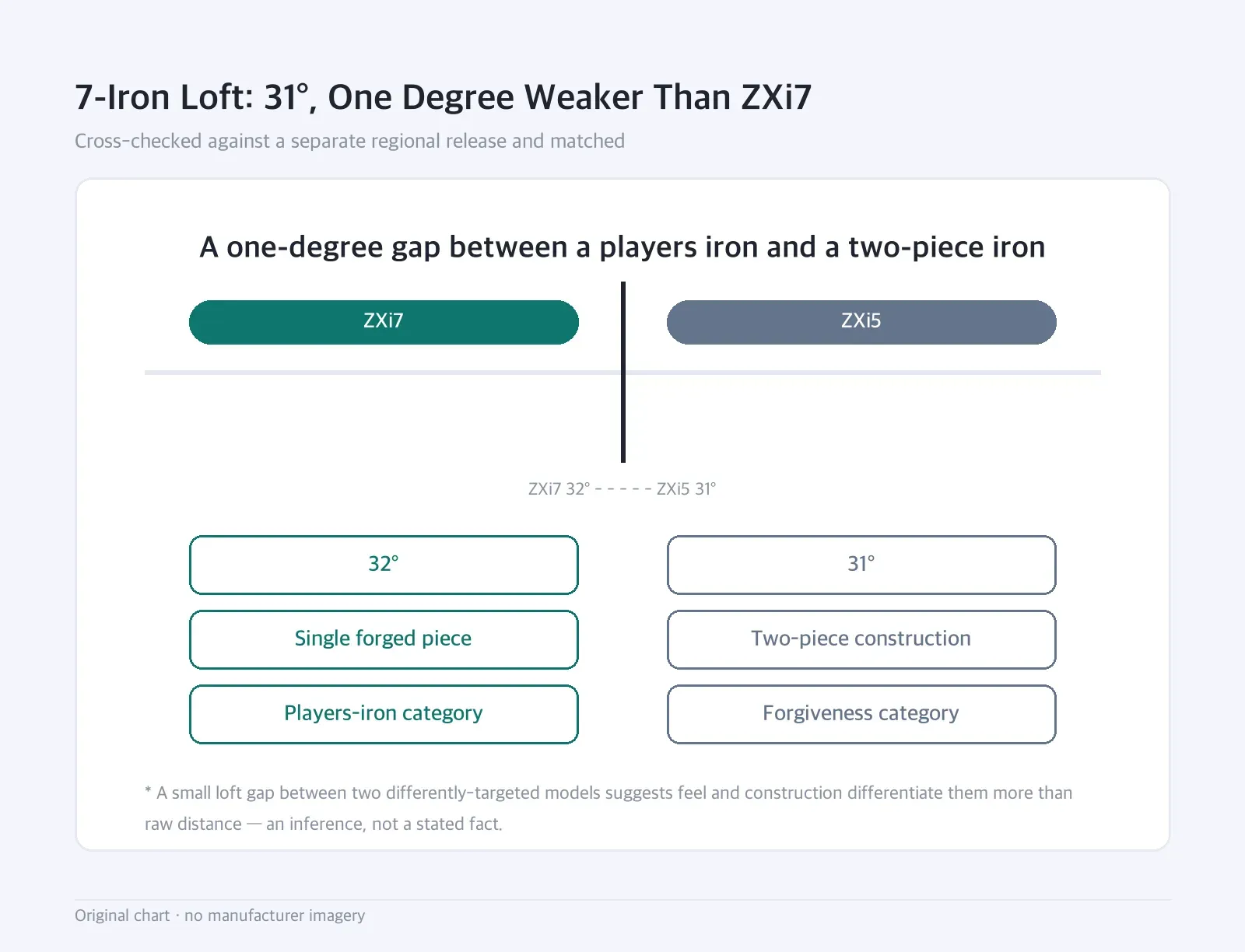
The 7-iron loft is 31 degrees. This figure comes from a secondary spec-aggregation source, but it was cross-checked against a separate regional official release loft and matched. That’s one degree weaker than ZXi7 (32 degrees) at the same position.
A one-degree gap against ZXi7 might not sound significant, but given that the two models target different golfer profiles, the gap being this small is notable rather than trivial. A small loft gap between a players iron (ZXi7) and a two-piece forgiveness iron (ZXi5) could suggest the two models are differentiated more by feel and construction than by raw distance. That’s an inference, though — no manufacturer statement to that effect was found.
4. Set composition — sources disagree
| Source | Set range | Status |
|---|---|---|
| Retail listing (confirmed unit) | 4-iron through PW, 7 clubs | Treated as confirmed |
| Secondary spec source | 3-iron through SW | Noted, not adopted as primary |
| ZXiR / ZXiR HL (same lineup) | #5-P.A.S | Different model, different range |
Set Composition — Sources Disagree — retail listing treated as the confirmed fact. Even within one brand, the starting iron number differs by model — no unified numbering across the ZXi lineup.
There’s a discrepancy worth flagging here. A secondary spec source lists ZXi7 and ZXi5 as running from the 3-iron through sand wedge, while the official retail listing checked shows a 7-club set running 4-iron through pitching wedge.
Rather than one source being wrong, this more likely reflects different set configurations by region or channel. The spec-aggregation source appears to reflect a full 3-iron-through-SW configuration, while the retail listing reflects the actual sold unit (4-through-PW, 7 clubs). This piece treats the retail-listing figure as the confirmed fact while also noting the 3-through-SW figure from the secondary source.
Worth noting: the same lineup’s ZXiR and ZXiR HL carry yet another set notation — “#5–P.A.S,” as covered in the companion piece on that model. Even within one brand, the starting iron number differs by model.
Putting this together, the question “what’s the Srixon iron set configuration” doesn’t have a single answer without specifying the model. ZXi7 and ZXi5 start at the 4-iron; ZXiR and ZXiR HL start at the 5-iron. Set composition alone shows this lineup wasn’t built on a unified numbering system — each model was designed independently.
5. Who this club fits
Judgment criteria inferred from confirmed specs. This does not replace an actual fitting.
- Golfers who want both rebound and feel — the two-piece split between body (S20C) and face (SUP10) is a design aimed at both qualities at once, which a single material struggles to optimize together. Fits golfers unwilling to fully trade off either forgiveness or feel.
- Golfers who want a wide sole for stability — the stated “wide sole” design is aimed at reducing head instability through impact, favoring golfers with inconsistent ground contact.
- Golfers for whom the standard 7-club set (4-iron through PW) is sufficient — that’s the confirmed configuration of the retail unit. If that’s your plan, this fits directly.
This is less useful for:
- Golfers who want a full set starting from the 3-iron — the secondary source lists 3-through-SW, but the confirmed retail unit is the 4-through-PW 7-club set. Check separately if a 3-iron is a requirement.
- Golfers who want to decide by hardness numbers rather than feel — no exact hardness comparison between S20C and SUP10 is published. If you prefer deciding by spec-sheet numbers over feel, that’s a gap worth knowing about upfront, especially compared with ZXi7 and ZXiR, which do publish comparative claims like “softest” or “10% softer.”
6. Confirmed spec — loft, lie, offset, length, swing weight (Asia region)
The full iron-by-iron spec table is published on the Srixon Asia regional site — it had not surfaced in the initial research, not because the manufacturer withholds it.
Confirmed Spec — Loft, Lie, Offset, Length (Asia Region) — Srixon Asia’s regional site, 4-through-SW, 9 lofts. Lengths on this page run about 1/4” longer than before due to a measurement-convention change, not a physical build change — this is Asia-region data, not a confirmed global release.
| HEAD | LOFT | LIE | OFFSET | LENGTH† |
|---|---|---|---|---|
| #4 | 22° | 60.5° | 2.8mm | 38.75″ |
| #5 | 24° | 61.0° | 3.0mm | 38.25″ |
| #6 | 27° | 61.5° | 3.2mm | 37.75″ |
| #7 | 31° | 62.0° | 3.5mm | 37.25″ |
| #8 | 35° | 62.5° | 3.8mm | 36.75″ |
| #9 | 39° | 63.0° | 4.1mm | 36.25″ |
| PW | 44° | 63.5° | 4.5mm | 35.75″ |
| AW | 50° | 63.5° | 4.9mm | 35.75″ |
| SW | 56° | 63.5° | 5.3mm | 35.75″ |
The 7-iron loft, 31 degrees, matches the figure already cross-checked in Section 3.
Swing weight and total club weight are broken out by shaft, again for the same regional listing:
- Graphite: swing weight D0 (D1 for AW/SW), 380g (S-flex, #5 reference)
- Steel MODUS³ 105: swing weight D2 (D3 for AW/SW), 407g
- Steel 950NEO: swing weight D2 (D3 for AW/SW), 405g
†A note on the same page flags a measurement change: published iron lengths run about ¼ inch longer than before, but this reflects a change in how length is measured, not a change to the physical clubs. If these numbers look off against another source’s figures for the same iron, that’s the likely reason — check which measurement convention that source uses before assuming a build difference.
Region caveat: this table comes from Srixon Asia’s regional product page, not a confirmed global release. This lineup has already shown region-specific differences elsewhere (see the companion piece on Z-STAR9, sold as Z-STAR in some markets) — treat these exact numbers as the Asia-market build and check your own region’s listing before ordering.
Two items remain open:
- Exact hardness comparison between S20C and SUP10 — only the word “high-strength” is used; no specific hardness figure was confirmed.
- Pricing — not confirmed.
- Whether the naming is “PureFrame” or “PureFrame iQ” — unresolved (see the companion ZXiR piece for the same open question).
- Manufacturer-claimed distance figures — not cited, as they could not be verified.
In one line
ZXi5 is a two-piece iron using different steels in body and face. Its 7-iron loft, 31 degrees, was cross-checked against a separate regional release and confirmed — and the full loft/lie/offset/length/swing-weight table (Asia region) is now confirmed as well. Set composition still differs between the retail listing (4-through-PW, 7 clubs) and a secondary source (3-through-SW); checking against your own region’s listing is the safe move for both set composition and exact spec numbers.
Charts in this piece were built from scratch, and figures come only from confirmed sources. Where a value could not be confirmed, it was left blank. Material structure, loft, lie, offset, length, and swing weight are confirmed for the Asia-region build; hardness comparison and pricing remain open.
Sources
- Srixon Asia regional product page — the iron-by-iron spec table in Section 6 (loft, lie, offset, length, swing weight).
- Srixon regional official release — the 7-iron loft of 31 degrees, used to cross-check the secondary figure.
- Secondary spec-aggregation listing — the 3-iron-through-SW set composition, which disagrees with the retail page.
- Korean retail product page — the confirmed seven-club set, 4-iron through pitching wedge.
No archived URLs are recorded for these sources in the original research. Each claim above names the publication it came from; where two sources disagreed, the disagreement is stated in the body rather than resolved silently.