TaylorMade’s hybrid line moves through generations quickly, and the naming doesn’t follow a simple sequence. That makes it worth sorting out the lineage before looking at the club itself.
1. The lineage — Qi10, then Qi35, then Qi4D
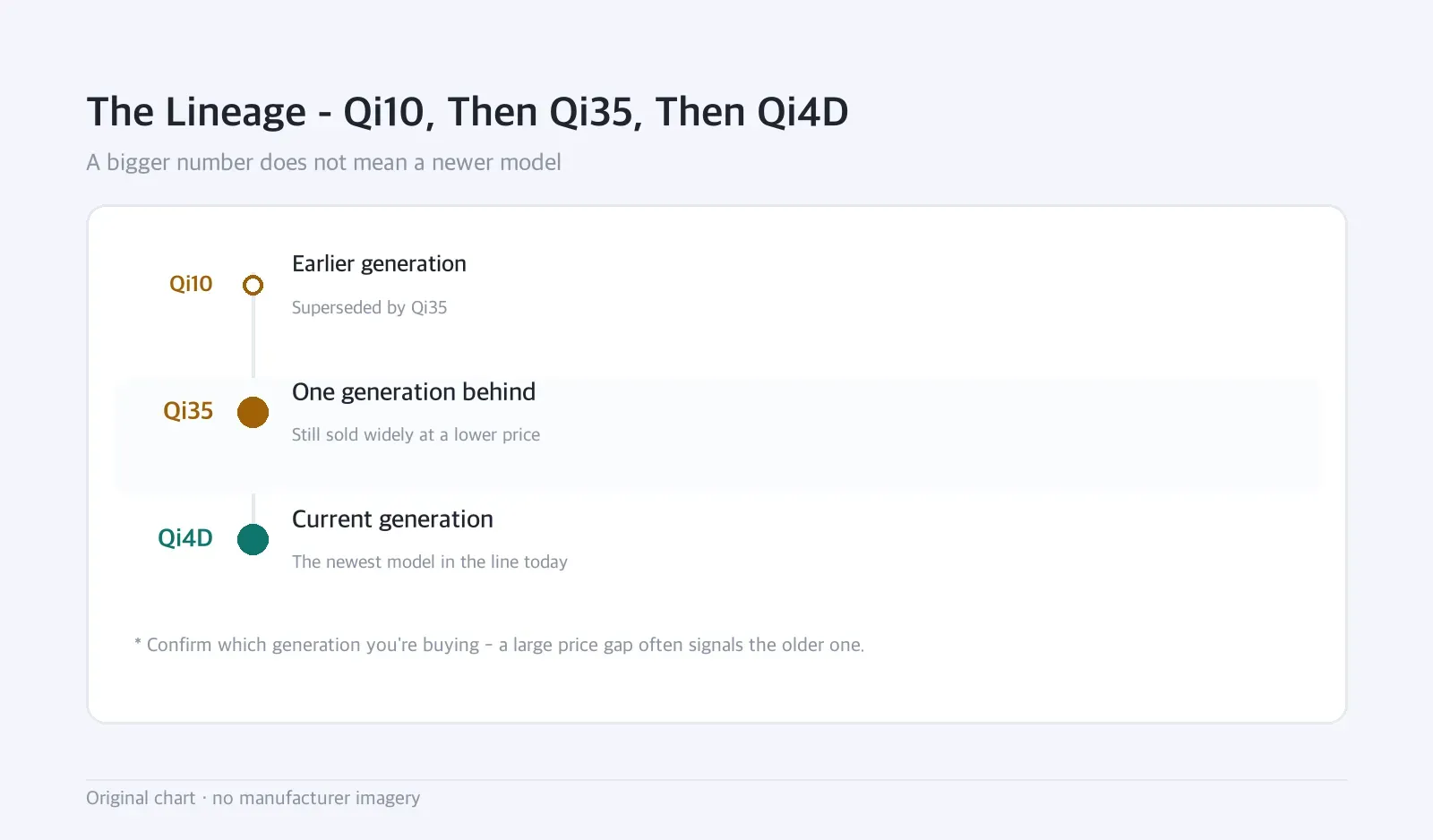
TaylorMade’s current hybrid is the Qi4D. The lineage runs:
- Qi10 → Qi35 → Qi4D
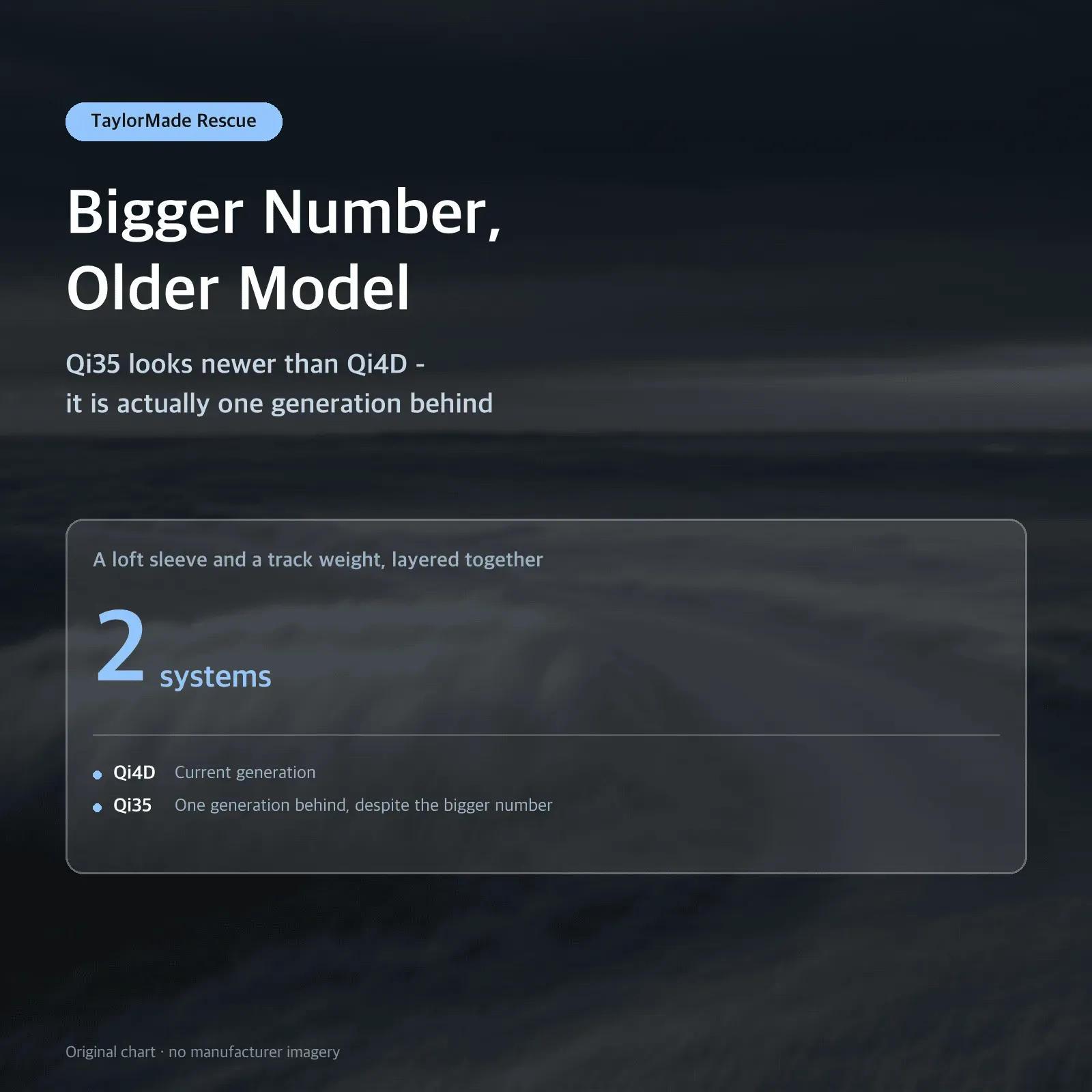
Because the naming isn’t sequential in an obvious way, it’s easy to misread the generation order. A bigger number doesn’t mean newer — Qi4D is the newer model, despite Qi35 carrying the larger-looking number.
Qi35 is now one generation behind. It’s still sold widely at a lower price, which means an older generation can still be moving well in the market. Confirm which generation you’re buying.
2. Three models within the current line
The current Qi4D hybrid lineup has three models:
- Qi4D Rescue — the standard model.
- Qi4D Max Rescue — built with more forgiveness.
- Qi4D Max Lite — the most forgiving in the line, with the highest launch angle.
“Rescue” is TaylorMade’s own name for this club category — it’s the same category as what other brands call a hybrid.
According to TaylorMade Korea’s official spec sheet (taylormadegolf.co.kr, viewed directly in-browser), the lofts are:
- Standard Rescue — #3 19° · #4 22° · #5 25°
- Max Rescue — #3 20° · #4 23° · #5 26°
One inconsistency surfaced on TaylorMade’s own Korean site: the same page’s model-comparison table labels the Max Rescue’s club numbers as “4, 5, 6,” while the spec table for the identical lofts (20°/23°/26°) labels them “3, 4, 5.” The loft values agree; only the club-number label disagrees, within a single manufacturer page. That’s left here as-is rather than resolved in either direction — it isn’t clear which numbering TaylorMade intends as authoritative, and no source ranks one label over the other.
3. Two adjustment systems
| Spec | Standard Rescue | Max Rescue |
|---|---|---|
| Lofts | #3 19deg / #4 22deg / #5 25deg | #3 20deg / #4 23deg / #5 26deg |
| Loft sleeve | 3deg sleeve (+/-1.5deg) | None |
| Lie angle | Published as a range (sleeve moves it) | Published as a single value |
| 8g weight position | Front of head | Back of head |
| Length | 40.25” / 39.75” / 39.25” (shared) | 40.25” / 39.75” / 39.25” (shared) |
Standard Rescue vs. Max Rescue — Per TaylorMade Korea’s official spec sheet. One TaylorMade Korea page also labels the Max Rescue numbers “4, 5, 6” elsewhere — left unresolved.
This club’s defining feature is its adjustment range. There are two systems.
A 3° loft sleeve — moves 1.5° up or down from the stated loft. A 20° head, for example, can be set anywhere from 18.5° to 21.5°. Adjusting the sleeve moves lie angle and face angle along with loft, not loft alone.
An 8-gram track weight — adjusts trajectory, spin, and swingweight.
This is also where the standard Rescue and the Max Rescue diverge structurally, per TaylorMade Korea’s spec sheet:
- Standard Rescue has the loft sleeve, so lie angle is published as a range rather than a single number — 56.5°–60.5° (#3), 57°–61° (#4), 57.5°–61.5° (#5), reflecting the ±1.5° the sleeve can move it. Its 8-gram weight sits at the front of the head.
- Max Rescue has no loft sleeve, so lie angle is published as a single value — 59° (#3), 59.5° (#4), 60° (#5). Its 8-gram weight sits at the back of the head.
Length is shared across both models: 40.25″ (#3), 39.75″ (#4), 39.25″ (#5).
TaylorMade doesn’t explain why the front/back weight split lines up with the sleeve/no-sleeve split, so no reason is asserted here — only that the two facts sit together on the same spec sheet.
On swingweight specifically: it has been reported elsewhere as unpublished, but that description doesn’t hold up against TaylorMade Korea’s own page — it’s listed there under the Korean-language field for “balance,” not under the more commonly searched Korean term for “swingweight.” For the stock REAX 65 shaft, both models list: S flex → D0, SR flex → C9, R flex → C9. Approximate #4-club total weight is 345g (S) / 339g (SR) / 335g (R), with shaft weight around 62g / 56.5g / 53g. Stock grip: 2026 Lamkin Crossline 360, 42.5g.
One practical detail follows from this: the 3° loft range is wide enough to overlap the neighboring loft. Since 20° and 23° are 3° apart, and the adjustment range is also 3°, a single head can reach the boundary of the neighboring loft.
That said, adjusting loft up or down also moves face angle and lie together. Dialing in a matching number doesn’t make the club identical to one built at that loft from the factory. It’s safer to treat the adjustment as fine-tuning rather than a substitute for choosing the right loft to begin with.
4. Compared against other brands
| Brand | Adjustment |
|---|---|
| TaylorMade Qi4D Rescue | 3deg sleeve (+/-1.5deg) plus an 8-gram track weight |
| Ping G440 | +/-1.5deg loft, lie adjustable up to 3deg flat |
| Callaway OptiFit4 | 3deg adjustment, 7 shot-shape settings |
Adjustment Range, Compared Across Brands — similar magnitude, different mechanisms. Ping’s +/-1.5deg and TaylorMade’s 3deg sleeve describe effectively the same range.
Lined up by adjustment range:
- TaylorMade — 3° sleeve (±1.5°) plus an 8-gram weight.
- PING G440 — ±1.5°, lie adjustable up to 3° flat.
- Callaway — OptiFit4 hosel with 3° adjustment and 7 shot-shape settings.
PING’s ±1.5° and TaylorMade’s 3° sleeve are effectively the same range, described with different notation.
By sheer number of combinations, Callaway offers the most. But a wider adjustment range isn’t automatically better — it also means more combinations to test before landing on the right one.
5. Pricing varies significantly by shaft spec
Retail pricing for the same club head varies substantially depending on shaft choice — the gap between a stock shaft and an aftermarket shaft largely accounts for the spread.
That means comparing lowest-price listings against each other can mislead you. Compare within the same shaft specification. Even shafts labeled with the same flex, such as “S,” can differ in weight by as much as 29 grams — worth checking separately from the club itself.
6. So how do you choose
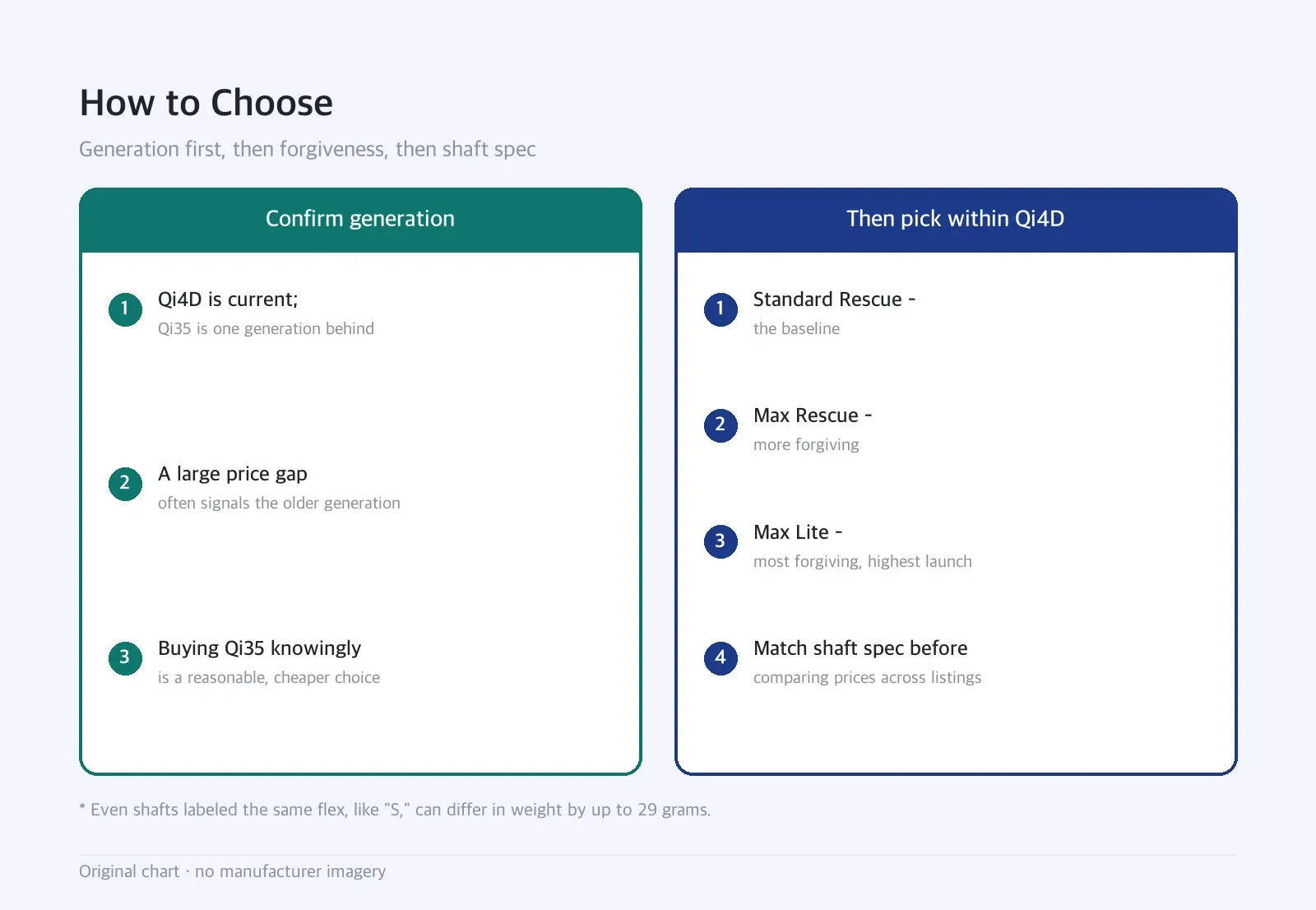
Confirm the generation first. Qi4D is current; Qi35 is one generation behind. A large price gap between listings often signals a generation difference. Buying the older generation at a lower price is a reasonable choice — buying it while believing it’s the newest is a different problem.
Among the three current models, forgiveness is the deciding factor.
- Standard Rescue — the baseline.
- Max Rescue — more forgiving.
- Max Lite — the most forgiving, highest launch. The easiest to hit in the line.
Treat the adjustment range as a safety margin, not a substitute. The 3° sleeve makes it a little easier to commit when you’re torn between two adjacent lofts, but choosing the right loft up front should still come first.
Settle the shaft spec alongside the head. Most of the price spread within this model traces back to shaft choice. Comparing head prices alone without accounting for the shaft isn’t a real comparison.
7. Who this club fits
These are inferences drawn from the confirmed specifications, not a ranking.
- A golfer who wants to fine-tune through adjustment — this line has two separate systems, the loft sleeve and the 8-gram weight.
- A golfer torn between two adjacent lofts — the adjustment range reaches the boundary of the neighboring loft.
- A golfer who prioritizes forgiveness — Max Lite is built to be the most forgiving in the line.
- A golfer also considering a discounted previous-generation model — Qi35 is still in wide circulation one generation back; buying it knowingly can save money.
Cases where the fit runs the other way:
- A golfer judging “newest” by the size of the generation number — the larger-looking Qi35 is actually the older model.
- A golfer expecting the adjustment feature to change shot shape on its own — moving loft also moves face angle and lie together.
- A golfer comparing only the lowest listed price — prices for the same model can vary substantially, largely due to shaft differences.
8. What could not be verified
Loft, length, lie angle, and swingweight (listed under the Korean term for “balance” on the Korean site) for both the standard Rescue and Max Rescue have since been confirmed directly from TaylorMade Korea’s official spec sheet (see §2 and §3). What remains open:
- Max Lite’s spec sheet — lofts, lie angle, length, and swingweight for the Max Lite model specifically were not pulled from an equivalent official page during this pass.
- Head volume across the three models — not listed on the pages reviewed.
- Stated shot-shape bias for each model — no material describing an explicit fade/draw bias, comparable to PING’s, was found.
- Adjustable positions on the 8-gram track weight — the weight’s location (front on standard, back on Max) is confirmed, but the number of discrete slots or positions it can occupy is not.
- Global-market specs — the figures above are from TaylorMade’s Korean site specifically; global (US/other-region) spec sheets were not checked in this pass, and this line has had region-specific naming differences before (e.g., the Z-STAR9 vs. Z-STAR case in this same series of pieces), so no assumption is made that Korean and global specs match.
Summary
The Qi4D Rescue is a club built with two layered adjustment systems, which gives it a wider effective tuning range than the sleeve numbers alone suggest.
The thing to watch most carefully with this brand isn’t performance — it’s the name. Qi35 looks newer than Qi4D by its number, but it’s actually a generation behind. And since pricing for the same model can vary substantially by shaft spec, it’s worth matching specs before comparing prices directly.
The adjustment ranges and loft figures in this piece are drawn only from TaylorMade’s official specifications. Where a figure could not be confirmed, it has been left blank rather than estimated.
Sources
- TaylorMade Korea spec sheet (Qi4D Rescue, Qi4D Max Rescue) — the structural divergence between standard Rescue (loft sleeve, so lie is published as a range) and Max Rescue.
🔴 A naming conflict is left unresolved rather than decided: it is not clear which numbering TaylorMade intends as authoritative, and no source ranks one label over the other.
Both links above were opened directly and confirmed live as of August 2026. Standard Rescue’s page lists lofts 19°/22°/25°, lie ranges 56.5°-60.5°/57°-61°/57.5°-61.5°, length 40.25”/39.75”/39.25”, and swingweight (밸런스) D0/C9/C9 — all matching this piece exactly. Max Rescue’s page lists lofts 20°/23°/26° and lie 59°/59.5°/60° — also matching. The club-number label inconsistency (Max Rescue shown as “4, 5, 6” in one table on the same page) is confirmed present on the live page as well. Items the manufacturer does not publish are named as unconfirmed rather than estimated.