One thing kept getting in the way while looking into zero-torque putters: no numbers. Brands explain the construction but rarely publish the measurements behind it.
🔴 Correction, 30 August 2026. This piece originally attributed 2° of shaft lean and 34mm of onset to the Spider ZT, and treated a “Center Shaft profile” as a second model with half those figures. Both are wrong. Checked against TaylorMade’s own product pages on 30 August 2026: the Spider ZT publishes 25mm of onset and describes its lean only as “slight,” without a figure; the Spider ZT Max is the model that publishes 2° of lean and 34mm of onset. “Center Shaft” is a hosel option offered on both, not a separate model, and the 1° figure this piece gave for it could not be found on any TaylorMade page. The header card carrying the wrong attribution has been removed. The piece below has been corrected.
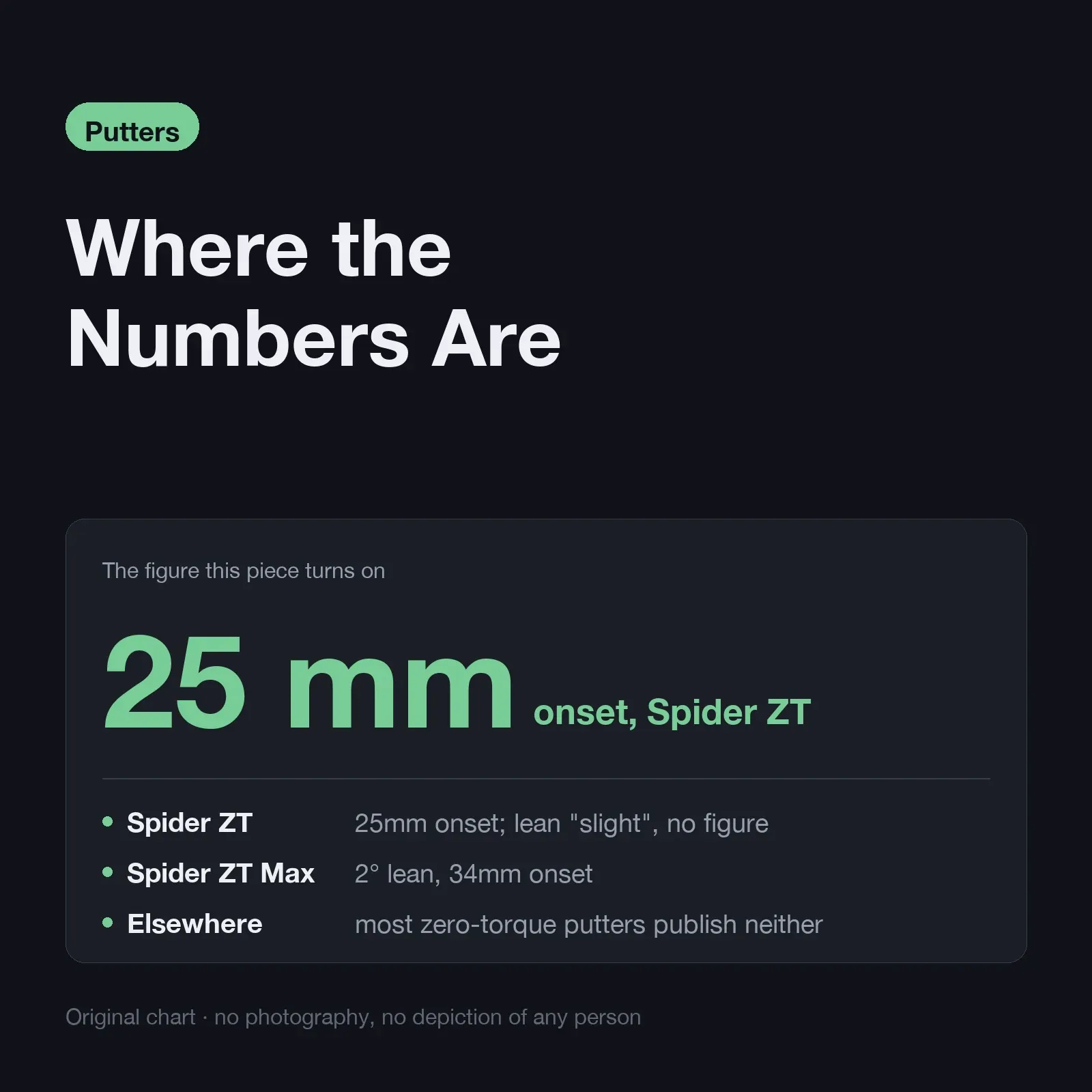
One brand does publish figures, though — just not all of them on the same model. TaylorMade lists 25mm of onset on the Spider ZT, and 2 degrees of shaft lean with 34mm of onset on the Spider ZT Max.
That sounds small, but in this category it’s unusual. Here’s what those figures mean.
1. Spider was originally a mallet name
| Model | Note |
|---|---|
| Spider ZT | The zero-torque model |
| Spider ZT Max | New for 2026, “the next stage of zero torque” |
| Spider Tour Torched | Refreshed for 2026, four head shapes, reworked crown marking |
Spider - a Mallet Line, Now With a ZT Branch — ZT stands for Zero Torque, spelled directly into the name. Tour Torched sits outside the zero-torque family.
Spider is TaylorMade’s flagship mallet putter line. A zero-torque branch was added to it in 2026.
- Spider ZT — the zero-torque model
- Spider ZT Max — new for 2026, introduced as “the next stage of zero torque”
- Spider Tour Torched — refreshed for 2026, torched finish, four head shapes
ZT stands for Zero Torque, spelled directly into the name.
Tour Torched sits outside the zero-torque family. This refresh reworked its crown alignment marking, intended to make aiming easier.
2. Two numbers — shaft lean and onset
| Model | Shaft lean | Onset |
|---|---|---|
| Spider ZT | not published (“slight” forward lean) | 25mm |
| Spider ZT Max | 2 degrees | 34mm |
What TaylorMade actually publishes, model by model. The base ZT gives an onset figure but no lean angle; the Max gives both.
The published figures:
- Spider ZT — 25mm of onset; shaft lean described only as “slight,” with no angle given
- Spider ZT Max — 2 degrees of shaft lean · 34mm of onset
Onset is the distance the face sits back from the shaft axis. At 34mm — 3.4 centimeters — that’s not a small figure relative to a putter head’s front-to-back length.
Shaft lean is the forward tilt of the shaft, which builds a hands-ahead-of-ball address position into the club itself.
Comparing the two shows a direction: the Max, built as the higher-MOI model, carries the larger onset and the only published lean angle. The base ZT sits about a quarter shorter in onset — enough to change the look at address, though TaylorMade does not put a lean figure to it.
3. The shaft is bored toward the toe
| Brand | Approach |
|---|---|
| TaylorMade | Bore near the CG toward the toe, plus lean and onset |
| Odyssey | Center shaft with a coplanar center of gravity |
| L.A.B. Golf | CG precisely on the shaft axis at playing lie angle |
The Shaft Is Bored Toward the Toe — construction, next to how other brands reach zero torque. Onset and lean are added on top to cancel the rotation that remains.
The construction is distinctive. TaylorMade bores the shaft near the center of gravity, angled toward the toe.
On a conventional putter, the shaft rises from the heel side, which places the center of gravity toward the toe relative to the shaft axis and produces rotation.
Moving the shaft entry closer to the center of gravity shrinks that distance. Onset and lean are added on top to cancel the remaining rotation.
Even within zero torque, the approach differs by brand. Odyssey pairs a center shaft with a coplanar center of gravity; L.A.B. places the center of gravity precisely on the shaft axis at playing lie angle. TaylorMade solves it through the combination of bore position, angle, and distance.
4. What it means to have numbers at all
One thing became clear while covering this category: of the brands reviewed here, TaylorMade is the only one that publishes numbers.
That doesn’t mean better performance. It means there’s now something to compare against.
Putter shopping usually runs on feel — you hit it, it feels good, you buy it. That’s not wrong by itself, but if you don’t know why it felt good, the next search starts from zero again.
If 2 degrees of lean and 34mm of onset felt right, that becomes a reference point. Looking at another putter, you can say “this one has less onset” and mean something concrete by it.
That comparison is admittedly partial as long as other brands withhold their numbers. Still, having one reference is better than none.
Iron loft gaps and shaft weights can be compared across brands because those figures sit in official spec sheets. Putters rarely offer that — many models don’t even publish head weight.
That’s part of why putter reviews so often end at “it felt good when I hit it.” There’s usually no number to argue from.
5. How to choose
| Want… | Look at |
|---|---|
| Zero torque | ZT or ZT Max |
| Maximum forgiveness | ZT Max |
| A less unfamiliar address look | Spider ZT (25mm, roughly a quarter less onset than the Max) |
| The familiar Spider feel | Tour Torched |
How to Choose — start by choosing among the three branches. A large onset shifts effective ball position forward — a few swings usually settle it.
Start by choosing among the three branches.
- Want zero torque → ZT or ZT Max
- Want maximum forgiveness → ZT Max is positioned that way
- Want the familiar Spider feel → Tour Torched
If the address look bothers you, check the base Spider ZT rather than the Max. At 25mm of onset it sets up with noticeably less offset than the Max’s 34mm — the middle point if you want the platform without the largest onset. TaylorMade does not publish a lean angle for it.
A large onset shifts effective ball position. With the face pulled back, standing in your usual spot puts the ball relatively farther forward. That’s usually the source of the unfamiliar feel at first; a few swings and an adjusted ball position usually settle it.
If alignment feels difficult, look at Tour Torched. The crown marking is exactly what this refresh reworked.
6. Who this putter is for
Judgment calls based on confirmed specs.
- Golfers who want to shop by numbers — the only brand in this category publishing lean and onset figures
- Golfers who want the platform without the largest onset — the base ZT’s 25mm sits under the Max’s 34mm
- Golfers who prefer a mallet shape — Spider is a mallet line at its core
- Golfers who struggle with alignment — Tour Torched’s reworked crown marking addresses this
It may be less suited for:
- Golfers who want a blade — this line is mallet-focused
- Golfers uncomfortable with a large onset setup — 34mm is not a small figure
- Golfers who use an opening-and-closing face motion — the ZT family is built to remove that motion
7. What we could not confirm
- A published shaft-lean angle for the base Spider ZT — TaylorMade gives only “slight forward shaft lean,” with no number
- Head weight, length, and loft for each model
- The specific differences among the four Tour Torched head shapes
- Measured results of the zero-torque effect — construction is disclosed, but not resulting figures
- What “the next stage of zero torque” specifically refers to — only the phrase itself was confirmed
In one line
Spider ZT eliminates rotation by moving the shaft bore near the center of gravity and adding 2 degrees of lean and 34mm of onset.
The practical significance is that this is nearly the only brand in this category publishing numbers — giving a reference point in a category usually judged on feel alone.
If the onset feels like too much, the base Spider ZT’s 25mm sits under the Max’s 34mm as the middle option.
Figures and construction details here are drawn only from official TaylorMade materials. What we couldn’t confirm is left blank.
Sources
- TaylorMade Spider ZT product page — 25mm of onset; shaft lean described as “slight” with no angle published.
- TaylorMade Spider ZT Max product page — “a 2° shaft lean and 34mm of onset behind the face.”
Both pages were opened in a browser on 30 August 2026 and the figures read off them directly. They are also what established that this piece’s original attribution was wrong — see the correction at the top. Items the manufacturer does not publish are named as unconfirmed rather than estimated.