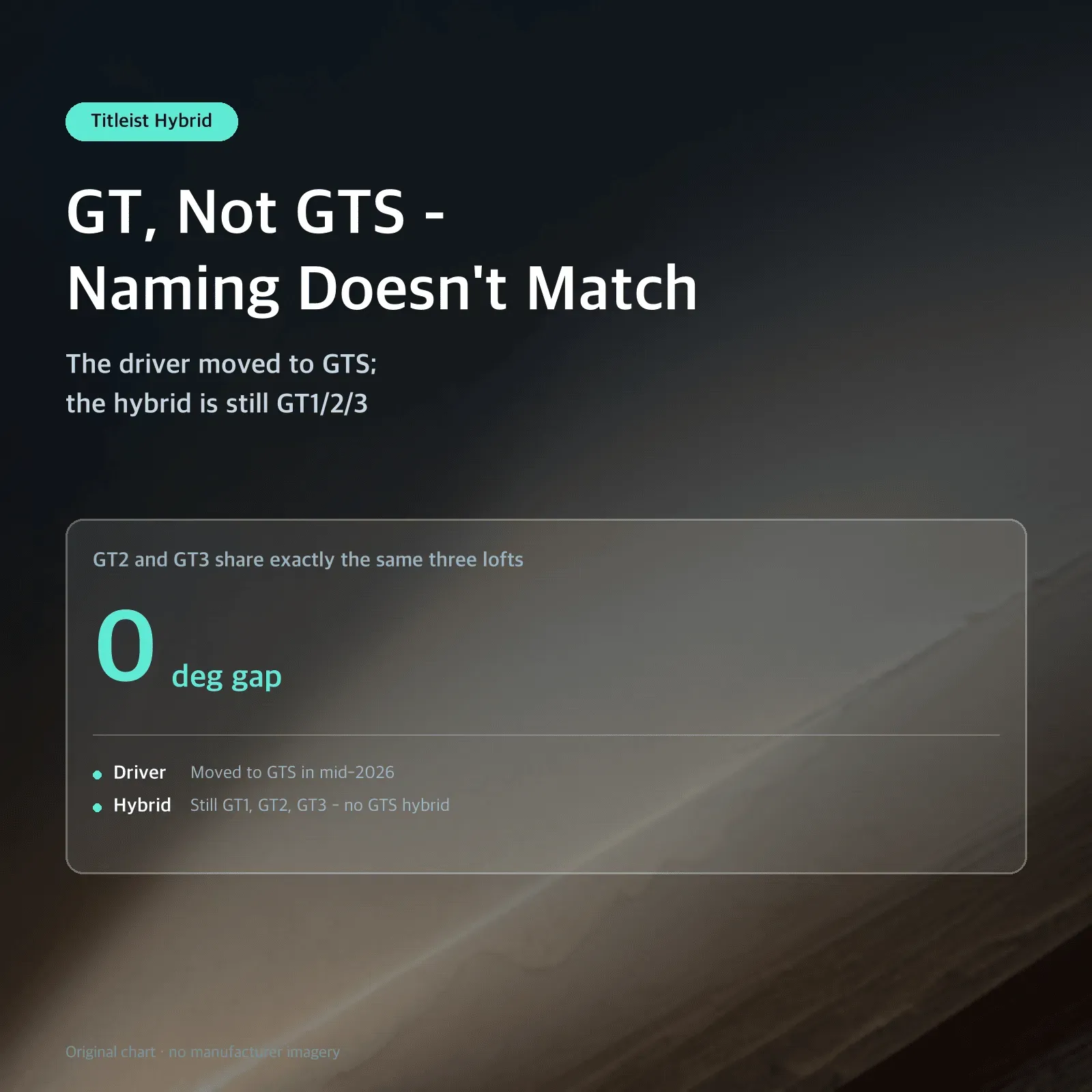
Anyone who’s looked into Titleist drivers recently will recognize the name GTS. The driver line switched from GT to GTS in full in mid-2026.
Search for a matching GTS hybrid, though, and there isn’t one. The hybrids are still GT1, GT2, and GT3. No GTS hybrid has been announced.
Within the same brand, the driver and the hybrid are currently running on different generation names.
1. Sorting out the naming first
| Club | Current name | Notes |
|---|---|---|
| Driver | GTS2 / GTS3 / GTS4 | Retail launch June 11, 2026 |
| Hybrid | GT1 / GT2 / GT3 | Introduced January 2025 - still current |
Sorting Out the Naming First — driver and hybrid currently run different generation names. Search for “GT hybrid,” not “GTS hybrid” — the latter doesn’t exist.
Worth clearing up before anything else, since it’s an easy place to search for the wrong thing.
- Driver — moved from GT to GTS: GTS2, GTS3, GTS4. Retail launch was June 11, 2026.
- Hybrid — still GT1, GT2, GT3, introduced in January 2025.
The naming mismatch doesn’t mean the hybrid line is an outdated leftover. The driver simply moved to a new generation first, while the hybrid continues to be sold as the current line.
When searching, look for GT hybrid — searching for a “GTS hybrid” won’t return the right results.
2. Loft across the three models — GT2 and GT3 are identical
| Model | Lofts |
|---|---|
| GT1 | 18deg / 21deg / 24deg |
| GT2 | 19deg / 21deg / 24deg |
| GT3 | 19deg / 21deg / 24deg |
| GT1 extended | 20deg / 23deg / 26deg / 29deg |
GT2 and GT3 Share Identical Lofts — a loft table alone cannot tell these two apart. Only GT1 differs, at 18deg. What separates GT2 from GT3 is head size and weighting, not loft.
The official lofts:
- GT1 — 18°, 21°, 24°
- GT2 — 19°, 21°, 24°
- GT3 — 19°, 21°, 24°
GT2 and GT3 share exactly the same lofts. All three figures match.
That means a loft table cannot distinguish between these two models. What separates them isn’t loft — it’s head size, weight distribution, and the type of player each is built for.
Only GT1 differs, sitting one degree lower at 18°. GT1 also has a separate extended-loft line built for slower swing speeds: 20°, 23°, 26°, 29°.
Length and lie angle are disclosed for GT1’s extended-loft line and confirm the same pattern seen across other brands — length shortens and lie angle steepens as loft increases:
- GT1 (20°/23°/26°/29°) — length 40.5″ / 40″ / 39.5″ / 39″; lie 57.5° / 58.0° / 58.5° / 59.0°
- GT2 (18°/21°/24°) — length 40.5″ / 40″ / 39.5″; lie 57.0° / 57.5° / 58.0°
- GT3 (19°/21°/24°) — length and lie follow the same pattern as GT2
Swingweight itself is not published anywhere in Titleist’s official materials. Checking the spec table on titleist.com directly — including through the customizer step before final configuration — confirms this isn’t a gap in what we happened to find: there is no swingweight field on the page at all, not merely an unpublished value sitting off to the side. Lie and length get a column; swingweight does not.
3. What stopping at 24° means
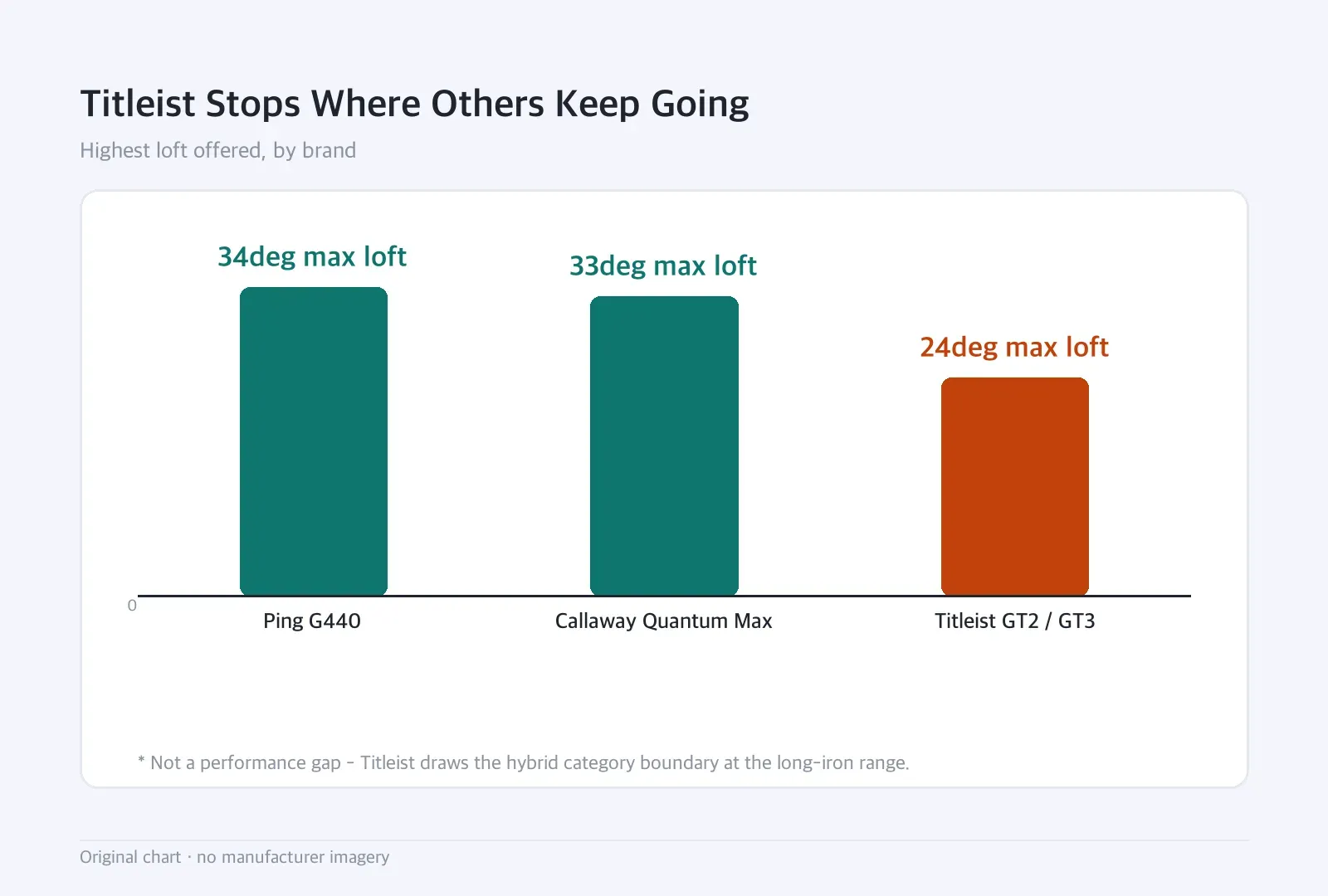
Placed alongside other brands, this line’s character becomes clear.
- PING G440 — six lofts from 17° up to 34°
- Callaway Quantum Max — six lofts from 19° up to 33°
- Titleist GT2, GT3 — three lofts from 19° to 24°
PING and Callaway reach into the middle of an iron set — 34° sits roughly where a 7-iron would be.
Titleist’s line stops at 24°, roughly where a 4-iron sits. That marks the outer boundary of what this company treats as hybrid territory.
This isn’t a difference in performance — it’s a difference in where the category boundary is drawn. But the practical result is clear: if you’re replacing a 6- or 7-iron with a hybrid, this brand doesn’t have one for that job. The GT1 extended line’s 29° is the highest loft on offer.
Put differently, this line is built specifically to fill the gap between fairway wood and long irons — nothing further.
4. What changed from the previous generation
Titleist points to two changes when introducing the GT hybrid line.
Moment of inertia is raised over the previous generation. Higher MOI means the head twists less on off-center hits — more stability and forgiveness.
Flat weight adjustment is new. This lets you shift weight to tune trajectory and shot shape.
Titleist also states the three models are each built for a different type of player. That’s the reason GT2 and GT3 exist side by side despite sharing lofts — the same angle delivered in different ways for different golfers.
5. So how do you choose
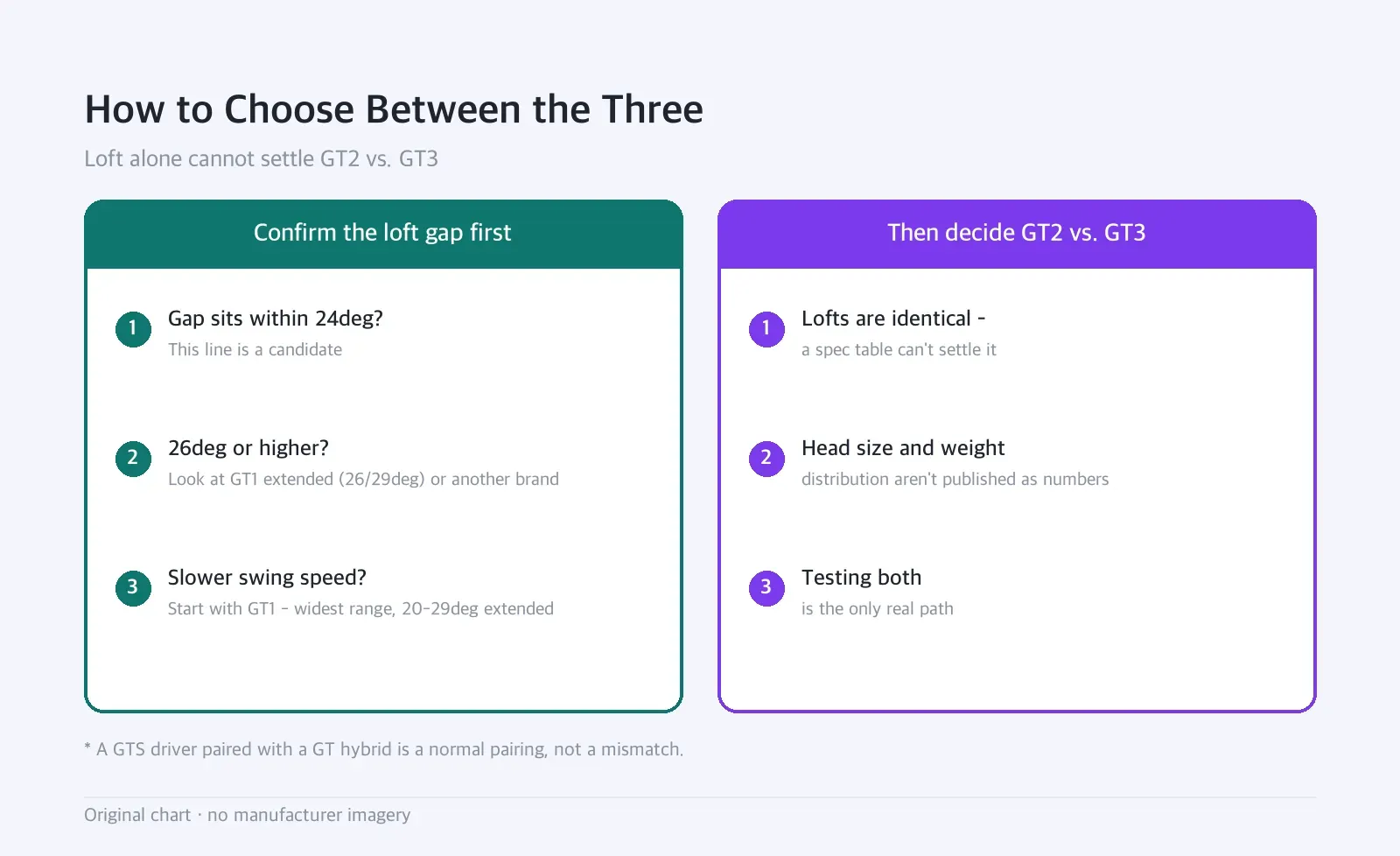
Don’t choose the model based on loft. GT2 and GT3 share identical lofts. Needing 19° does not, by itself, tell you which model to buy.
First, confirm whether the gap you need to fill is within 24°.
- Within 24° — this line is a candidate.
- 26° or higher — look at the GT1 extended line (26° and 29°), or look at a different brand entirely.
Between the three models, testing is the only way to decide. Since the lofts overlap, a spec table can’t settle it. The differences created by head size and weight distribution aren’t published as numbers, so hitting them is the only path.
If your swing speed is on the slower side, start with GT1. It’s the ultra-lightweight build, and its extended line runs from 20° to 29°, the highest lofts available in this brand.
A GTS driver and a GT hybrid is a normal pairing, not a mismatch. The generation names simply differ — the two aren’t out of sync in any functional sense.
6. Who this club fits
These are inferences drawn from the confirmed specifications, not a ranking.
- A golfer looking to fill the gap between fairway wood and long irons specifically — the 19°-24° range is exactly what this line is built around. If that’s the gap you need filled, the narrow range isn’t a drawback.
- A golfer who prioritizes stability on off-center hits — MOI is stated to be higher than the previous generation.
- A golfer who wants to fine-tune trajectory through weight adjustment — flat weight adjustment is new to this generation.
- A golfer with a slower swing speed — GT1’s extended line, at 20° to 29°, is the widest range in this brand’s hybrid lineup.
Cases where the fit runs the other way:
- A golfer looking to replace a 6- or 7-iron — this brand has no hybrid above 30°.
- A golfer trying to pick a model from the loft table alone — GT2 and GT3 share identical lofts, so the table can’t distinguish them.
- A golfer who wants to decide without testing — the factors that separate the three models aren’t published as figures.
7. What could not be confirmed
- The specific factors separating GT1, GT2, and GT3 — head volume and weight distribution figures are not disclosed.
- Swingweight — the GT hybrid spec table has no swingweight field at all, confirmed directly on titleist.com (including through the customizer flow). Length and lie angle are confirmed by loft (see Section 2).
- Whether SureFit hosel adjustment is included — the GT hybrid page carries no SureFit wording anywhere we checked. That’s consistent with the hybrid not carrying a SureFit adapter, but we’re stating only what we found (no mention), not confirming the adapter’s absence as a manufacturer statement.
- A numeric MOI figure — only “higher than the previous generation” is disclosed, with no specific value.
- Hosel adjustment range for loft — flat weight adjustment was confirmed, but the hosel adjustment range itself was not.
- Any plans for a GTS hybrid — nothing has been announced, so this could not be confirmed either way.
Summary
Titleist’s current hybrid is labeled GT, not GTS. Only the driver has moved to the new generation name.
And this line stops at 24°. It’s built specifically to fill the gap between fairway wood and long irons — a good fit if that’s the gap you need, and not a candidate at all if your plan is to replace mid-irons.
The lofts and technology descriptions in this piece are drawn only from Titleist’s official announcements. Where a figure could not be confirmed, it has been left blank rather than estimated.
Sources
- Titleist official hybrid lofts — GT1 at 18°/21°/24°, GT2 and GT3 both at 19°/21°/24°.
🔴 Unpublished, so untestable on paper: the differences created by head size and weight distribution are not given as numbers, which is why the body says hitting them is the only path.
No archived URLs are recorded for these sources in the original research. Everything above is drawn from first-party manufacturer material; items the manufacturer does not publish are named as unconfirmed rather than estimated.