Shopping for a hybrid usually comes down to loft alone — calculate the right number for your set and stop there.
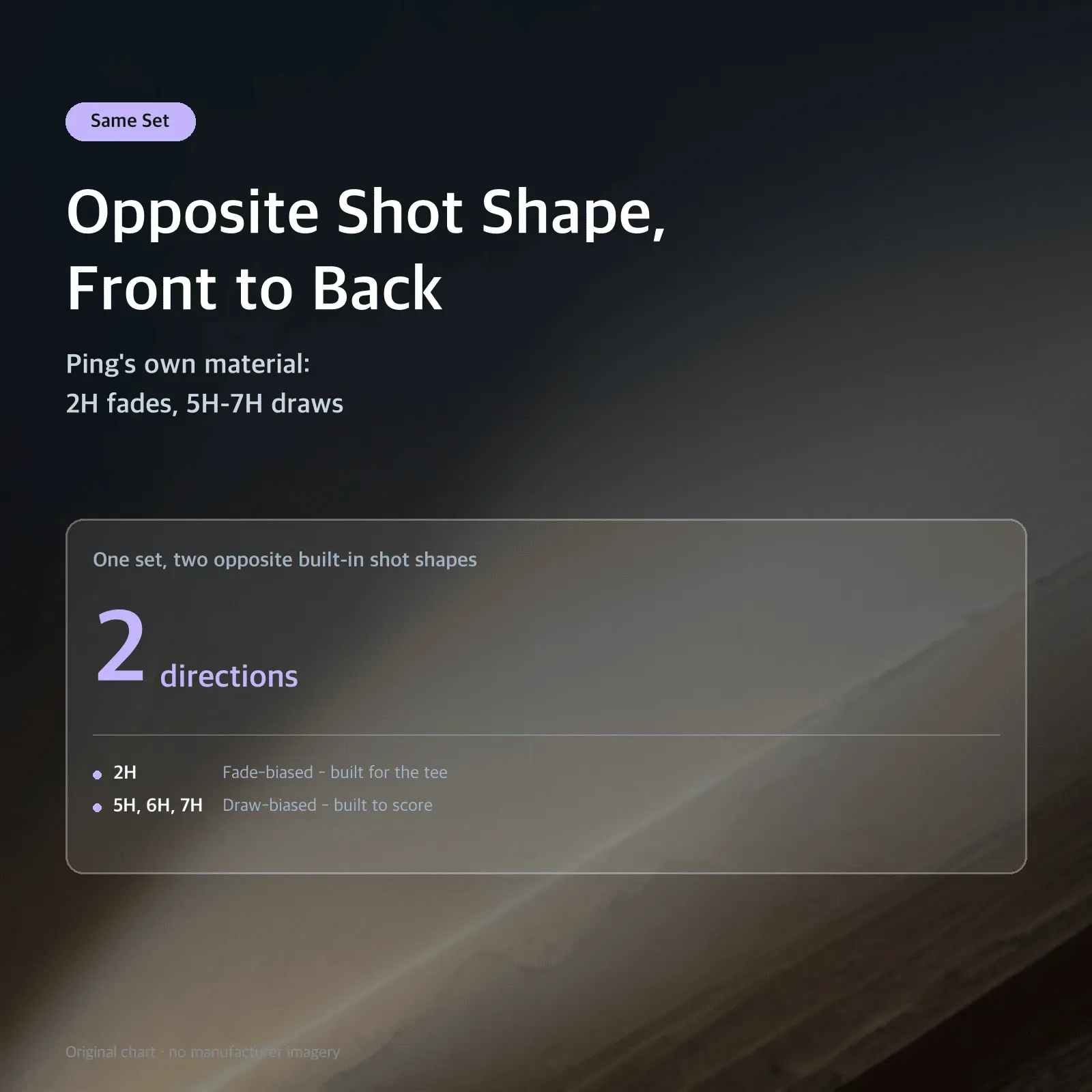
Reading Ping’s official material turns up an unexpected line, though: the 2-hybrid is built fade-biased, while the 5-, 6-, and 7-hybrids are built draw-biased.
Within the same-named set, the low and high numbers are designed in opposite directions.
1. Ping states it designs by number
| Hybrid | Bias | Stated purpose |
|---|---|---|
| 2H | Fade-biased | Lower, penetrating flight - built for the tee |
| 3H, 4H | Neutral | Loft raised - flies higher, holds greens better |
| 5H, 6H, 7H | Draw-biased | Higher, straighter - blends into the iron set |
Ping States It Designs by Number — From Ping’s official G440 hybrid material. Ping calls this “loft-specific design” - each number is a genuinely different build.
This breakdown comes directly from Ping’s official G440 hybrid material:
- 2H — fade-biased. Lower, more penetrating flight, stated as built for the tee.
- 3H, 4H — neutral. Loft raised so the ball flies higher and holds greens better.
- 5H, 6H, 7H — draw-biased. Built to fly higher, straighter, and blend into the iron set.
Ping calls this “loft-specific design” — a stated acknowledgment that each number is a genuinely different build.
2. Why build them opposite
At first glance this seems backwards — you’d expect a set to keep a consistent character throughout.
But look at how each number actually gets used and it lines up.
The 2-hybrid is effectively a driver substitute. Ping states it’s built for the tee. Off the tee, protecting the fairway matters, so a ball that curves left is a problem. Lower, straighter, with a slight bias to the right, is the safer flight there.
The 5-, 6-, and 7-hybrids are approach clubs. These numbers replace an iron, and what’s needed there isn’t safety — it’s height. The ball needs to get up and hold the green. A draw bias is one route to higher launch through added spin axis tilt.
Put together: the low numbers protect against trouble, the high numbers are built to score. Different jobs, different designs.
3. This isn’t Ping-specific
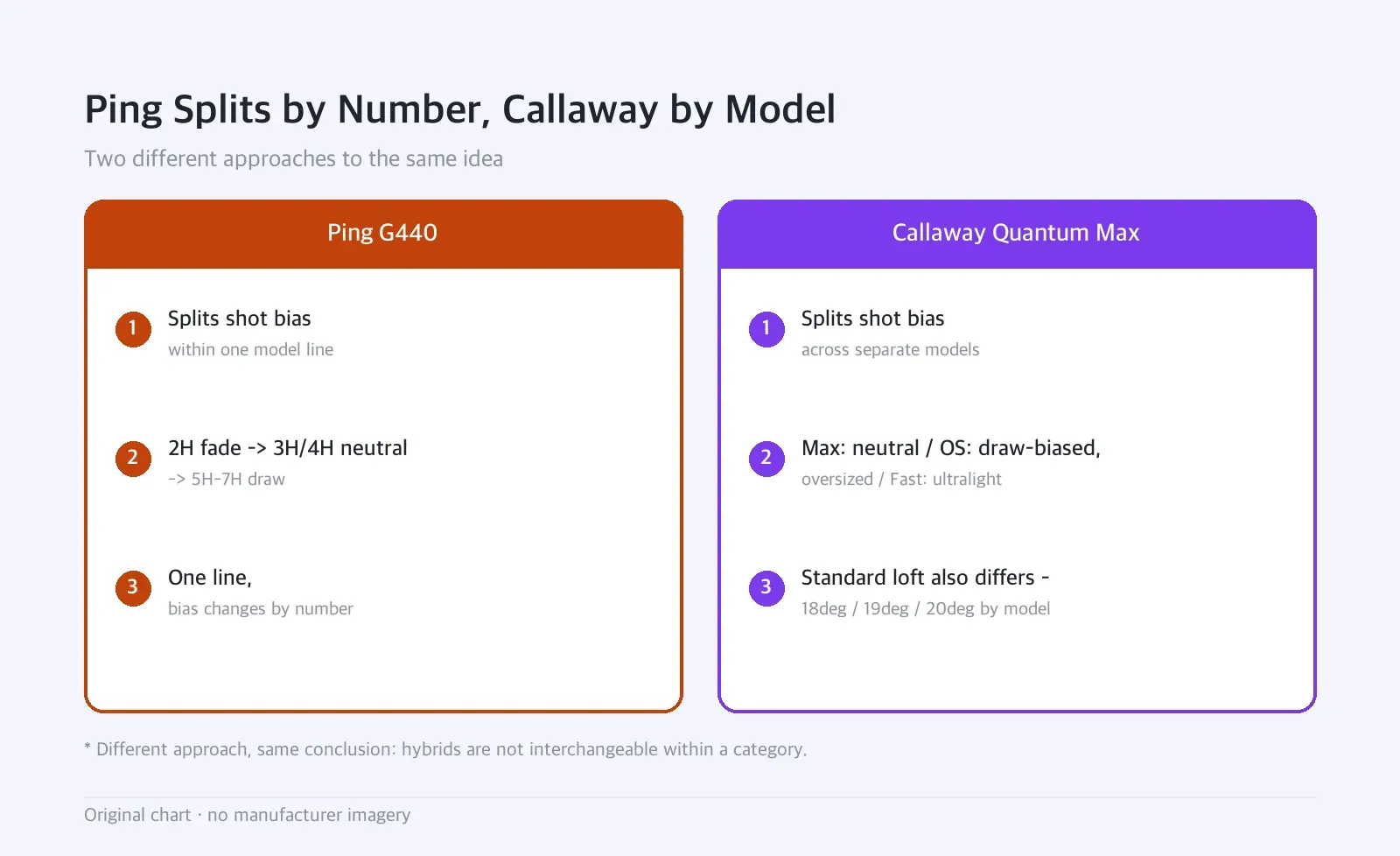
Some brands split shot bias by model instead of by number within one line. Callaway is one of them.
Its Quantum Max hybrid line splits three ways:
- Quantum Max — a neutral, all-around build
- Quantum Max OS — oversized, draw-biased
- Quantum Max Fast — ultralight, aimed at slower swing speeds
On top of that, standard loft differs across all three — 18, 19, and 20 degrees for the three models respectively. Same target zone, offset by a degree between models.
Ping splits by number within one model line; Callaway splits by separate models entirely. The approach differs, but the conclusion is the same: hybrids are not interchangeable within a category.
4. This is a separate question from adjustability
| Model | Adjustment range |
|---|---|
| Ping G440 | Loft +/-1.5deg, lie up to 3deg flatter |
| TaylorMade Qi4D Rescue | 3deg sleeve (1.5deg either side of stated loft) |
| Callaway OptiFit4 | 3deg adjustment, 7 face-angle settings |
A Separate Question From Adjustability — Adjustment fine-tunes; bias is the starting point. Weight placement and head size can’t be changed with a screw - adjustment is fine-tuning.
One place this gets confusing: most current hybrids also carry an adjustable hosel.
- Ping G440 — loft adjustable ±1.5 degrees, lie adjustable up to 3 degrees flatter.
- TaylorMade Qi4D Rescue — a 3-degree sleeve (1.5 degrees either side of stated loft).
- Callaway — OptiFit 4 hosel, 3-degree adjustment with seven face-angle settings.
Adjustment can shift shot shape to a degree — steepen the lie and the ball tends left, flatten it and the ball tends right.
But that’s a different layer from the head’s own design. Where the weight sits and how large the head is can’t be changed with a screw. Adjustment is fine-tuning; bias is the starting point.
Trying to make two clubs with opposite starting biases meet in the middle through adjustment means using up the entire adjustment range. It’s usually more efficient to start with the right build.
5. So what to look for when choosing
| Situation | What to do |
|---|---|
| Keeping the ball in play off the tee | Look at the lower numbers - fade bias is built for this |
| Attacking greens | Look at the higher numbers - draw bias, higher launch |
| Common miss curves left | A draw-biased model can make that miss worse |
| Carrying two hybrids | Expect the biases to differ - don’t assume a matched feel |
| Unsure | Start neutral: Ping 3H/4H, or Callaway’s standard Quantum Max |
What to Look for When Choosing — Match the bias to where you’ll actually use the club. Save the models with a pronounced bias for once you’ve confirmed you actually need that bias.
First, decide where you’ll actually use this club.
If it’s for keeping the ball in play off the tee, look at the lower numbers. A fade bias is built for exactly that job.
If it’s for attacking greens, look at the higher numbers. Draw bias and a higher launch are built for that side.
Then check whether it matches your own miss.
This part matters. A golfer whose common miss curves left will make that miss worse with a draw-biased model. A golfer whose common miss drifts right may find a draw bias actually helps.
By the same logic, a golfer whose problem is a left miss may actually find the 2-hybrid’s fade bias more comfortable.
If you’re carrying two hybrids, expect the biases to differ.
Pairing a 3H and a 6H, for instance, means pairing a neutral club with a draw-biased one. Don’t expect them to feel the same in hand.
If you’re unsure, start neutral. For Ping that’s the 3H/4H; for Callaway, the standard Quantum Max. Save the models with a pronounced bias for once you’ve confirmed you actually need that bias.
6. Who this is useful for
Useful for golfers planning to use a hybrid off the tee — Ping states its 2H is designed for exactly that, with a low, penetrating flight and fade bias.
Useful for golfers replacing a 5- through 7-iron — that range is built draw-biased with a higher launch, aimed specifically at getting the ball up higher than the iron would.
Useful for golfers whose common miss curves left — a draw-biased model is worth avoiding. Callaway’s Max OS sits in that category.
Useful for golfers carrying more than one hybrid — worth knowing bias can differ by number before combining clubs.
Less useful for golfers assuming adjustability will fix any mismatch — adjustment is fine-tuning. Weight placement and head size don’t change.
Less useful for golfers trying to compare bias across brands directly — Ping splits by number, Callaway by model. The comparison frameworks don’t line up on a shared table.
7. What we could not confirm
- The magnitude of the bias — brands disclose direction (“fade-biased,” “draw-biased”) but not how many yards that translates to.
- Specific weight-placement figures — where exactly, and how many grams, is mostly undisclosed.
- Titleist’s GT1/GT2/GT3 bias distinctions — their lofts overlap, and what differentiates them could not be confirmed.
- Bias direction across TaylorMade’s Qi4D lineup — not confirmed.
- How much lie-angle adjustment actually affects shot shape — direction is known; magnitude is not.
In one line
Two hybrids of different numbers don’t just differ in loft — they can be built for different shot shapes entirely. The low numbers protect against trouble off the tee; the high numbers are built to score.
Getting the loft math right isn’t the end of the decision. Check which direction that number was designed toward, and whether it lines up with — or fights against — your own miss.
Sources
- Ping official G440 hybrid material — Ping’s own statement that it designs bias by number (2H fade-biased; 5H, 6H, 7H draw-biased).
No archived URLs are recorded for these sources in the original research. Items the source does not publish are named as unconfirmed rather than estimated.