The numbers on a hybrid — 3H, 4H — follow iron numbering. A 3-hybrid is meant to stand in for a 3-iron.
Reading Ping’s official spec sheet turns up an unexpected column, though. Next to loft, length, and lie angle sits a “matching wood” column — and starting at the 5-hybrid, that column is blank.
Not an omission. There simply isn’t a wood to put there.
1. Manufacturers publish the matching table directly
| Hybrid | Loft | Matching iron | Matching wood |
|---|---|---|---|
| 2H | 17.0deg | 2-iron | 5-wood |
| 3H | 20.0deg | 3-iron | 7-wood |
| 4H | 23.0deg | 4-iron | 9-wood |
| 5H | 26.0deg | 5-iron | none |
| 6H | 30.0deg | 6-iron | none |
| 7H | 34.0deg | 7-iron | none |
Ping G440 - Matching Iron and Wood — Loft, matching iron, and matching wood, as published. The first three list a matching wood; the last three do not - no wood covers that loft range.
Ping’s official G440 hybrid spec sheet lists two extra columns next to loft, length, and lie angle: “matching iron” and “matching wood.”
- 2H — 17.0° · 2-iron · 5-wood
- 3H — 20.0° · 3-iron · 7-wood
- 4H — 23.0° · 4-iron · 9-wood
- 5H — 26.0° · 5-iron · none
- 6H — 30.0° · 6-iron · none
- 7H — 34.0° · 7-iron · none
The first three have a matching wood listed. The last three don’t — there’s no wood alternative for that range.
2. Why there’s no wood past the 5-hybrid
A wood has a large head with the center of gravity set back. That geometry can’t push loft up indefinitely. Fairway woods commonly go up to 9-wood; an 11-wood or 13-wood isn’t a standard product.
Meanwhile, 26 to 34 degrees is an awkward zone for irons. A 5- to 7-iron isn’t as long as a true long iron, but it’s still long enough, and getting the ball to hold a green with one, isn’t easy for most golfers.
That gap sat open, and the hybrid moved in to fill it. So numbers like 6H and 7H aren’t wood replacements — they’re iron replacements. Same “hybrid” name, different role from the lower-numbered hybrids.
3. Loft spacing widens toward the higher numbers
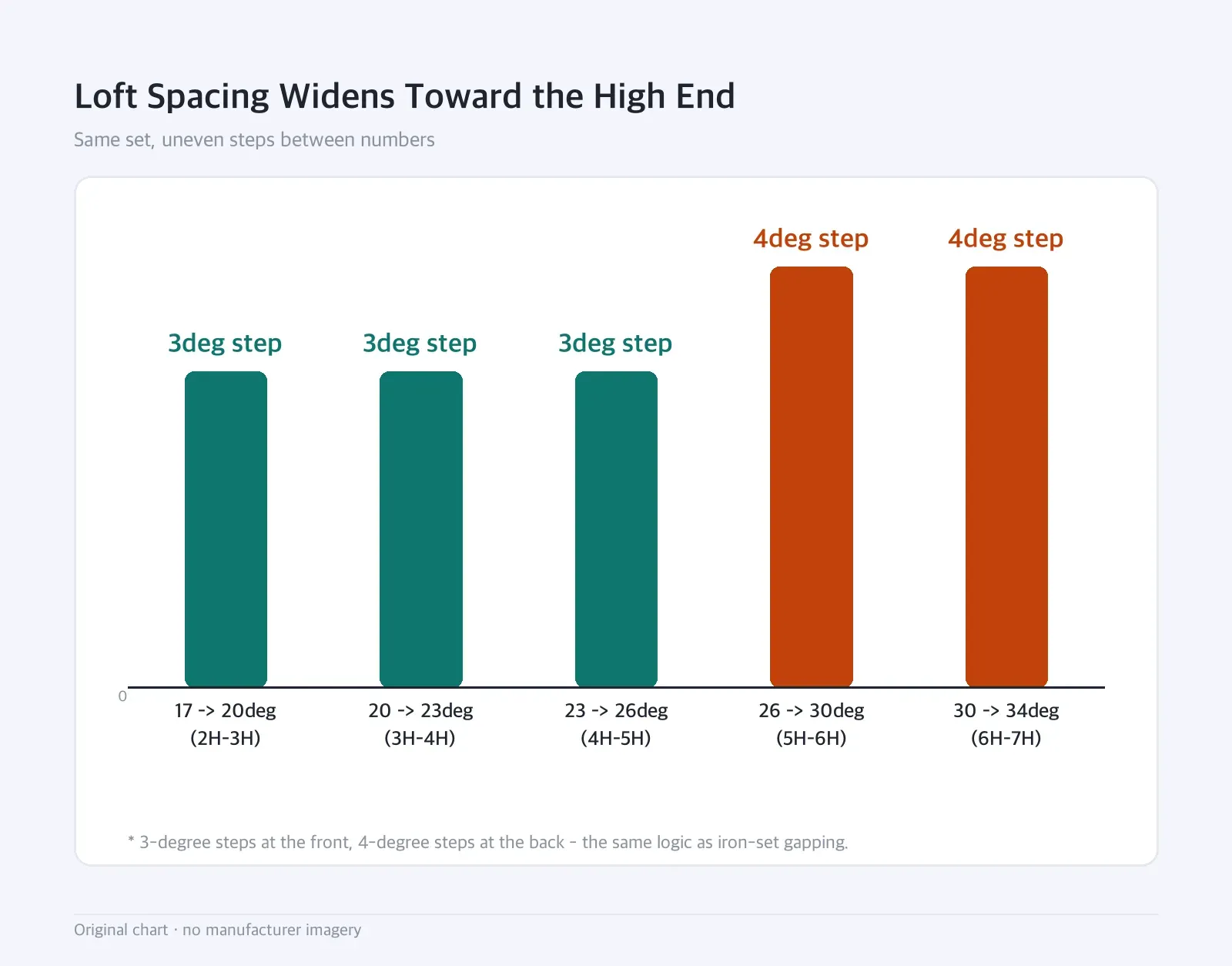
Line up the G440’s lofts in order and the spacing isn’t even.
- 17 → 20 → 23 → 26° — 3° steps
- 26 → 30 → 34° — 4° steps
Tight at the front, wider at the back.
At lower lofts, a single degree makes a bigger difference in distance, so the spacing is tighter. As loft climbs, that same one-degree difference matters less, so the spacing can widen.
The same thing happens in iron sets — long irons stepping 3 degrees apart, short irons stepping 4. Hybrids follow the same rule.
4. Length and lie angle are exactly consistent
| Hybrid | Length | Lie angle |
|---|---|---|
| 2H | 40 3/4” | 57.0deg |
| 3H | 40 1/4” | 57.5deg |
| 4H | 39 3/4” | 58.0deg |
| 5H | 39 1/4” | 58.5deg |
| 6H | 38 3/4” | 59.0deg |
| 7H | 38 1/4” | 59.5deg |
Length and Lie - Perfectly Regular — Unlike loft, these two specs step evenly at every number. Exactly half an inch shorter and 0.5deg more upright at every step. Swingweight is D1 throughout.
The loft spacing is uneven, but the other two specs are strikingly regular.
- Length shortens by exactly half an inch per step, from 40 3/4 inches down to 38 1/4 inches.
- Lie angle upright by exactly 0.5 degrees per step, from 57.0 to 59.5 degrees.
Getting shorter and more upright as the number climbs follows the same principle as an iron set. A shorter club naturally sets you closer to the ball, and standing closer means the club has to sit more upright for the sole to match the ground.
Swingweight is also held constant, D1 across every number. Different lofts, same weight-in-hand.
5. But this table differs by brand
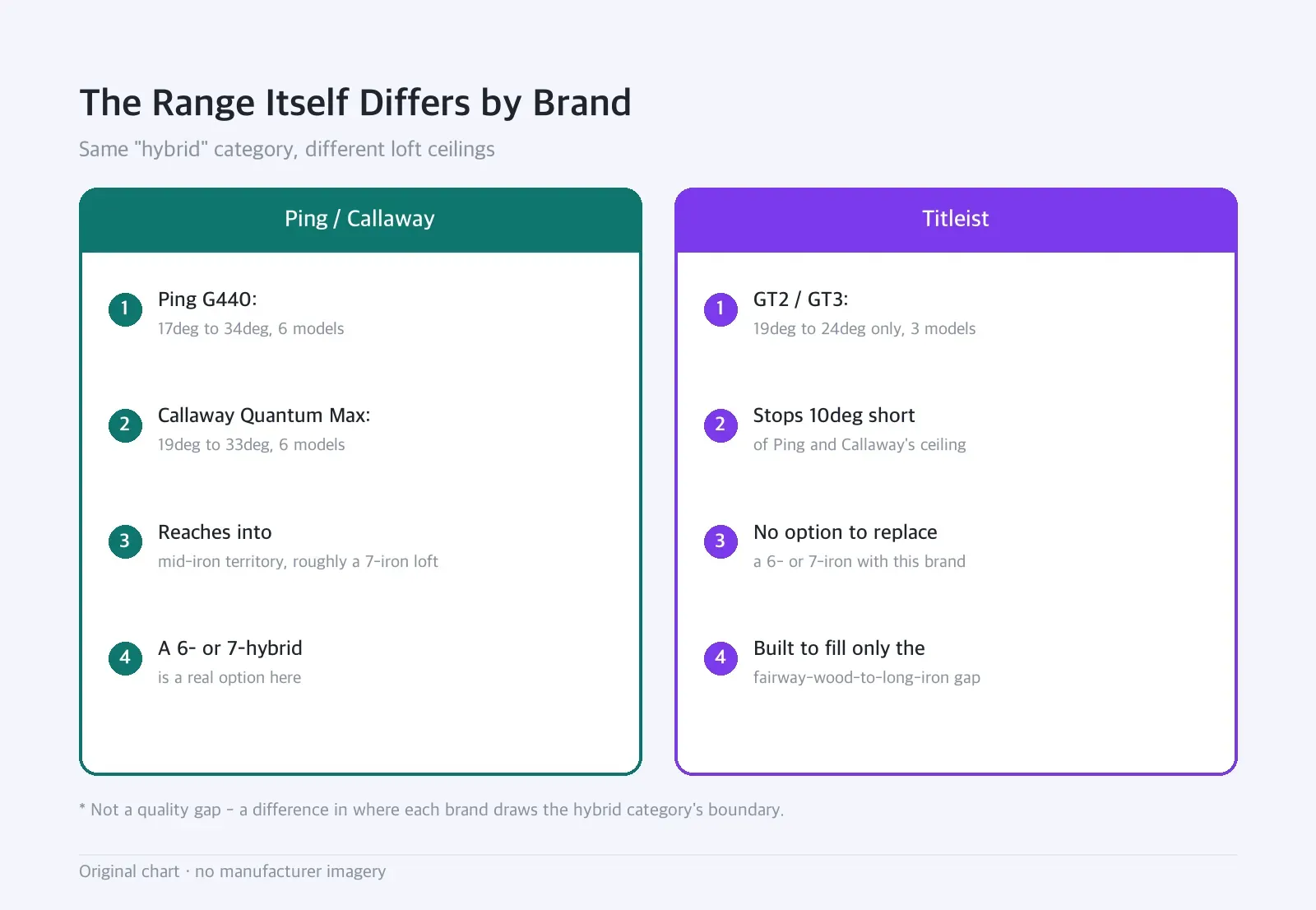
Everything above is Ping. Move to another brand and the range itself changes.
- Ping G440 — 17° to 34°, six models
- Callaway Quantum Max — 19° to 33°, six models
- Titleist GT2 / GT3 — 19° to 24° only, three models
Titleist stops at 24 degrees, ten degrees short of where Ping and Callaway reach.
This isn’t a quality gap — it’s a difference in where each brand draws the category’s boundary. The result is clear either way: Titleist’s mainline hybrids offer no option to replace a 6- or 7-iron. For that range, you have to look at another brand.
6. So how do you choose a number
| Situation | What to do |
|---|---|
| Gap between 3-wood and irons | A 3H or 4H fills the empty slot |
| A long iron won’t get airborne | Swap that number directly for the same-number hybrid |
| Considering 6H or 7H | This ends your iron set there - a set-composition call, not a preference |
| Torn between two neighboring numbers | Check whether the loft-adjustment ranges overlap |
How to Choose a Number — Start from the gap in your own set, not the catalog. Ping’s G440 adjusts +/-1.5deg; TaylorMade and Callaway offer 3-degree sleeves.
Start by finding the empty slot in your current set.
The most common gap sits between your fairway wood and your irons. If your 3-wood is followed by a 5-iron, that’s an open gap — a 3H or 4H fills it.
If a long iron isn’t cooperating, swap the number directly.
If your 4-iron won’t get airborne, a 4-hybrid steps into the same slot. Loft is matched closely enough that you shouldn’t have to rework your distance plan.
Past the 5-hybrid, the question is how many irons you’re willing to drop.
Adding a 6H or 7H means ending your iron set at the 6- or 7-iron. That’s a set-composition decision, not a preference, so it’s worth starting with a 4-hybrid and judging from there rather than deciding all at once.
If your hybrid has loft adjustment, you can worry less about the printed number. Ping’s G440 adjusts ±1.5 degrees; TaylorMade and Callaway offer 3-degree sleeves. A 20-degree hybrid can be run at 21.5 degrees, so if you’re torn between two neighboring numbers, check whether the adjustment ranges overlap.
7. Who this is useful for
Useful for golfers with a gap between their fairway wood and irons — 2H through 4H are aimed at exactly that range, and the matching-wood column makes clear what each is replacing.
Useful for golfers whose 5- through 7-irons won’t hold a green — that range has no wood alternative. A hybrid is the only real option.
Useful for golfers rebuilding a set from scratch — half-inch length steps, 0.5-degree lie steps, and a fixed D1 swingweight carry the same logic through as an iron set.
Useful for golfers who’ve already picked a brand — Titleist’s range stops at 24 degrees. If you need anything below that, the brand choice needs revisiting first.
Less useful for golfers comparing brands by number alone — the same “3H” sits at 19 degrees for one brand and 20 for another.
Less useful for golfers hoping one hybrid covers multiple gaps — adjustment ranges from ±1.5 to 3 degrees. One club won’t fill two slots.
8. What we could not confirm
- Matching-iron labeling from other major brands — confirmed on Ping’s official spec sheet only.
- Full length and lie-angle tables from other brands — confirmed for Ping only.
- Measured distance gaps between hybrids and irons — varies too much by tester and conditions to cite.
- Other manufacturers’ current hybrid line loft ranges beyond those listed here — not confirmed, so left out.
In one line
Hybrid numbers follow iron numbers, and the lower numbers can be replaced by a wood — but past 5, there’s nothing but the hybrid itself.
So choose by finding the empty slot in your own set, not by catalog order. And if that slot sits above 26 degrees, know going in that your options are narrower than they look.
Sources
- PING G440 Hybrid — official spec page — confirms every figure in this piece: the 2H–7H loft table (17.0°–34.0°), the matching-iron and matching-wood columns, the half-inch length steps, the 0.5° lie-angle steps, and the constant D1 swingweight. Live as of this check.