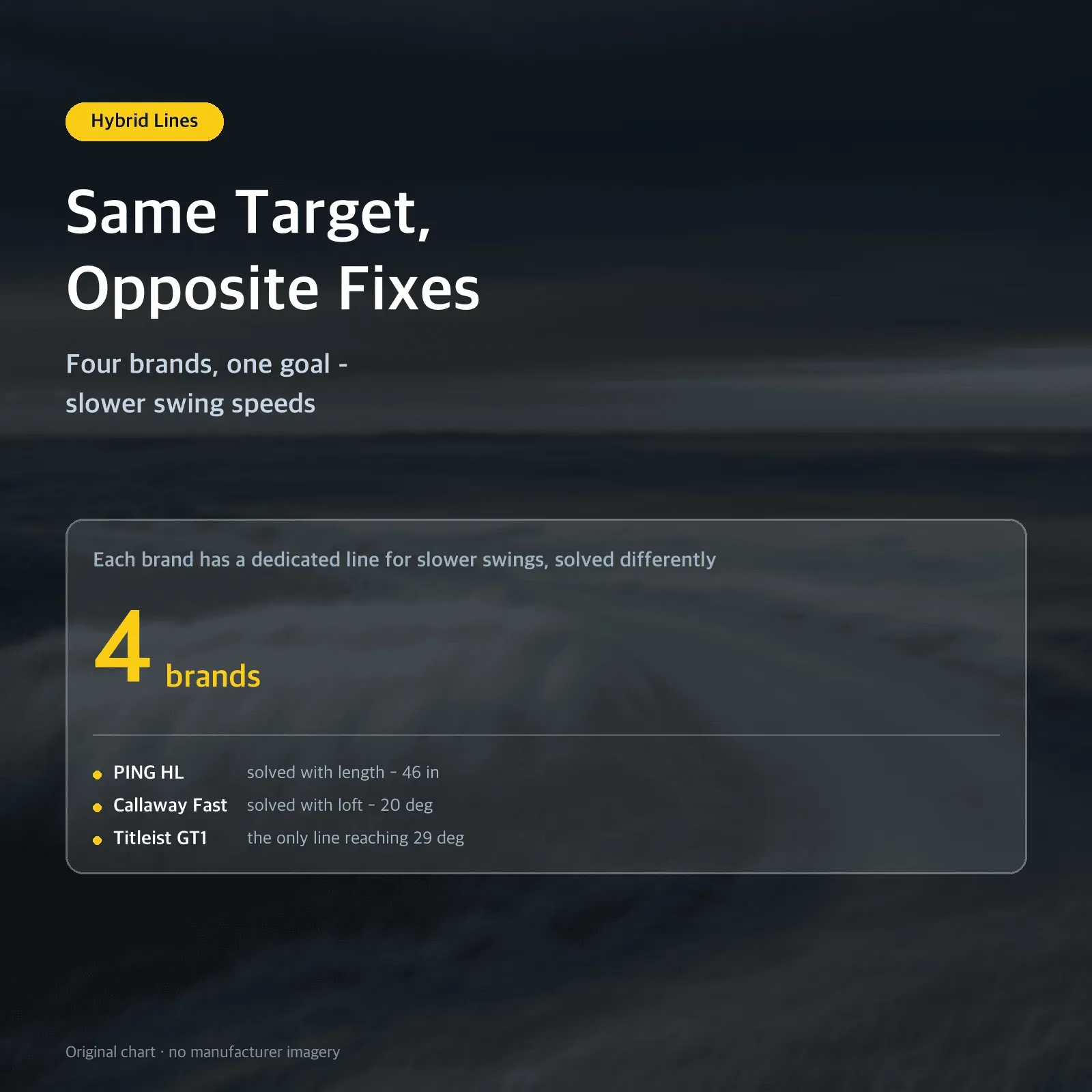
Going through hybrid lineups turned up a shared pattern. Each brand names it differently, but each has a dedicated model aimed at the same target.
PING calls it HL, Callaway calls it Max Fast, TaylorMade calls it Max Lite. Titleist’s closest equivalent is GT1.
All of them are pitched at golfers with slower swing speeds. But they solve the same problem in different ways.
1. The line from each brand
| Brand | Line name |
|---|---|
| PING | G440 HL (High Launch) |
| Callaway | Quantum Max Fast |
| TaylorMade | Qi4D Max Lite |
| Titleist | GT1 (plus an extended-loft line) |
The Line From Each Brand — Different names, same target: slower swing speeds. HL points to launch angle, “Fast” to speed, “Lite” to weight - same target, different emphasis.
Names first.
- PING — G440 HL (High Launch)
- Callaway — Quantum Max Fast
- TaylorMade — Qi4D Max Lite
- Titleist — GT1 (plus an extended-loft line)
The words in each name reveal the approach. HL points to launch angle, “Fast” points to speed, “Lite” points to weight. Same target, different emphasis.
2. PING HL — solved with length
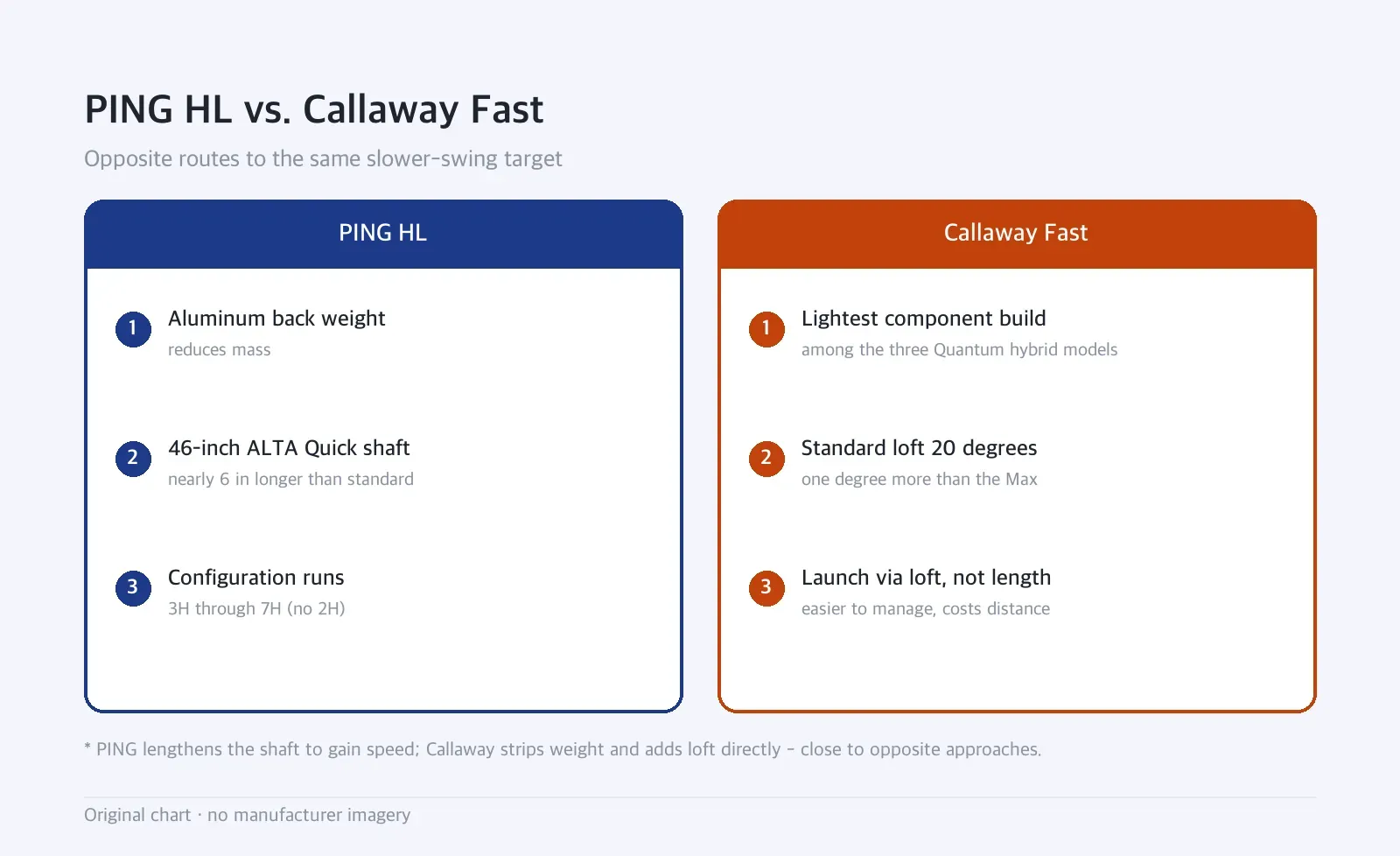
PING’s G440 HL differs clearly from the standard line in its build.
- Aluminum back weight — reduces mass
- 46-inch ALTA Quick shaft
- Lamkin UTx Lite grip
- Configuration runs 3H through 7H
The 46-inch length stands out. Compared with the standard G440 hybrid’s roughly 40.25-inch 3H, that’s nearly six inches longer — closer to driver length.
A longer club makes it easier to gain head speed: the same swing effort traces a wider arc, so speed goes up. The trade-off is control — it gets harder to manage.
Dropping the 2H model from this line also tracks. 17 degrees is a loft that’s hard to launch without enough speed behind it, which doesn’t fit this line’s target golfer to begin with.
3. Callaway Fast — solved with loft
| Brand | How it diverges |
|---|---|
| PING | Lengthens the shaft to gain more speed (46 in) |
| Callaway | Adds a degree of loft to launch directly (20 deg) |
| TaylorMade | Raises both forgiveness and launch angle together |
| Titleist | Widens the loft line itself (up to 29 deg) |
What Each Brand Fills In From the Baseline — All four brands cut weight - the shared strategy - then diverge from there. Going the length route gains distance but adds difficulty; going the loft route gets easier but costs distance.
Callaway’s Quantum Max Fast takes a different route.
- The lightest component build among the three models
- Standard loft of 20 degrees — one degree more than the Max (19 degrees), two more than the Max OS (18 degrees)
Build it light to gain speed, then add a degree of loft to boost launch directly.
Where PING adds length to generate speed and launch that way, Callaway strips weight and adds loft directly. Same target, close to opposite approach.
Launching via loft is easier to manage — the club doesn’t get longer, so there’s less room for the swing to go off track. The trade-off is distance: more loft costs yards.
4. TaylorMade and Titleist
TaylorMade’s Qi4D Max Lite is described as the most forgiving model in the line with the highest launch angle. True to its name, it leads with lightness.
Titleist’s GT1 is an ultra-lightweight build and the only model in the brand with an extended-loft line — 20, 23, 26, and 29 degrees.
Titleist’s standard hybrid line stops at 24 degrees, but the GT1 extended line alone reaches up to 29. If a Titleist golfer needs a higher loft, GT1 is the only path.
In other words, the slow-swing line doubles as “the only line with high lofts available.”
5. What’s shared and what’s different
| Item | Status |
|---|---|
| PING HL’s specific lofts | Only the 3H-7H configuration confirmed |
| Callaway Max Fast’s full loft range | Only the standard 20 degrees confirmed |
| TaylorMade Max Lite’s loft and weight | Not confirmed |
| Specific swing-speed threshold per brand | None stated beyond “for slower swings” |
What We Could Not Confirm — Left blank rather than filled by guesswork. Brands describe these lines as “light” without publishing gram figures in most cases.
Lined up together, the four brands sort into this pattern.
Shared — all four cut weight. Making components lighter so the same swing effort produces more speed is the baseline strategy for all of them.
Where they diverge — how each one fills in from there.
- PING — lengthens the shaft to gain more speed (46 inches)
- Callaway — adds a degree of loft to launch directly (20 degrees)
- TaylorMade — raises both forgiveness and launch angle together
- Titleist — widens the loft line itself (up to 29 degrees)
Going the length route gains distance but adds difficulty. Going the loft route gets easier but costs distance. Neither is free.
6. How to choose
Start by identifying what’s actually missing. “Slow swing” as a label hides several different problems.
- If the ball isn’t launching — go the loft route: Callaway Fast or Titleist’s GT1 extended line.
- If distance is the shortfall — go the speed route: PING HL’s 46-inch build.
- If mishits are the issue — go the forgiveness route: TaylorMade Max Lite.
Check whether a longer shaft is manageable first. 46 inches is driver length. If the driver itself is already hard to control, adding that length to a hybrid can compound the problem.
A lighter shaft on the standard line is also an option. Even without a dedicated line, swapping in a lighter shaft alone can produce a similar effect, though the head’s weight distribution stays the same.
Choosing loft to launch means giving up distance. A ball launched with 20 degrees generally travels shorter than one launched with 18. Knowing that trade-off up front makes the choice easier.
7. Who this comparison is useful for
Judgment criteria inferred from confirmed specs.
- Golfers with a below-average driver swing speed — all four brands offer a dedicated line here. The field is wider than it might seem.
- Golfers whose ball doesn’t launch high enough — the loft-based route (Callaway Fast, Titleist GT1) fits the problem.
- Golfers looking to gain distance — PING HL’s 46-inch build points that direction, with the trade-off being harder control.
- Golfers looking for high loft within Titleist’s line — GT1’s extended line is the only path (up to 29 degrees).
This is less useful for:
- Golfers who find long clubs unwieldy — PING HL’s default length is 46 inches.
- Golfers unwilling to give up any distance — the loft-based approach costs yardage by design.
- Golfers put off by the “slow swing” label — it’s just a label; the underlying design is built to launch more easily either way.
8. What we could not confirm
- PING HL’s specific lofts — only the 3H–7H configuration was confirmed.
- Callaway Max Fast’s full loft range — only the standard 20 degrees was confirmed.
- TaylorMade Max Lite’s loft and weight — could not be confirmed.
- Total weight for each line — brands describe them as “light” without publishing gram figures in most cases.
- The specific swing-speed threshold each brand targets — none of the brands stated a specific mph figure beyond “for slower swings.”
- The actual speed gain from added length — omitted, since this varies by measurement conditions.
In one line
All four brands have a dedicated line for slower swings, split between gaining speed through length and launching directly through loft.
So choosing on the “slow swing” label alone can send you the wrong direction. Figure out first whether the problem is the ball not launching or a lack of distance, and the right answer becomes clear.
Specs and configurations in this piece come only from confirmed official manufacturer descriptions. Where a value could not be confirmed, it was left blank.
Sources
- Confirmed official manufacturer descriptions only — specs and configurations in this piece come from no other source.
No archived URLs are recorded for these sources in the original research. Items the source does not publish are named as unconfirmed rather than estimated.