There’s a line you run into constantly when researching TaylorMade’s P790: “the loft is strong, so it flies far.” We took that at face value too.
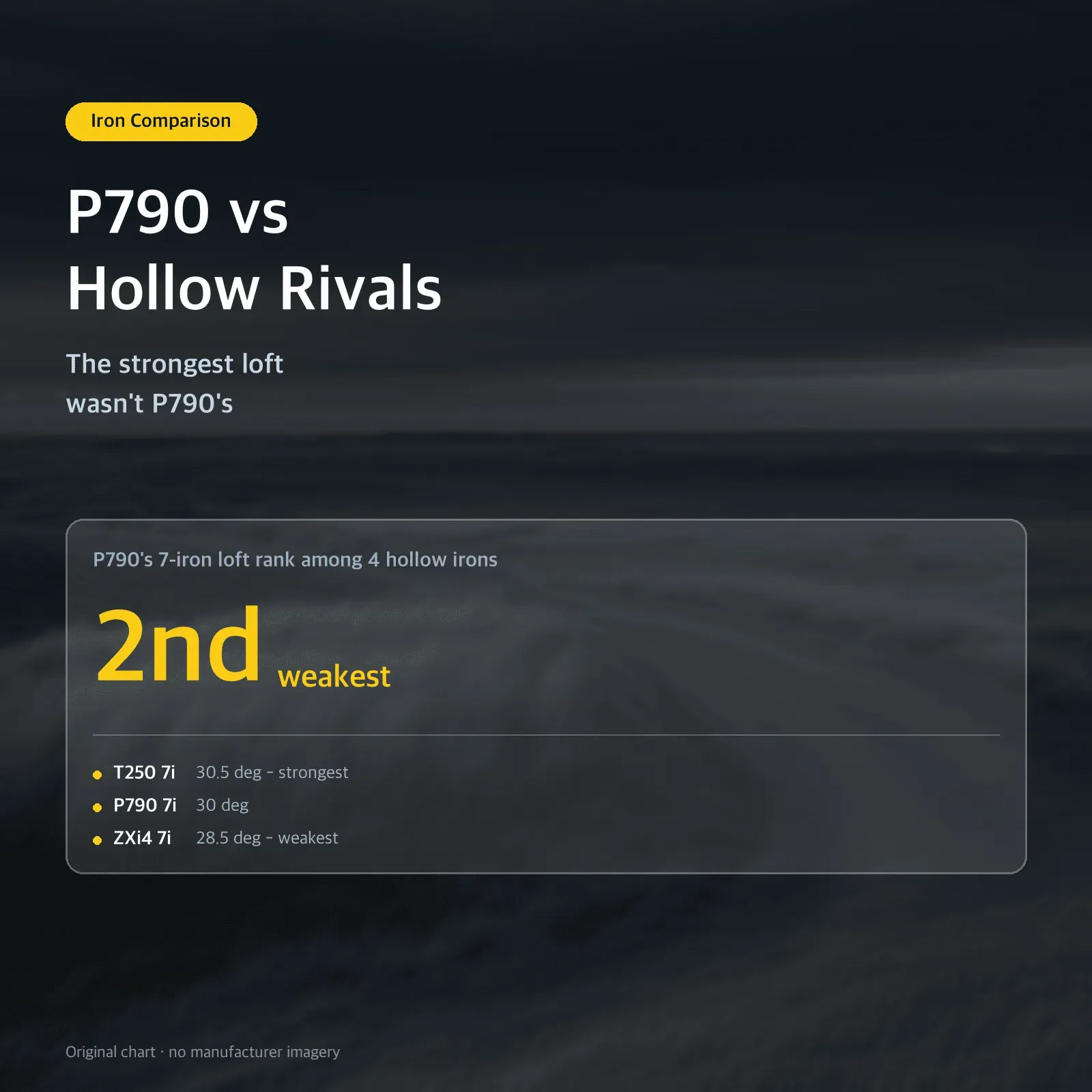
But lay P790’s official spec sheet next to other hollow irons that share the same construction, and that line starts to wobble. Within this peer group, P790’s 7-iron isn’t the strongest loft. It’s second from the weakest.
1. First — what counts as a “peer”?
| Model | Structure |
|---|---|
| P790 | Hollow, internal filler, forged 4340M face (2025) |
| Titleist T250 | All-steel hollow, forged L-face |
| Mizuno Pro M-15 | Multi-material hollow 4-8i, partial hollow 9-GW |
| Srixon ZXi4 | Hollow body, forged face, SUS17-47 body |
What Counts as a Peer Here — grouped by one structural fact: is the head hollow inside? Excluded: Titleist T200 (superseded by T250), Mizuno Pro 245 (superseded by M-15), and non-hollow same-brand models (T150, ZXi5).
A comparison collapses the moment you pick the wrong peer group. So instead of brand recognition or price, we grouped by one structural fact: is the head hollow inside?
- Titleist T250 — described officially as all-steel hollow with a forged L-face
- Mizuno Pro M-15 — multi-material hollow on the 4–8 irons, partial hollow on 9–GW
- Srixon ZXi4 — hollow body with a forged face and a SUS17-47 body
Worth flagging first: while preparing this comparison, we found that two models commonly cited as P790’s rivals have already been superseded. Titleist’s T200 is gone from the current iron lineup, replaced by T250, and Mizuno’s Pro 245 product page now redirects to its successor, Pro M-15.
We also excluded same-brand models that aren’t hollow. Titleist’s T150 is a forged dual-cavity, and Srixon’s ZXi5 isn’t hollow either. A similar name doesn’t mean the same category.
2. Overlay the lofts
| Model | 7-iron loft |
|---|---|
| Srixon ZXi4 | 28.5 deg |
| Mizuno Pro M-15 | 29 deg |
| P790 | 30 deg |
| Titleist T250 | 30.5 deg |
7-Iron Loft, Weakest to Strongest — two clubs are stronger-lofted than P790 here. At the 4-iron, P790 ties Mizuno M-15 for strongest at 20 deg — the order flips by the 7-iron.
Four lines run nearly together climbing upward. Look closely and the order flips partway through.
At the 4-iron, P790 is strongest at 20° (tied with the Mizuno M-15). At the 7-iron, the order reverses.
- ZXi4 — 28.5°
- Pro M-15 — 29°
- P790 — 30°
- T250 — 30.5°
At the 7-iron, two clubs are stronger-lofted than P790. “P790 has strong loft” holds within TaylorMade’s own lineup — it doesn’t hold once you place it against hollow rivals from other brands.
3. The point this piece really wants to make
Don’t read the numbers one club at a time — read the width of the set as a whole, and the story changes.
Measure the loft spread from 4-iron through PW for each:
- P790 — 20° to 44°, a 24° spread
- Pro M-15 — 20° to 43°, a 23° spread
- ZXi4 — 21° to 43°, a 22° spread
- T250 — 22° to 43°, a 21° spread
P790 is the widest. It sets the top the strongest and the bottom the weakest, packing 24 degrees into seven clubs — an average of 4.0° per club number. T250 comes in at 3.5°.
What that means: P790 isn’t “a strong set overall” — it’s “the set with the widest spread.” Long irons are pushed further, and the PW is set upright. The distance gain comes from the top of the set, and the trade-off is a wider gap between clubs.
A wider spread isn’t good or bad by itself. It just means the wedge lineup needs to be planned together with it, since the distance gaps that need filling are wider.
4. Same 7-iron number, different shaft length
| Model | 4i-PW range | Spread |
|---|---|---|
| P790 | 20 deg to 44 deg | 24 deg |
| Mizuno Pro M-15 | 20 deg to 43 deg | 23 deg |
| Srixon ZXi4 | 21 deg to 43 deg | 22 deg |
| Titleist T250 | 22 deg to 43 deg | 21 deg |
4-Iron to PW Loft Spread — P790 sets the widest spread of the four. 24 degrees across 7 clubs averages 4.0 deg per club number, vs 3.5 deg for T250 — a wider spread means a wider gap for the wedges to fill.
Comparing loft alone misses one thing entirely: length.
At the 7-iron, P790 and T250 are both 37.00 inches; Mizuno M-15 and Srixon ZXi4 are 37.25 inches. A quarter-inch difference clubs to club.
That means the ZXi4 is 1.5° stronger-lofted than P790 and a quarter-inch longer — two distance advantages stacked on top of each other.
There’s one more wrinkle. Mizuno and Srixon have each stated that their listed lengths grew by about a quarter-inch following a change in how USGA/R&A measurement standards are applied. The clubs themselves didn’t get longer — the measurement method changed. So a 0.25-inch gap in the table above shouldn’t be read as a real physical difference outright. Listing conventions aren’t the same across brands, and that matters as much as the number itself.
5. Two documents from the same company disagree
| Source | 4-iron / 7-iron / PW |
|---|---|
| Official product page | 20 deg / 30 deg / 44 deg |
| Official P-series combo guide PDF | 21 deg / 30.5 deg / 45 deg |
Two TaylorMade Documents Disagree — P790’s own official sources don’t match. Up to a full degree apart. This piece could not settle which is correct — both are listed rather than picking one.
Something unexpected turned up mid-research: P790’s loft doesn’t match across two of TaylorMade’s own sources.
The official product page lists 20° / 30° / 44° for the 4-iron / 7-iron / PW. The same company’s official P-series combo guide PDF lists a stock loft column of 21° / 30.5° / 45° — up to a full degree different.
We could not settle which one is correct, so rather than pick one, both are listed here. This is likely one reason so many P790 spec tables online contradict each other.
6. All four are “hollow,” but hollowed out differently
Same broad construction, four different approaches to the inside.
P790’s entire set is hollow with internal filler. The face switched to forged 4340M for the 2025 model.
T250 is an all-steel hollow with a forged L-shaped face.
Pro M-15’s structure changes by club number: multi-material hollow on 4–8, partial hollow on 9 through GW. It swaps construction mid-set.
ZXi4 is a hollow body with a forged face bonded to a SUS17-47 body.
7. So how should you actually compare?
| Variable | Spread across the 4 models |
|---|---|
| Loft (7-iron) | Up to 2 deg apart |
| Length (7-iron) | 37.00 in vs 37.25 in - 0.25 in apart |
| Lie | Up to 1 deg apart |
| Listing convention | Differs by brand - not a physical difference alone |
How to Actually Compare — 7-iron to 7-iron carries almost no meaning across these four. Match by loft, or throw the iron number out and compare measured carry distance instead.
To sum up:
Comparing 7-iron to 7-iron in a catalog carries almost no meaning here. Loft varies by up to 2 degrees, length by 0.25 inches, lie by up to 1 degree — and even the listing conventions behind those numbers differ by brand.
If you’re going to compare, do one of two things: match by loft, or throw the numbers out entirely and compare measured carry distance. This is exactly why fitters talk in degrees, not iron numbers.
8. Who this comparison is useful for
A judgment framework drawn from the confirmed differences among the four models.
- Golfers who believed “P790 has the strongest loft in this category” — at the 7-iron it’s stronger than the ZXi4 and M-15, but weaker than the T250 (30.5°). The ranking itself flips.
- Golfers who want both long-iron distance and short-iron precision spread across a set — P790’s 4-iron-to-PW spread of 24° is the widest of the four, which points in that direction.
- Golfers planning wedge setup alongside their irons — a set with a wide spread like P790’s also has a wider distance gap left to fill.
This may not fit:
- Golfers deciding based only on catalog 7-iron numbers — loft varies by up to 2°, length by 0.25 in, lie by up to 1°, and even the listing conventions differ by brand.
- Golfers who want a single confirmed loft number for P790 — TaylorMade’s own two sources (product page vs combo guide) disagree by up to 1°, and this piece could not settle which is correct either.
9. What we could not confirm
- Offset for P790 and T250 — neither company’s official spec sheet has this field.
- Bounce across all four models — only Mizuno M-15 publishes it (2° to 9°).
- Blade length across all four models — none of the four publish it.
- Which of P790’s two conflicting loft figures is the official US stock spec — unresolved.
- Measured carry distance — varies by tester and condition, so not cited here.
In one line
P790 isn’t the strongest-lofted club in this group — it’s the club with the widest spread across the set.
So the claim “P790 flies further” flips entirely depending on who you set it against. When you look at the numbers, look past the iron number to the angle, and past the angle to the length.
Every chart here was built directly, and every number comes from each model’s current-generation official spec sheet. Anything we could not confirm was left blank.
Sources
- Official spec sheets for TaylorMade P790 and three hollow-construction rivals — the lofts compared here:
- TaylorMade P790 — 4-iron 20°, 7-iron 30°, PW 44°.
- Titleist T250 — 4-iron 22°, 7-iron 30.5°, PW 43°; 7-iron length 37.00”, lie 63°.
- Mizuno Pro M-15 — 4-iron 20°, 7-iron 29°, PW 43°; 7-iron length 37.25”; bounce 2°-9° published.
- Srixon ZXi4 — 4-iron 21°, 7-iron 28.5°, PW 43°; 4-iron length 38.75”, 7-iron 37.25”.
- Mizuno’s and Srixon’s statements on the change in how USGA/R&A measurement standards are applied — the roughly quarter-inch growth in published lengths. Confirmed on the Srixon ZXi4 page above: “Srixon has modified how club lengths are measured and published… approximately ¼” longer for Irons… the actual length of the Irons has not changed, only how they are measured.”
🔴 A first-party disagreement is reported rather than resolved: P790’s loft does not match across two of TaylorMade’s own published sources. The body states both figures and which one this piece treats as confirmed. All four links above were opened directly and confirmed live as of August 2026, with every loft/lie/length figure in this piece matching what’s on those pages. TaylorMade’s P-series combo guide PDF referenced as the second, conflicting source could not be located as a live URL during this pass.