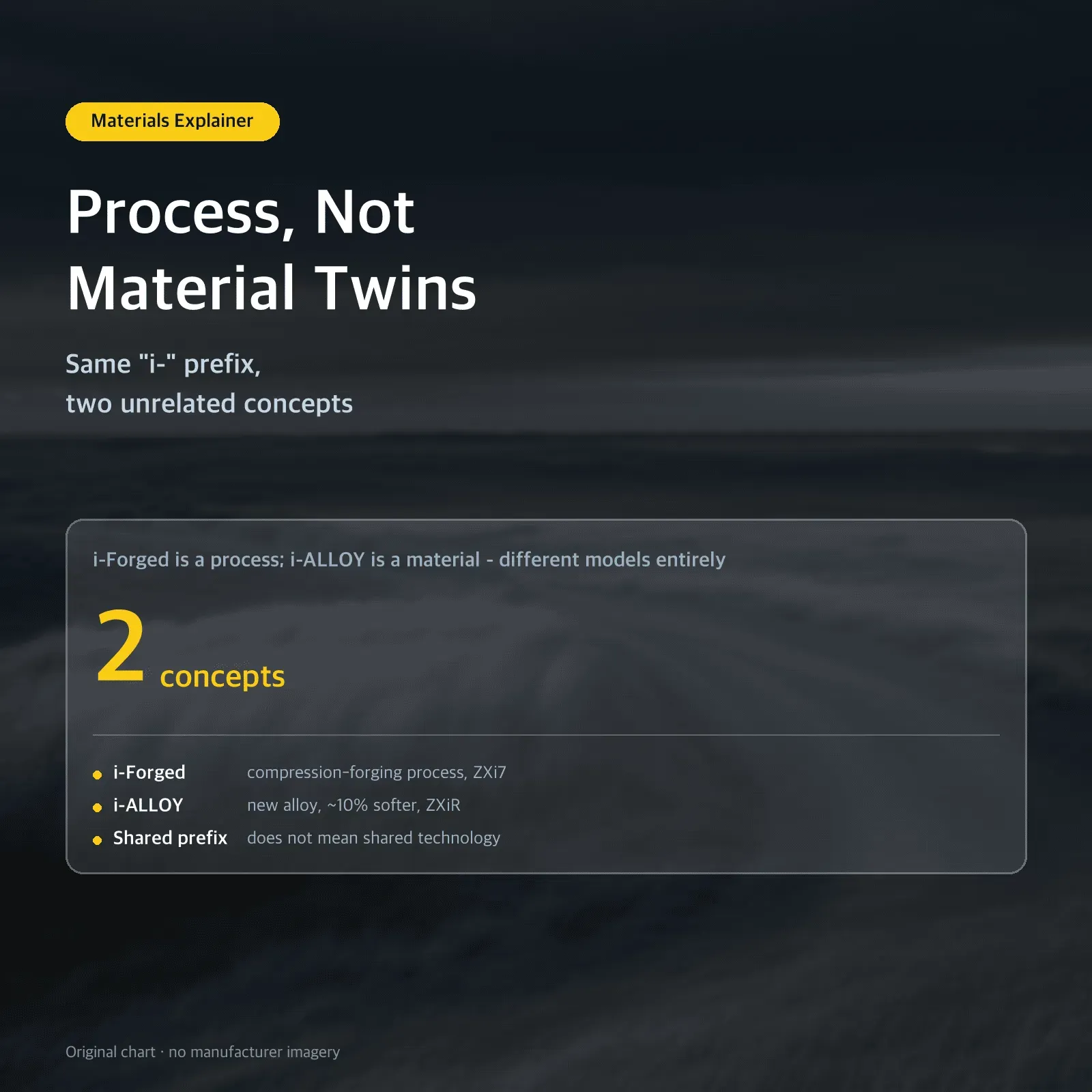
Researching Srixon’s ZXi lineup turns up two similarly named terms again and again: i-Forged and i-ALLOY. Sharing the letter “i” makes them easy to mix up, but they’re entirely different concepts. One is a manufacturing process. The other is a material.
1. Process or material — start with the distinction
| i-Forged | i-ALLOY | |
|---|---|---|
| What it is | Compression-forging process | A new alloy (material) |
| Applies to | ZXi7 and similar (forged line) | ZXiR (cast line) |
| Debuted | Srixon’s 2025 irons | Current ZXi generation |
Process or Material - Start With the Distinction — they apply to different models with different concepts. i-Forged is a process improvement for the forged line; i-ALLOY is a material improvement for the cast line - target models do not overlap.
i-Forged is a compression-forging process — a question of “how it’s made.” It debuted in Srixon’s 2025 irons.
i-ALLOY is a new alloy — the material itself, a question of “what it’s made of.” It’s used in the ZXiR.
These apply to different models with different underlying concepts, and the shared naming makes it easy to mistake them for two versions of the same technology. To be precise: i-Forged is a process improvement for the forged line (ZXi7 and similar), while i-ALLOY is a material improvement for the cast line (ZXiR).
The shared “i-” prefix adds to the confusion. It reads like a branding prefix meant to suggest AI-assisted design or “innovation,” and the fact that it’s attached to both technologies doesn’t mean they’re one system. Even the target models don’t overlap — one is forged, the other cast.
2. i-Forged — compression that stiffens the topline and softens the face
i-Forged is a compression-forging process that reinforces the topline while softening the face at the same time. Making one area harder and another softer through a single process is the core of what this technology does.
Dunlop states that this process doesn’t come at the cost of durability. Reinforcing the topline while thinning (softening) the face would typically raise durability concerns, and the fact that the manufacturer addresses this directly and states “no compromise” suggests it’s a question that comes up often. That said, this is a manufacturer claim — we did not find independent third-party durability testing.
We directly confirmed a banner reading “ZXi IRONS WITH i-FORGED” on the Korean official product page.
That banner matters because the Korean product page’s spec content otherwise consists only of two banner images and a video. With no detailed figures available, this technology name is one of the few pieces of information visible at all. Put the other way: information outside that banner — hardness figures, exactly which models it applies to — could not be filled in from the Korean page alone.
3. i-ALLOY — cast construction chasing a forged feel
| i-Forged | i-ALLOY | |
|---|---|---|
| Mechanism | Reinforces topline, softens face | Replaces standard stainless |
| Claim | “No compromise” on durability | ~10% softer than stainless |
| Verified by | Manufacturer only | Manufacturer only |
What Each Technology Actually Does — one reinforces and softens; the other changes the raw material. Opposite starting points - forged getting softer, cast getting closer to forged - aimed at the same goal: feel.
i-ALLOY is a new material roughly 10% softer than standard stainless steel (the same figure referenced in earlier pieces on this brand’s materials). The point worth emphasizing here is the direction: a cast material aiming for a feel that approaches forged.
If i-Forged tries to make a forged iron “softer,” i-ALLOY tries to make a cast iron “closer to forged.” The starting points are opposite; the destination is similar — both are aimed at the same goal, improved feel, from opposite directions.
Pursuing both improvements at once also suggests Dunlop isn’t giving up on either construction method. Companies introducing new technology often concentrate on one category. This generation of ZXi instead attaches a distinct improvement to both the forged line (ZXi7) and the cast line (ZXiR).
4. Japan’s technology name, iQ — a coming generation, not the current one
| Region / source | Face technology named |
|---|---|
| US official site | PureFrame (ZXi7), MainFrame (ZXi5) |
| Asia-region official site | PureFrame (ZXi7), MainFrame (ZXi5) |
| Japan, Sept. 12, 2026 release | PureFrame iQ / MainFrame iQ (next generation) |
| Korean official product page | Not confirmed - page has no detailed spec text |
PureFrame, Not “iQ” - Current Generation Only — Japan’s Sept. 12, 2026 release carries the “iQ” name, a coming generation. “iQ” marks the coming generation, not the current one - the Korean page itself cannot be confirmed either way from its own content.
One thing worth flagging directly: the ZXi7, ZXi5, ZXiR, and ZXiU releasing in Japan on September 12, 2026 carry the technology names PUREFRAME iQ and MAINFRAME iQ.
These are two separate technologies, not one. PureFrame is a piece of steel forged into the body of the ZXi7 to damp vibration — Srixon states a 9.3% reduction in vibration displacement against the ZX7 Mk II. MainFrame is the face technology, a variable-thickness network of grooves, channels and notches milled into the back of the face, and it appears on the ZXi4, ZXi5 and ZXiU rather than the ZXi7. Whether the Korean listings append “iQ” to either name could not be determined from the Korean official product page — its content is limited to two banner images and a video, with no detailed spec text.
Checking outside Korea narrows this down, though. Dunlop’s US site and Srixon’s Asia-region site both list the current, already-released generation as PureFrame on the ZXi7 and MainFrame on the ZXi5 — neither carrying “iQ.” The “iQ” designation instead belongs to the next-generation model releasing in Japan in 2026, which Dunlop Japan’s own materials describe as a tour-tested, not-yet-released update. In other words, PureFrame and PureFrame iQ are two different generations, not two names for the same current product.
So this piece does not claim that “the Korean version is an earlier generation” in the sense of running behind other regions on the same product. The defensible statement is narrower: the currently sold ZXi7 uses PureFrame and the ZXi5 uses MainFrame, neither with “iQ,” in the US and Asia-region official materials; “iQ” marks the coming generation. The Korean official page itself still cannot be confirmed one way or the other from its own content — but the naming used elsewhere for this same generation is PureFrame, not PureFrame iQ.
| Forged line | Cast line | |
|---|---|---|
| Model | ZXi7 | ZXiR |
| Technology | i-Forged (process) | i-ALLOY (material) |
| Direction | Forged made softer | Cast made closer to forged |
Two Improvements, Opposite Directions — both are aimed at the same target: feel. Pursuing both at once suggests the manufacturer is not giving up on either construction method.
5. Who feels this material difference
This piece is a process-and-material breakdown rather than a review of a specific model, so instead of “who this fits,” here’s who is likely to notice the difference.
- Golfers who value a forged iron’s feel but worry about durability — i-Forged is a process that reinforces the topline while softening the face. If “soft, without getting weaker” is what you’re after, this process targets exactly that combination (with the caveat that it’s a manufacturer claim).
- Golfers who found cast game-improvement irons’ feel unsatisfying — i-ALLOY is a cast material trying to move closer to a forged feel. If the muted feel typical of cast construction has been a frustration, this is a point worth noticing.
Where the difference may be less noticeable:
- Golfers who have only ever played forged irons — i-ALLOY applies to the ZXiR, a cast model. If you’re only considering the forged line (ZXi7), this material change doesn’t apply to what you’re looking at.
- Golfers who want to compare on hard numbers before deciding — both i-Forged and i-ALLOY are described mainly in qualitative manufacturer language (“softer,” “no compromise”), without absolute comparative figures, making it hard to judge how much difference you’ll actually feel from specs alone.
6. What we could not confirm
- Official Korean banner language for i-ALLOY — we directly confirmed the “ZXi IRONS WITH i-FORGED” banner, but found no equivalent banner confirming i-ALLOY.
- Whether the Korean official product page appends “iQ” to PureFrame or MainFrame — its content is limited to banner images and a video, so it cannot confirm the local naming directly. What is confirmed: US and Asia-region official materials name the current, already-released generation PureFrame (ZXi7) and MainFrame (ZXi5), neither with “iQ,” and reserve “iQ” for the separate, not-yet-released Japan generation.
- Independent durability testing of the i-Forged process — only the manufacturer’s “no compromise” claim was confirmed, with no third-party verification.
- The absolute hardness figure for i-ALLOY — only the relative “10% softer than standard stainless” figure was confirmed.
- The exact correspondence between Japan’s “iQ” naming and i-Forged/i-ALLOY — not confirmed.
In one line
i-Forged is a forged-process improvement; i-ALLOY is a cast-material improvement. The names sound alike, but they’re completely different technologies, both ultimately aimed at the same target — feel — from opposite directions. The Korean official page’s own naming still cannot be confirmed directly, but US and Asia-region official materials place the current generation at PureFrame (ZXi7) and MainFrame (ZXi5), with “iQ” marking the next, not-yet-released generation — checking in person at a Korean retailer remains the most reliable way to confirm the local naming.
When two names starting with “i-” show up in the same lineup, it’s worth sorting out process from material before going further — that’s what keeps track of which model each technology actually applies to.
All charts in this piece were built from scratch, and only confirmed figures were used. Where a figure could not be confirmed, the space was left blank.
Sources
- Srixon/Dunlop official product material — the process descriptions and the manufacturer’s own statement addressing durability of the thinned face.
🔴 This is a manufacturer claim. No independent third-party durability testing was found.
No archived URLs are recorded for these sources in the original research. Everything above is drawn from first-party manufacturer material; items the manufacturer does not publish are named as unconfirmed rather than estimated.