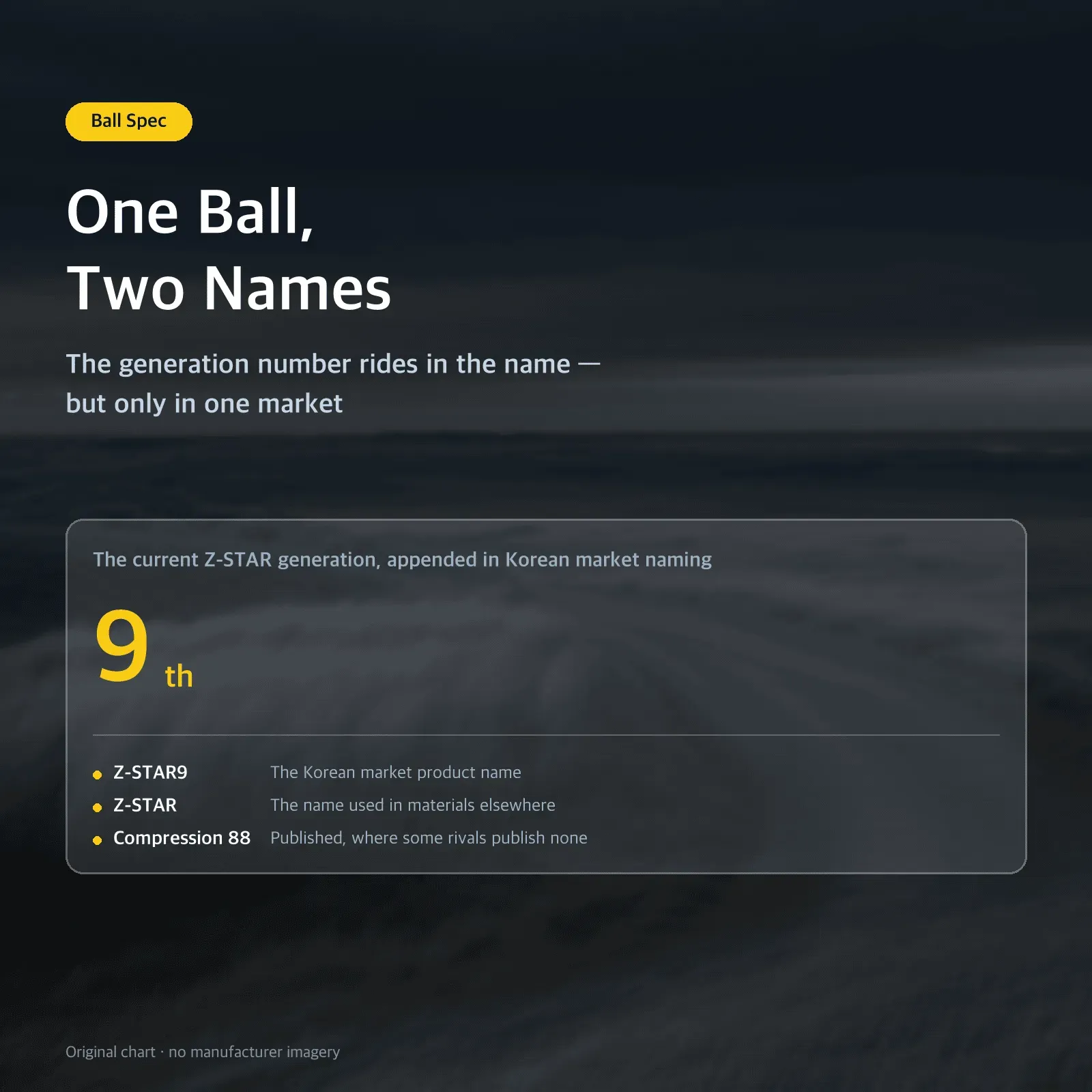
Search for Srixon’s tour ball and the name shows up two ways. In the Korean market it’s sold as Z-STAR9. In most other regions’ materials, it’s simply Z-STAR.
It’s the same ball. The generation number is only appended in the Korean market’s product name.
This company has done something similar with its irons before, where regional lineups actually differed. With this ball, the lineup is identical — only the naming convention differs. Worth clearing up first, since it’s an easy place to get confused searching for reviews.
1. The name — 9 marks the ninth generation
| Korean market name | Name used elsewhere |
|---|---|
| Z-STAR9 | Z-STAR |
| Z-STAR9 XV | Z-STAR XV |
| Z-STAR9 Diamond | Z-STAR Diamond |
Same Lineup, Two Naming Conventions — the lineup is identical, only the naming differs. Searching international sources means dropping the 9 to find matching material.
The current Z-STAR generation is the ninth.
- Korean market naming — Z-STAR9, Z-STAR9 XV, Z-STAR9 Diamond
- Naming elsewhere — Z-STAR, Z-STAR XV, Z-STAR Diamond
Putting the generation number in the product name is convenient for that market’s buyers — you can tell which generation you’re holding just by looking at the box. The tradeoff, if you’re searching international sources, is that you need to drop the 9 to find matching material.
The Diamond model first appeared in the previous generation, dropped out, and has returned to the line this generation.
2. What this generation changed — core and cover
| Part | Name or change | What it does |
|---|---|---|
| Core | FastLayer DG Core 2.0 | Firmness shifts gradually, centre to surface |
| Cover | Ultra-thin urethane, biomass content | Thinner cover, more greenside spin |
What the Ninth Generation Rebuilt — layer count held; core and cover formulations changed. The same pattern as other 2026 releases: the layer count did not change, the materials did.
The ninth generation reworked both the core and the cover.
Core — “FastLayer DG Core 2.0”
Srixon’s core is built with firmness that shifts gradually from center to surface, rather than splitting cleanly into distinct layers. This generation rebuilt that gradient formulation.
Cover — ultra-thin urethane with biomass content
The cover was made extremely thin, with biomass material incorporated. A thinner cover generally means more spin around the green, and it’s harder to manufacture reliably.
The same pattern shows up here as with other brands releasing new balls around 2026: the layer count didn’t change — the materials did. That’s the common thread across this generation’s new releases.
3. Z-STAR9 and XV — Srixon discloses compression
| Model | Pieces | Compression | Direction |
|---|---|---|---|
| Z-STAR9 | 3-piece | 88 | Softest in the line |
| Z-STAR9 XV | 4-piece | Highest in the line | Firmness added mid-core |
Srixon Publishes Compression — a contrast with Titleist, which does not disclose it. There is no industry-standard compression test - 88 places Z-STAR9 against XV, not against other brands.
Srixon is one of the manufacturers that publishes compression figures — a contrast with Titleist, which does not.
- Z-STAR9 — 88. Disclosed as the lowest compression in the company’s line. Three-piece.
- Z-STAR9 XV — the highest in the company’s line. Four-piece, described as built to maximize distance.
XV is described as adding firmness starting partway through the core. Z-STAR9, in the opposite direction, softens the center of the core to aim for the softest feel in the line.
One thing to keep in mind when using the figure 88: there’s no industry-standard method for measuring golf ball compression. 88 isn’t a number meant for comparison against other brands — it establishes that Z-STAR9 is softer than XV. Figures measured by the same company using the same method can be trusted relative to each other; figures across companies cannot.
4. Release timing
| Item | As published |
|---|---|
| U.S. price | $49.99 per dozen |
| Release date | January 24 |
| Other configurations | Divide two-tone, custom marking, separate editions |
Release and Pricing as Published — U.S. figures from the maker’s own listings. Editions differ in configuration - check what is included before buying one priced off the standard line.
U.S. pricing is $49.99 per dozen, with a January 24 release date.
Beyond the standard specification, there are additional variants in some markets — a two-tone Divide finish, custom marking options, and separate editions priced differently from the standard model. Editions differ in configuration, so check what’s included before buying one priced differently from the standard line.
5. So how do you choose
The choice between Z-STAR9 and XV is relatively clear, since Srixon publishes the compression figures directly.
By feel
- If you want a softer feel, that’s Z-STAR9 (88) — the softest in the company’s line.
- If a firmer feel suits you, that’s XV.
By trajectory and distance
- If control and feel around the green come first, that’s Z-STAR9.
- If distance comes first, that’s XV — the structure that adds firmness starting mid-core is built in that direction.
6. Who each ball fits
These are inferences drawn from the confirmed specifications, not a ranking.
- A golfer who wants to choose between sibling models using a compression number — Srixon publishes 88 directly in its own materials, which gives you one more data point than brands that don’t disclose it.
- A golfer who prioritizes a soft feel — Z-STAR9 is engineered to the lowest compression in the company’s line.
- A golfer who cares about alignment markings — the Divide finish is part of the standard lineup.
Cases where the fit runs the other way:
- A golfer trying to place 88 next to another brand’s compression number — there’s no shared measurement standard, so that comparison doesn’t hold.
- A golfer searching international reviews using the market name with the 9 attached — drop the 9 to find matching material from most other sources.
7. What could not be confirmed
- Z-STAR9 XV’s compression figure — only confirmed as “the highest in the company’s line,” with no number disclosed.
- Diamond’s layer count and compression — not confirmed.
- Dimple count — not confirmed for any model in the line.
- Cover thickness — only described as “ultra-thin,” with no figure given.
- Configuration details for regional edition variants — pricing differences appear to trace to configuration differences, but this wasn’t confirmed.
Summary
Z-STAR9 is a ball whose market name carries a generation number, and whose manufacturer discloses compression where several competitors don’t.
Both are pieces of information you can actually use when deciding. The willingness to publish a compression figure is a real point of difference from brands that keep it undisclosed — just remember that number is only meaningful within Srixon’s own line, not against a competitor’s.
The construction details, compression figures, and pricing in this piece are drawn only from Srixon’s official specifications and U.S. retail pricing. Where a figure could not be confirmed, it has been left blank rather than estimated.
Sources
- Z-STAR Golf Balls — Dunlop Sports US (official Srixon US site) — confirms the model is named “Z-STAR” (without the “9”) in the US market.
- 스릭슨 Z-STAR — Dunlop Sports Korea (official Srixon Korea site) — confirms the Korean market lineup is named “Z-STAR9,” “Z-STAR9 XV,” and “Z-STAR9 DIAMOND.”
The practical note in the body follows from the sources: searching international listings requires dropping the 9 to find matching material.
Two archived URLs are recorded above; both confirm the naming split this piece turns on. The Z-STAR9 compression figure (88) and U.S. pricing/release date cited elsewhere in the body could not be located on either official page in this pass, so they remain unconfirmed rather than linked. Items the manufacturer does not publish are named as unconfirmed rather than estimated.